This article was featured in Eurofish Magazine 1 2026.

Albania is entering a transformative phase in its fisheries and aquaculture sector, marked by a series of strategic developments that reflect the country’s commitment to sustainability, innovation, and regional cooperation.
As Albania approaches accession to the EU, spatial planning reforms, digital modernisation, and marine conservation among other developments are reshaping the country’s fisheries and aquaculture sector to meet both national priorities and international standards.
Distinct progress in aligning with EU acquis
A report from the European Commission on the progress Albanian fisheries and aquaculture is making towards EU standards makes encouraging reading despite some shortfalls. Alignment with the EU acquis has reached an advanced stage though data collection particularly regarding for sharks, eel, recreational fisheries and discard plans needs further efforts. Interpreting and implementing national legislation on data collection, data management, and scientific capacity need to be further improved. The report notes that Albania is following GFCM recommendations on sustainable exploitation of fish stocks.
Inspection, monitoring, and control institutions and equipment have been strengthened and a functional vessel monitoring system is in place. These, as well as other, measures together with integrity plans in the fisheries directorate and regular internal and external audits will also help to fight corruption in the fisheries sector. However, laws concerned with market policy, such as market plans, need to be more fully aligned with EU legislation. The report also finds that the country needs to work on its national maritime spatial plan as well as cooperate more closely with partners in the Adriatic to promote regional maritime initiatives.
New AZAs host fish cages and mussel longlines
As regards aquaculture, a major turning point came with the adoption of Decision of the Council of Ministers No. 461, dated 26 July 2023, which approved the policy guiding document for Allocated Zones for Aquaculture (AZA). This decision officially mapped out designated areas along the Albanian coast for fish and bivalve mollusc farming, laying the groundwork for a more organised and environmentally responsible aquaculture industry.
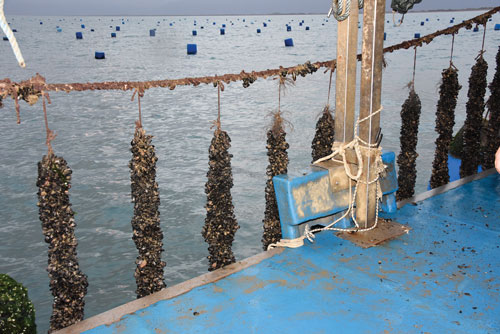
The implementation of these AZAs began in earnest during 2024–2025, when the Ministry of Agriculture and Rural Development announced the operationalisation of zones in Vlorë, Shëngjin, Durrës, and Sarandë. These regions, known for their rich marine biodiversity and strategic coastal access, are now home to a growing number of aquaculture operators. Currently, six businesses are engaged in intensive marine aquaculture using cages, while three others are cultivating mussels through extensive longline systems. These activities are conducted within the newly established AZAs, ensuring that operations are aligned with spatial planning and environmental safeguards. Looking ahead, the Ministry is preparing to launch a public procurement process for the remaining AZAs. This initiative is expected to attract further investment, encourage innovation, and expand the sector’s capacity. By opening these zones to competitive bidding, Albania is fostering a transparent and inclusive approach to aquaculture development, one that balances economic opportunity with ecological responsibility.
Fisheries management goes digital offering multiple benefits
In parallel with these spatial reforms, Albania has also taken a significant step toward digital transformation in fisheries management through the implementation of the Electronic Reporting System (ERS). This system allows for real-time electronic reporting of catch data and vessel activity, enhancing the country’s ability to monitor, control, and enforce regulations across the sector. The ERS is a powerful tool in the fight against illegal, unreported, and unregulated (IUU) fishing, providing authorities with accurate and timely data to support decision-making and policy development. By improving traceability and transparency, the system helps ensure that fisheries activities are conducted responsibly and in line with EU standards and international commitments.
New fisheries restricted area will protect ecosystems in the southern Adriatic Sea
Another landmark achievement in Albania’s marine governance is the establishment of the Otranto Channel Fisheries Restricted Area (FRA), officially endorsed by the GFCM during its 47th annual session. This FRA, located in the southern Adriatic between Albania and Italy, represents the first shared FRA between EU and non-EU countries, and is a result of years of scientific collaboration and stakeholder engagement. The Otranto FRA was created to protect vulnerable marine ecosystems, particularly the bamboo coral (Isidella elongata) and essential habitats for demersal species such as deep-water shrimp, European hake, and Norway lobster. Covering a core area of 1,900 km² closed to bottom fishing and a buffer zone of 700 km² with reduced fishing effort, the FRA is now the largest marine reserve in the Adriatic Sea.
This initiative not only enhances biodiversity conservation but also contributes to the long-term sustainability of fish stocks, supporting both ecological resilience and economic stability. The FRA is part of a broader GFCM strategy to strengthen fisheries management in the Adriatic through multiannual management plans, scientific assessments, and spatial protection measures.