

 Capital: Bucharest
 Population: 19 million (2025, Eurostat)
 GDP: €353,6 billion (2024, Eurostat)
- GDP/capita: €18 560 (2024, Eurostat)

Overview of the Romanian fisheries and aquaculture sector



Marine fisheries
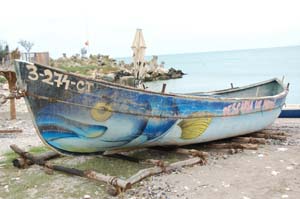
Situated in southeast Europe, Romania has a coastline 256 km long, representing 5,3% of the total Black Sea coastline and 0,5% of the total coastline of the 22 EU coastal Member States. Around 900.000 people, or 4,5% of Romania’s total population, live in coastal areas.
Marine fishing is exclusively in Romanian territorial waters in the Black Sea. The fishing activity is seasonal and depends on the weather conditions in the Black Sea, where there are large differences of temperature between winter and summer, as well as strong winds.
The national fishing fleet is mostly small-scale, i.e. vessels less than 12 metres in length. In 2024, Romania had 164 registered vessels – 5 vessels were longer than 15 metres, 22 vessels between 12-15 metres, 29 vessels between 10-12 metres and 108 vessels under 10 metres in length. Of the 164 vessels, 67 (41%) are without an engine and are engaged in small-scale coastal fishing using gillnets, pound nets, pots, the manual harvesting of rapa whelk and mussels, while 97 vessels (59%) are equipped with an engine and towed gear and use gillnets and trawls.
In 2024, fishery landings totalled 2.527 tonnes. The main commercial species is veined rapa whelk, whose share in the total marine catch volumes was over 70%. Other major species include Mediterranean mussel, European sprat, as well as turbot and Mediterranean horse mackerel. There are Total Allowable Catches (TACs) for turbot and sprat, in accordance with EU regulations.
All fish landed is used for human consumption. Fishing in Romania is practised along the coastline and is supported by five main fishing ports (Sulina, Midia, Tomis, Constanța and Mangalia), 13 landing sites for turbot and dogfish and 44 landing sites for other Black Sea species Fisheries and aquaculture are of particular importance in remote areas, where they represent the primary source of income for local populations.
Inland fisheries
The total area of inland waters exceeds 7.000 km, about 3% of the total area of the country. The Danube, home of Romania’s most important inland fisheries, has a total length of 1.074 km in Romania, corresponding to about 3.430 km and holding an average of about 2,2 million cubic metres of water. Other waters that are of interest for inland fisheries activities include 500.000 ha of stagnating waters and 66.000 km of running waters in the mountain, hill, and plain areas.
Inland fishing is a full-time occupation practiced mainly by traditional fishers. In most cases it is a subsistence activity. Commercial inland fishing takes place in rivers, ponds, and reservoirs, including the Danube River, the Danube Delta, and Danube Delta Biosphere Reserve. Most of the fishing activities are concentrated on the Danube and its overflow areas, the Delta, and some of its former lagoons.
In 2024 the catches from inland waters amounted to 3.830 tonnes. Prussian carp is the main catch, followed by freshwater bream and common carp) Other important commercial species include Pontic shad, Northern pike and European catfish.
Aquaculture
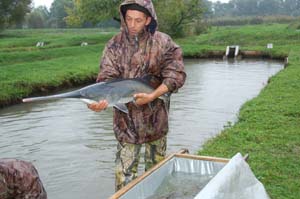
Aquaculture is predominantly freshwater, and the country’s land resources and availability of inland waters provide excellent conditions for fish farming. The number of cultivated species is over 20, and the most important cultured fish species belong to the Cyprinidae family, particularly common carp, as well as bighead, silver, and crucian carps. Other species are trout and sturgeons, and to lesser extent pike-perch, African catfish, and pike among others. In 2024 the aquaculture sector produced 10.059 tonnes. Cyprinids (common carp and bighead carp) and trout were the main farmed species.
The production of species new to Romanian aquaculture, such as sturgeon, is still low. Recently, extensive fish farms have become multifunctional, providing services such as ecological tourism, recreational fishing, and educational activities related to knowledge about and protection of aquatic biodiversity. There is a trend to diversify and increase the current range of aquaculture activities.
Processing and trade
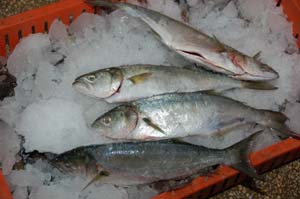
There were 41 registered fish processing companies in 2023, which employed 1.384 people, and the production net turnover amounted €186,7 million. Romania’s traditional Salată de Icre (salad made from carp, pike, and herring roes) was the major product. Fish processors are to a high degree dependent on imported raw materials: frozen fish or fillets of herring, mackerel, sardine, or sprat. On average, about 80% of the raw material for processing is imported.
Romania is a net importer of fisheries and aquaculture products. In the past several years the volumes have shown a slight upward trend, reaching a volume of 120.461 tonnes and €523 million in value in 2024. More than four-fifths of all imports come from other EU Member States, with the Netherlands, Spain, Poland, Germany and Bulgaria being the top partner countries. Salmon, mackerel, tuna, and trout were the main imported species. Among non-EU countries, Turkey and Vietnam were the main partner countries. Frozen fish still prevail in the structure of imports followed by canned products and chilled fillets.
The volumes of Romania’s exports of fisheries and aquaculture products for human consumption have been growing in recent years. In 2024 export volume reached 29.099 tonnes, amounting to €128,1 million. The major export market was the EU (over 60% of the total value), where France, Hungary, Italy, the Netherlands and Poland were the major destinations. Moldova and the United Kingdom were the largest non-EU destinations. Rapa whelk was the largest single species with about half of the overall export value.
Consumption
Romanian consumers traditionally prefer meat other than fish, and the consumption of fisheries and aquaculture products is far below the EU average. However, the average apparent consumption of fish and seafood has trended upward in recent years, to an estimated 8,75 kg per capita in 2023 (live weight equivalent). Most fish and fisheries products are distributed and sold through supermarket chains. Romanian’s household consumption is dominated by live/fresh fish, followed by frozen fish, and marinated and prepared products. The top four preferred species are trout, carp, mackerel, and salmon.
Publications
The latest version of the Guide to Recirculation Aquaculture is available in Romanian here:
Useful Links for Romania
- Ministry of Agriculture and Rural Development
- ANPA (National Agency for Fisheries and Aquaculture)
- Managing Authority for Operational Programme for Fisheries (Romanian)
- RomFish – Association of Fish Producers (Romanian)
- Danube Delta National Institute for Research and Development
- Danube Delta Biosphere Reserve Authority
- National Institute for Marine Research and Development
- The Fish Culture Research and Development Station
If any of the above listed links do not work or if you have a relevant link to add, send us an email here.