Ilma Joniene, Chief of Production at Dese, says the frozen raw material has the advantage of stable high quality and easier logistics than fresh fish.

The fish processing sector in Lithuania is based mainly on imported raw materials which are converted into a variety of products both for domestic consumption and for export. Some companies are also using locally-caught and locally-farmed fish to add variety to the range of products they manufacture.
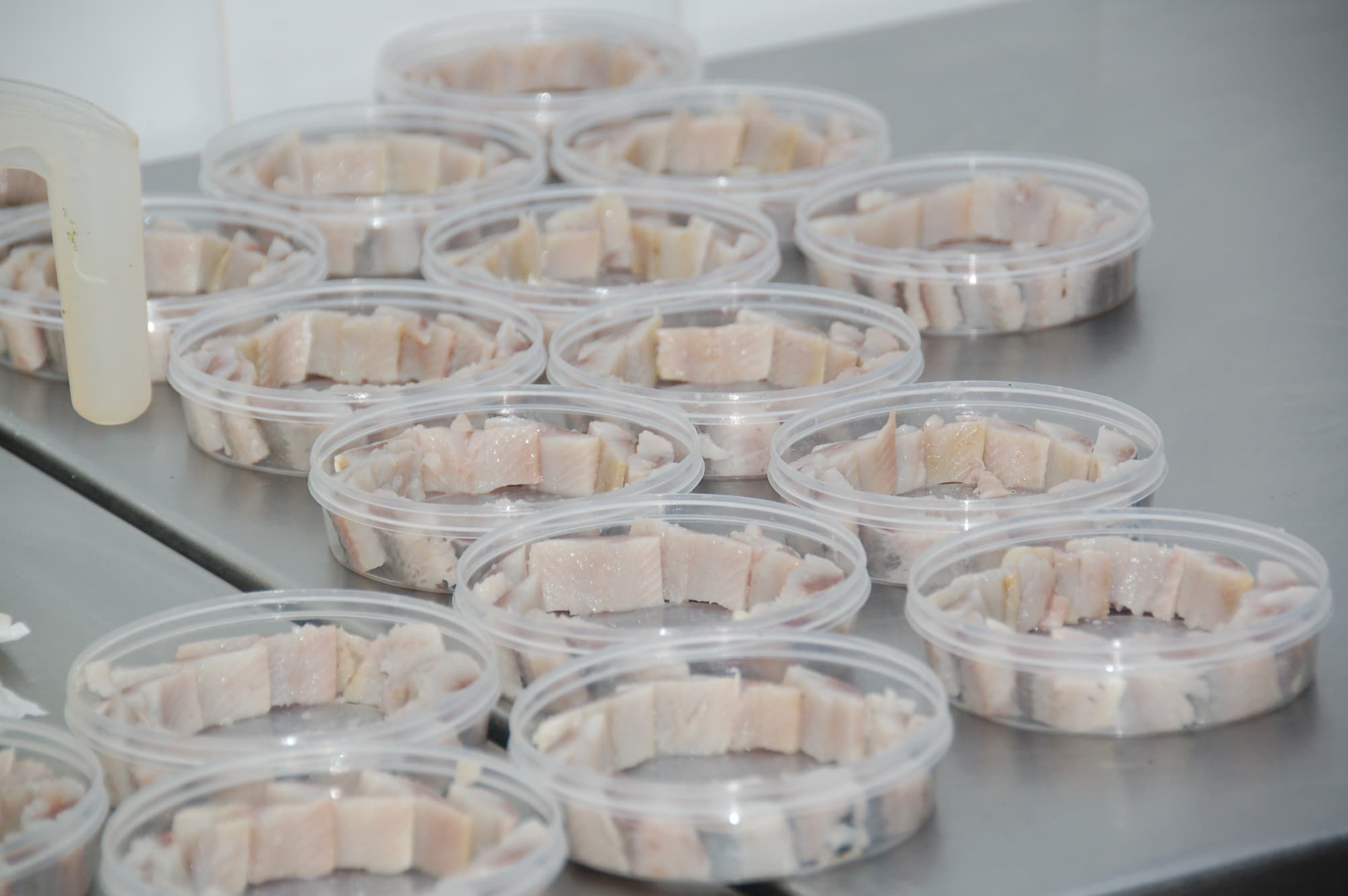
There are altogether about 46 companies in Lithuania that process fish and seafood. While a few of them are very big operations processing large volumes of raw material into a variety of products mainly for export, others are more modest and serve primarily the domestic market. The range of products made for the domestic markets is impressive. A big supermarket stocks fresh fish, canned and frozen fish and seafood, and numerous smoked, salted and marinated products. Products based on locally caught wild fish both marine and freshwater and locally farmed fish such as trout, sturgeon, and carp are available, but the overwhelming majority of the products are based on imported fish, salmon, seabass seabream, mackerel, and herring as well as shellfish.
Raw materials from Norway, Iceland
In 2014 the combined output of the Lithuanian processing sector was 93 thousand tonnes, according to the Agricultural Information and Rural Business Centre. Just under a third of this production was surimi products, a fifth was smoked products, 15% fresh and chilled fish, and 11% prepared or preserved products (excluding surimi). Among the manufacturers of prepared or preserved products is the company Dese. Located about halfway between Vilnius and Kaunas in the Kaisiadorys district Dese specialises in herring products making a huge range of salted, marinated, fried, and cooked items that are sold primarily on the domestic market with some exports to Latvia, Estonia, the UK and the US. Ilma Joniene, the chief of production, explains that the company imports its entire requirement of herring from Norway and Iceland. The fish is imported as block-frozen fillets that have been processed on board the vessels that catch the fish so that the time between catching and freezing is minimal. The company has long-standing relationships with its suppliers and is happy with the quality of the fish and the price, and so for the moment at least is not considering other suppliers for example from Scotland or the Faroe Islands.
The company also uses Baltic herring in its production which it buys from local suppliers, but the volumes are much smaller than those of the Atlantic herring. On a typical day the company will process 5-10 tonnes of raw material in total. The frozen fish is thawed in defrosting machines which are connected to freezing chambers. Heat from the freezers is used to defrost the frozen fish, a way of recycling energy. This is a dry way of defrosting as opposed to defrosting with water. Working with frozen fish means that Dese never has a problem with supplies as it is always possible to get the frozen product, which has a shelf life of several months. Mr Joniene does not use fresh fish in the production as it would call for new logistical arrangements including changes to the facilities at the processing plant so that fresh raw material could be properly stored. In addition, the seasonality of the fishery would make it difficult to get the same uniform quality of fresh raw material all the year round.
Fish waste goes into biogas production
Once the fish has been defrosted and washed it is salted by immersing it into a salt solution for three days. Although salt acts as a preservative the solution includes additional preservatives in order to extend the shelf life of the final product. Dese also produces a range of marinated products which are characterised by a slightly sour flavour, a result of being immersed in a vinegar-based marinade for a further 24 hour period after being salted. The fish then continues further into the production. Fish waste from the production is also a useful commodity. Some of it is used for the production of mink fodder. This, however, is the destination for fish that has not been salted. If the raw material has been salted the leftovers are exported to Latvia where they are used to generate biogas.
At its factory the company processes fish into products that will be sold under its own brand, but it also produces for private labels. The recipes for these products are often provided by the company for whom the production is intended. Mr Joniene says Dese can fulfil all a customer’s requirements, for example, providing fillets with the skin on or with the skin off, using special ingredients, or a certain type of packaging. The company produces a large variety of products by combining the herring with different vegetables (peppers, carrots, beetroots, cucumbers etc), sauces, spices, herbs, and other ingredients. One of the most common vegetables used in the different preparations is onions as it is traditional to eat herring and onions in some form together, a combination that is prevalent not only in Lithuania, but in many of the countries surrounding the Baltic. All the vegetables that are used in the production are obtained directly from local farmers each day to ensure the freshest raw materials go into the product.

Skilled at adapting products to local tastes
Vytautas Bilida, the head of quality, is responsible for developing recipes. We are constantly looking for new ideas, she says, and look for inspiration on other markets as well as from shows like Seafood Expo Global in Brussels, where the company has been several times both as an exhibitor and a visitor. Part of the production is exported to neighbouring companies, and some of it also goes further afield to Ireland, Germany, and the UK, but the biggest markets are Lithuania and Latvia. Part of the challenge of exporting is that tastes vary from country to country. We only export limited quantities to Poland, says Mr Joniene, because they prefer a marinate that makes the herring very sour. But if it is profitable then we do adapt our recipes to cater to local tastes. In Lithuania Dese sells through the retail chains, Rimi, Maxima, Norfa, Iki, while on foreign markets the products go through intermediaries to the supermarkets. About 30% of the turnover is generated by sales outside Lithuania.
| Dese | |
|
Naujazerio k., Zasliy sen. Tel.: +370 346 44300 Sales Manager: Lina Pilkiene |
Chief of Production: Ilma Joniene Established: 1994 |
Since Dese was established in 1994 it has established a name for itself as a producer of high quality herring products. Lina Pilkiene, the sales manager, says that the company’s reputation speaks for itself. As a result she is unwilling to place labels on Dese’s products if they run the risk of confusing the consumer. For example, there are no taste enhancers in any of the products; this however is not something she needs to spell out in a label as she feels it is something that the consumers take for granted. Similarly, emphasising the presence of high levels of omega-3 fatty acids in the products may somehow weaken the perception that products under the Dese brand are healthful no matter what. We have achieved our current position by staying very focused, says Ms Pilkiene, and we intend to keep it that way. We have plans to increase the production, but by doing more with herring rather than diversifying into other species.