This article was featured in Eurofish Magazine 6 2026.

From trading Baltic sprat to importing and processing fish from around the world, the Polish company Morex has built its business on long-standing supplier relationships and an ability to respond to changing market conditions. Founder and CEO Roman Bigus sees further opportunities in Europe, although rising raw material costs and increasing competition present considerable challenges.
In 1995, the year Roman Bigus established Morex, the company concentrated on buying frozen Baltic sprat and herring from Polish producers and exporting them to Russia. Three decades later, the Gdynia-based business trades some 10,000 tonnes of fish from across the world and operates its own processing facilities. Although trading remains the company’s principal activity, its processing operations have grown considerably, particularly following investment in additional production facilities.
Trading with Eastern European markets was the start
Mr Bigus initially concentrated on exporting frozen Baltic fish to Russia but gradually the cooperation with his Russian partners expanded to importing frozen mackerel and herring from them and selling the fish to Polish processors. Around that time cooperation with Norwegian pelagic suppliers followed, broadening the company’s purchasing network. In the early noughties, Morex began importing products from China, including Alaska pollock and tilapia, responding to growing demand for affordable whitefish in Poland. The company simultaneously developed export markets in south-eastern Europe, particularly Romania, Bulgaria, and the countries of the former Yugoslavia. Today, its sourcing network extends to Norway, Iceland, the Faroe Islands, Denmark, Argentina, Chile, and New Zealand, among other countries. Its portfolio includes herring, mackerel, hoki, hake, cod, saithe, halibut, as well as other species.
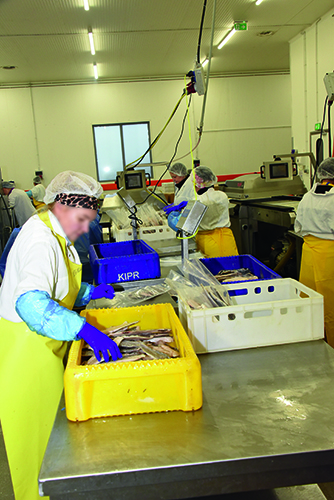
Products can be packed in different ways, bulk cartons, plastic bags, or vacuum packaged.
A significant turning point came when Mr Bigus decided to establish dedicated freezing facilities for Baltic fish. Demand for individually quick-frozen sprat was particularly strong in Balkan markets, but suitable processing capacity was difficult to secure in Poland. The company opened its production plant in 2015 which concentrated on freezing Baltic sprat and herring, with approximately 1,500 tonnes of cold storage capacity. However, restrictions on Baltic fishing quotas, seasonal fluctuations, and competition from fishmeal producers made supplies of fresh raw material less predictable than anticipated. Morex therefore diversified into portioning, cutting, glazing, and repacking frozen fish. A further investment in a new production building has substantially expanded these activities. The facilities now handle whitefish fillets, steaks, cubes, and portions prepared to customers’ specifications. Products are packed in bulk cartons, smaller retail bags, or vacuum packaging. Much of the production serves wholesalers supplying restaurants, catering companies, and institutional kitchens. Portions typically weigh between 100 and 150 g, although specifications depend on individual orders.
Freezing services exploit seasonal price differences
The company also provides freezing services for other businesses. For example, it freezes salmon on behalf of customers seeking to manage raw material supplies when market prices are favourable. Handling all this activity are approximately 50 people, including around 30 in processing and 15 in administration and commercial activities, with the remainder working in cold storage operations.
Hoki becomes a commercial success
One of Morex’s most significant achievements has been developing the Polish market for hoki, a whitefish sourced principally from Argentina, Chile, and New Zealand. The company began promoting hoki fillets in earnest around 2011, at a time when the species was relatively unfamiliar to Polish consumers. Through cooperation with established suppliers, it gradually built demand among wholesalers and foodservice customers. Today, Mr Bigus describes Morex as Poland’s largest importer of hoki fillets. The species is particularly important in terms of sales value, while herring and mackerel generally account for the largest traded volumes, though high prices for mackerel this year will probably depress volumes. Hoki’s appeal lies in its combination of acceptable pricing, consistent quality, and relatively consistent availability. With cod prices increasing sharply and supplies constrained, hoki has become a practical alternative for customers requiring whitefish at a more accessible price. Morex imports both fillets and frozen blocks, with the latter processed into portions and cubes for catering applications.
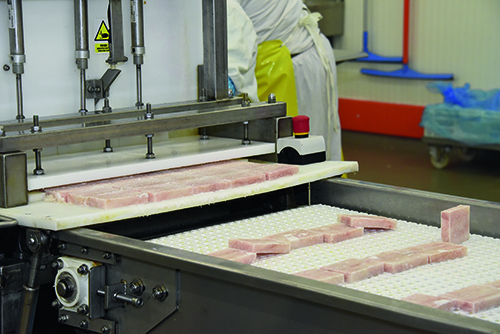
Frozen blocks are chopped into cubes and portions depending on the customer’s specifications.
For Mr Bigus, product quality is another important consideration. He believes excessive glazing and water retention in certain low-priced imported products undermine consumer confidence. Morex consequently emphasises fish quality with a low glazing fraction rather than competing solely on the lowest price.
Supply constraints reshape the market
Despite the expansion he has overseen during the last years, Mr Bigus considers the present trading environment consistently challenging. Limited fishing quotas, uncertain landings, higher production costs, and intense competition among importers are squeezing margins. The supply situation means he often must decide whether to sell quickly but at a lower price while supplies are available, or wait for a better price but risk that supplies run dry. For an individual trader sitting at a computer with a telephone and no other overheads there is no trade off. For Mr Bigus with 50 employees and all the infrastructure he has established, expanding sales is important but profitability is crucial. Moreover, there has been a vast increase in the paperwork related to trading. Suppliers, who in the past would send a vessel of fish on a phone call, now require multiple documents and insurance guarantees before they ship anything. These may be among the reasons that Mr Bigus is currently negotiating the sale of the company to a large international group that already has a presence in Poland.
The decision is not an easy one for, despite its international trading network, Morex retains a strong family character. Family members of Mr Bigus hold various positions within the company. On the other hand, he sees it as an opportunity to invest in the company, broaden the portfolio, and expand its sales to other European markets. Poland’s competition authority has approved the transaction, but the deal has not yet been finalised. I would like Morex to develop internationally, says Mr Bigus, but I need to secure the future of my employees.