This article was featured in Eurofish Magazine 6 2026.

The family-owned Polish processor is defending a labour-intensive speciality while investing in new products and ways to extract greater value from shrimp shells.
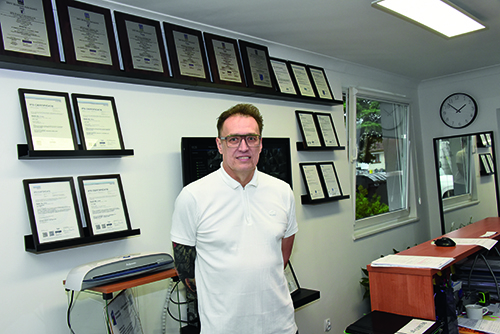
In a town in north-western Poland northern prawns (Pandalus borealis) are peeled by hand for markets mainly in Scandinavia. Yet for plant manager and co-owner Marcin Weltrowski, the future of the company, Resko, depends on doing much more than removing shells. With his wife, Magdalena Juncewicz, the company’s chief executive and fellow owner, he seeks to move from a traditional processing operation to activities that create greater value addition and make fuller use of raw materials.
Resko traces its origins to 1992, when Mr Weltrowski’s mother-in-law ran a substantial operation peeling brown shrimp (Crangon crangon) in 1994, employing around 200 people. Rising labour costs and competition from processors in North Africa subsequently changed the economics of this activity. When Ms Juncewicz and Mr Weltrowski assumed responsibility in 2011, they developed a relationship with a Greenlandic company and increasingly concentrated on northern prawns. The cooperation with the company ended around 2018, says Mr Weltrowski, creating a serious financial challenge but also making them determined to retain expertise in hand-peeling, but avoid relying exclusively on a single partner. Today P. borealis accounts for almost all production, although the company also offers smaller quantities of crayfish. Its principal markets remain Scandinavia, especially Sweden and Denmark, while Norway is a market it seeks to develop further. Resko supplies retailers mainly through private-label arrangements and also serves foodservice customers. Mr Weltrowski estimates that retail accounts for roughly 70% of output.
Hand-peeling gives a different product than machine peeling
Mr Weltrowski draws a distinction between shrimp subjected to hand-peeling and those processed mechanically. The prawns that Resko uses are cooked and frozen aboard fishing vessels, then transported frozen to a peeling facility. After thawing, workers remove the shells by hand. The meat is washed gently, placed in brine, and packed for customers. This handling preserves the prawn’s natural appearance and flavour, avoiding preparatory treatments that may be used with some mechanically peeled products. The company’s established hand-peeling expertise is also the point of departure for research into whether automation can reproduce the same result.
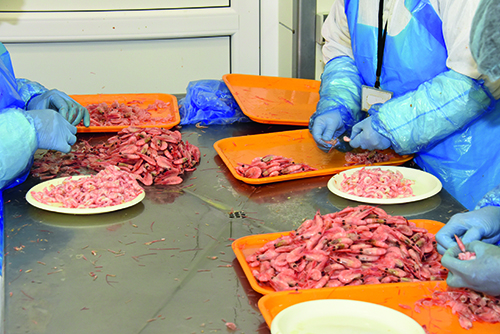
Northern prawns (Pandalus borealis) peeled by hand have a very different mouth feel from those peeled in a machine.
Resko employs about 50 people at its IFS and MSC certified site, including women who have worked there for decades. Mr Weltrowski considers maintaining this workforce essential despite the expense it entails. The plant has also worked with a local prison for approximately 15 years, offering supervised employment to inmates. He sees this both as a way to recruit staff in a difficult labour market and as an opportunity to help participants experience regular working life. At the same time, a substantial proportion of hand-peeling is undertaken by subcontractors in North Africa, where labour costs are lower. Mr Weltrowski puts combined peeling activity at approximately 10–11 tonnes a week. The company retains production in Poland while using a recently installed automated weighing and packing line to handle larger deliveries from partner plants. Batches of 10 tonnes or more can be repacked into small retail containers within two days, he says.
Changing what customers find on the shelf
Traditional cold-water prawns in brine are commonly sold in plastic jars, a format Mr Weltrowski believes does little to attract younger consumers or smaller households. A 180 g jar may be convenient for a family, he observes, but less suitable for people living alone. Resko is therefore working on smaller portions and modern packaging that makes its products stand out on crowded supermarket shelves. The company’s portfolio includes conventional, black-lidded jars and square containers, alongside pouches. Mr Weltrowski claims the pouch format uses up to 90% less plastic than comparable traditional packaging. The longer-term aim is a recyclable mono-material pack with adequate oxygen-barrier properties and the strength to withstand high-pressure processing (HPP). This research forms part of a wider programme supported by European funds. HPP is particularly important to Clean Label Seafood, the brand through which Resko offers ready-to-eat shrimp without conventional added preservatives. Rather than relying on heat, the technology subjects sealed food to high pressure to reduce microorganisms while largely retaining sensory characteristics. Resko is combining the method with simple formulations based on salt and citric acid and is developing packs intended to preserve safety and quality throughout chilled distribution.
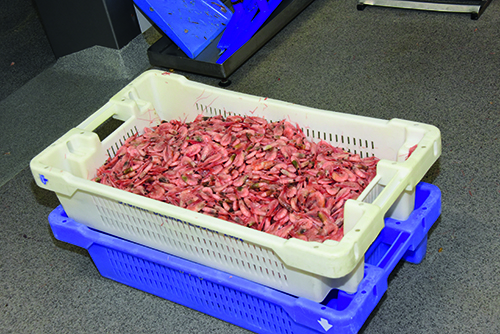
Cooked northern prawns are peeled and packaged by Resko for many Scandinavian customers.
While the company advertises a 50-day shelf life for its Clean Label range, Mr Weltrowski discusses the possibility of reaching as much as 60 days with new packaging and processing arrangements, although he says the next stage of production remains under development. The concept has attracted international attention. Clean Label Seafood was a finalist in the retail category of the 2026 Seafood Excellence Global Awards in Barcelona. However, Mr Weltrowski argues that international acknowledgement is not enough. Supermarkets must be willing to support unfamiliar formats and explain their benefits to shoppers.
Extracting value from the shells
The company is also looking at what happens after the prawns have been peeled. Shells and other residues are increasingly treated as raw materials. They are, for example, frozen and exported to Japan for ramen broth, and other outlets for these materials have been established in Europe. An EU-supported research project is investigating the extraction of astaxanthin, the red-orange carotenoid pigment present in shrimp shells that is also a powerful antioxidant. Mr Weltrowski hopes to obtain this valuable ingredient without using conventional organic solvents. Other work examines recovering oil and proteins from peeling residues, including protein suitable for animal feed. Resko is working with universities in Koszalin and Szczecin on related technology. One project explores the possibility of a semi-automated peeling device gentle enough to protect the meat’s appearance and texture, while another focuses on recovering protein from shells. If successful, such projects represent a way to secure more value from each kilogram of raw material purchased.
A business shaped by supply conditions
To get the raw material Resko buys northern prawns through fishing-sector partners and has broadened its purchasing relationships to include Canada. Mr Weltrowski says raw-material prices have risen sharply, while changes in trade flows and resource availability complicate planning. Canadian authorities have reduced total allowable catches in several northern shrimp fishing areas for 2026–27. The current season is almost over, says Mr Weltrowski, and he is unsure what will happen next year regarding the raw material situation. Hand-peeled northern prawn is the company’s core business, but much depends on the evolution in stocks of the species and their quotas. Seeking to extract the maximum value from the raw material is thus a strategy that makes eminent commercial sense when prices and volumes can fluctuate violently. Besides, as Mr Weltrowski puts it, the business does not want to be regarded simply as a peeling company.