This article was featured in Eurofish Magazine 1 2026.

Fish knives for the perfect cut
Perfectly de-boned fillets form the basis of many fish dishes. Although filleting is often done by machine these days, the manual cutting of fish, for example, as a service within the fish trade, has by no means lost its importance. The perfect cut, with which a fishmonger demonstrates their expertise and mastery to the amazement of customers, requires practice, experience and the appropriate knife. But which knives are best suited for the job?
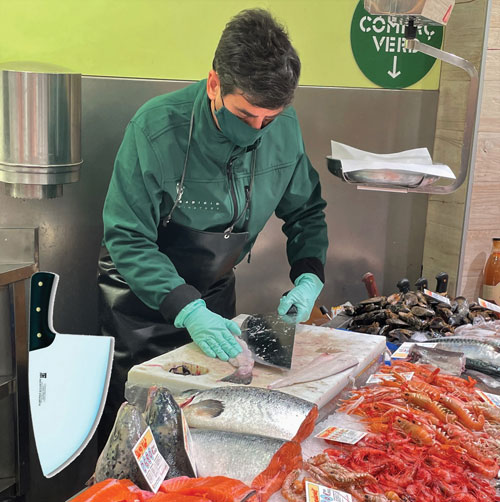
The ‘media luna’ may look a bit bulky, but with skilful handling it enables very precise and clean cuts.
Modern filleting machines such as the Baader 581 for salmon or the 482 for herring, which can process 100 to 200 fish per minute, are extremely powerful and enable high yields. In order to cut a few percent more off the bone, considerable manual skills are required, such as those possessed by the employees of Castro Seafood or other filleting companies in Bremerhaven that specialize in filleting fresh fish. But filleting is also very common at fish counters, in restaurant kitchens, by fishers, fish farmers and sporting anglers, although usually in smaller quantities and with varying yields. In order to be able to cut acceptable fillets at all, naturally, knives that are suitable for this quite special task are needed. While we usually prefer knives with long, narrow blades, in remote regions of the world other cutting tools are often preferred, which may seem unsuitable to some readers.
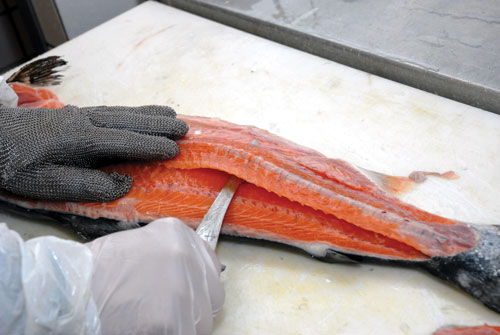
In Germany, the ideal filleting knife is characterized by a narrow,
very thin, at least 20 cm long, extremely sharp and usually pointed blade.
Sharpness, grip, design
In Germany, knife manufacturers’ recommendations are fairly uniform and the majority of users adhere to their advice. The ideal filleting knife, according to manufacturers, is characterized by a narrow, very thin, at least 20 cm long, extremely sharp blade that usually tapers to a point at the front (Figure 1). In order to achieve extreme sharpness, the blade’s steel must have a certain hardness. A good filleting knife should have a hardness of more than 55 Rockwell (HRC), which is generally considered to be of good quality, allowing for effective cutting while maintaining flexibility. However, this is a matter of personal preference, as some chefs prefer more rigid blades. The handle, also called the hilt, should be non-slip, ergonomically perfectly shaped and fit securely in the hand. A good balance between blade and handle is also important to prevent premature fatigue. Incidentally, it is not true that extremely sharp blades lead to more cuts, as a blunt knife requires much greater pressure, which increases the risk of slipping and thus cuts or injuries. Only very sharp blades provide a clean cut and protect the natural muscle structure of the fillet. In short, the requirements for a filleting knife can be summarized in the three characteristics of sharpness, grip and design.
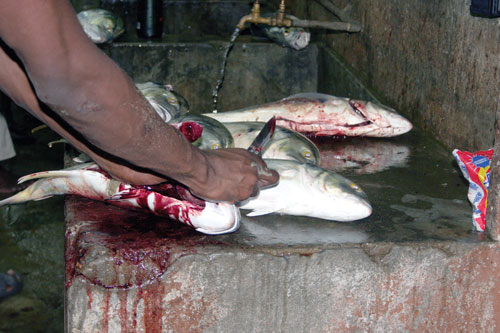
Universal, all-purpose knife for processing, portioning, gutting and filleting in the Caribbean.
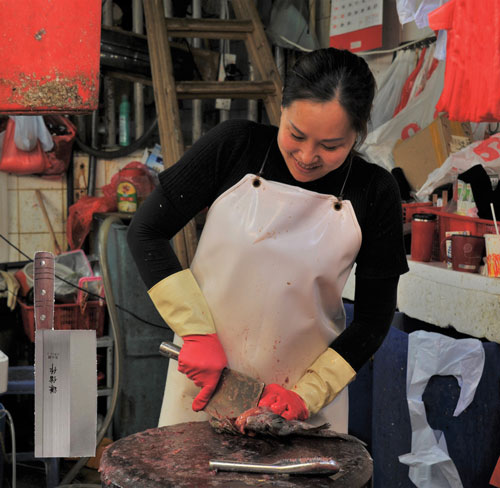
The so-called ‘Chinese chef’s knife’ is not a cleaver, but is used exclusively for cutting.
Different knife shapes for the same purposes
Relatively long and narrow knives are also used by fishers in the Caribbean, for example in Castara Bay (Tobago). However, since the fish here are rarely prepared as fillets, but are processed mostly whole or cut into slices, many opt for an all-purpose knife that is suitable for cutting the gills, opening the abdominal cavity and, if necessary, cutting fillets (Figure 2). Completely different cutting tools can be found in Spain. Butchers and fishmongers in particular like to use knives called ‘Media Luna’ (half moon) or ‘Cuchillo Media Luna’ in their daily work. The semi-circular blade, which is around 20 cm wide and almost 30 cm long, is usually made of high-quality, durable Nitrum stainless steel, which is extremely hard and allows for an extremely sharp cut. Despite their bulky appearance, these knives are surprisingly light (on average around 200 to 250 grams) and fit well in the hand, enabling precise cutting. Trained staff can use the ‘half moon’ to accurately fillet even the smallest fish like sardines and anchovies (Fig. 3).
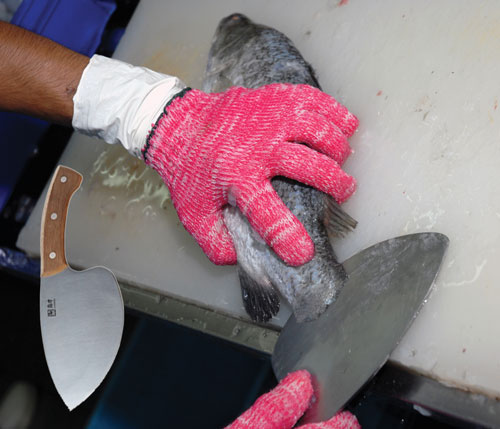
In Thai fish-processing plants, round knives are often used for filleting, with which semi-skilled
employees can achieve high fillet yields after a relatively short period of training.
In short, the requirements for a filleting knife can be summarised
in three characteristics: sharpness, grip and design.
Fishmongers in Italy sell similar knives under the name ‘mezzaluna’, which are also used in private kitchens for cutting fish, meat and cheese (in France, the mezzaluna is called ‘hachoir’, Fig. 4). In a modified form with two parallel blades, they serve as rocker knives for chopping herbs, for example, for pesto. A third variant of the wide knife blades is used in Thai slaughterhouses and processing plants for filleting tilapia and barramundi. The knife is reminiscent of the Spanish ‘media luna’, but is slightly rounder in shape, which is particularly noticeable at the back of the knife and the slightly curved handle. Thanks to this special design, the round knife, which weighs just under 300 grams, sits particularly well in the hand and limits fatigue in the hand when filleting.
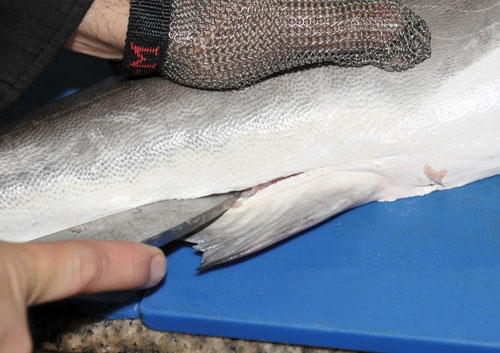
… then further processed and filleted with a knife with a thick, stiff blade.
Special cutting tools and universal knives
In China and other Asian countries, a razor-sharp, cleaver-like knife is popular for cutting fish, meat and vegetables (Fig. 5). The cutting tool, which we usually call a ‘Chinese chef’s knife’, has a narrow handle and a strikingly wide rectangular blade. Despite its cleaver-like shape, the knife is not intended for chopping, but only for cutting. In the hands of a skilled chef or fish seller, the Chinese chef’s knife proves to be a truly universal tool for almost any cutting purpose. Its ultra-sharp blade is suitable for cutting and filleting fish, as well as for dicing vegetables, chopping herbs and portioning meat and poultry.
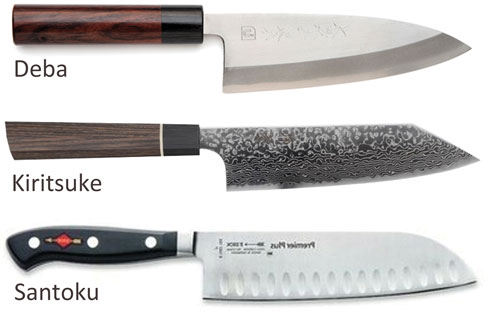
These three knives are often used in Japan for cutting and filleting fish.
Different types of knives are commonly used for slaughtering, cutting and filleting fish with tough skin and very hard bone structures such as cobia (Rachycentron canadum). At Open Blue slaughterhouse in Panama, the sturdy fish are first beheaded with a heavy cleaver (Fig. 6) and then the abdominal cavity is opened with a rigid, broad-backed knife to remove the entrails. Similar compact knives (Fig. 7) are then used for filleting, which are robust and sharp enough to cut through its almost leathery skin.
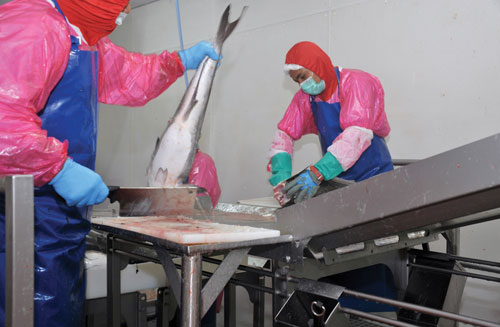
Cobia is beheaded with a heavy axe due to its hard bone structure…
Only very sharp blades provide a clean cut and protect
the natural muscle structure of the fillet.
When it comes to high-quality cutting tools, the reputation of Japanese knives is legendary. The differences between European and Japanese knives are not as great as is often assumed. Apart from the steel used, the main difference is in the grinding. While we usually sharpen the blade on both sides (U-grind), knives in Japan are usually sharpened on one side (V-grind), which enables particularly straight and smooth cuts. As in Europe, there are special knives for specific tasks in Japan. Three types of knives are preferred for processing fish (Fig. 8). The ‘Deba-bōchō’, a well-known and popular Japanese chef’s knife, has a wide blade about 20 cm long, which is ideal for cutting and filleting fish. Due to its relatively high weight, it can also be used as a cleaver. The ‘Kiritsuke’ is also good for cutting fish and is also very popular for slicing sashimi. In Japan, the ‘Santoku’ is considered a universal knife for almost all cutting tasks, from fish to meat to vegetables. The Santoku is characterized by its relatively short blade, the length of which usually varies between 120 and 180 mm, as well as its blade shape with its rounded tip.
Manfred Klinkhardt