

 Capital: Ankara
 Population: 85.7 million
(2025, Eurostat)
Population: 85.7 million
(2025, Eurostat) GDP: €1,253 trillion
(2024, Eurostat)
GDP: €1,253 trillion
(2024, Eurostat)- GDP/capita: €12 330 (2024, Eurostat)

Overview of the Turkish fisheries and aquaculture sector



Fisheries sector

Türkiye is surrounded by four seas which gives the country a rich and diverse coastline that supports many economic activities. With a total available water surface area of 26 million ha and rivers with a total length of 177.714 km, Türkiye has all the natural resources necessary for fish production.
In 2024, the total marine catch from the Mediterranean Sea, the Aegean Sea, the Black Sea, and the Sea of Marmara amounted to 322.388 tonnes, of which finfish accounted for as much as 90%. Anchovy was the major species caught, followed by Atlantic bonito and sardine. While anchovy present a key species in the Black Sea´s food chain, its catch amount fluctuated strongly throughout the past years, with a simultaneous decline in nutritional value and smaller size being reported over the years. The Black Sea is responsible for around three quarters of the annual catches.
Fish caught for human consumption comes from all the seas surrounding Türkiye, although the Black Sea catches are significantly higher than those from the other three maritime regions. Fish for industrial use comes primarily from the Black Sea. According to the national statistics, the marine fleet in 2023 comprised 15.219 vessels, of which around 90% are small coastal vessels less than 12 m in length.
Catches of molluscs and crustaceans were destined mainly for human consumption, while catches for industrial use were marginal. Striped venus was the major species with 51% of the volumes, followed by sea snail (21,5%), and deepwater rose prawn (8%).
Inland capture fisheries produced about 33.607 tonnes in 2024, continuing the trend in stagnating catches seen over the past several years. The most important species are tarek (Alburnus tarichi) and Prussian carp (Carassius gibelio), which together make up half the production. Other important species are sand smelt (Atherina presbyter), mullets, and common carp.
Aquaculture

The total production of the Turkish aquaculture sector reached 577.124 tonnes in 2024, with freshwater aquaculture production reaching 171382 tonnes, while marine aquaculture produced 405.742 tonnes. The main freshwater species is trout, which makes up almost all of the total freshwater production. The main marine species were European seabass and gilthead seabream with total production of 320.334 tonnes, which represents 79% of the total marine aquaculture production. The Mediterranean mussel is a promising species for the sector. The commercial production was first registered in 2015 with 3 tonnes only, and in 2024 it amounted to 11.320 tonnes. The volumes are still small, but they are expected to increase as the government encourages production.
Türkiye is one of the largest producers of farmed European seabass in the world, the largest exporter of European seabass products globally, and one of the largest producers of gilthead seabream in the world.
Technological advances, combined with governmental strategy and scientific know-how have facilitated an increase in national aquaculture output in recent decades. The rapid growth of the aquaculture sector has made Türkiye the leading producer in the Mediterranean Sea. European seabass gilthead seabream aquaculture production is carried out in provinces located on the coast of the Aegean Sea. Türkiye also has a tuna ranching industry which catches and fattens tuna for the Japanese market. Whereas mariculture production mostly depends on cage farming, freshwater production is carried out mostly in land-based units extracting water from rivers, but also in cages set in lakes and hydro-electric or irrigation dams.
Trade
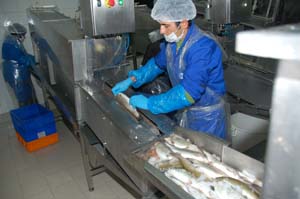
The export volume increased by 8% compared to the previous year, reaching 272.192 tonnes in 2023, and its value increased by about 4%, reaching EUR 1,7 billion. Aquatic products for human consumption produced in Türkiye in 2022 were exported to 103 countries around the world. About two thirds the seafood export volumes were supplied to the EU countries with Italy, Greece, the Netherlands, Germany, and Spain being the major destinations. The country where the most seafood is being exported to is Russia with 23% of the total volume. Overall, trout is the most exported species, followed by sea bream and sea bass.
Imports of fish and seafood products for human consumption in 2023 amounted to 105.252 tonnes worth €238,3 million. Morocco was the largest exporter with about 32% share of the total volumes, supplying mainly mackerel and sardines. Norway was the second largest source with a 14% share, supplying mainly mackerel and salmon. Imports of fishmeal and fish oil from Norway are also significant due to the large demand for fish feed, though the volume and value are not included in the data above.
Consumption
Although, it is surrounded by seas, fish consumption in Türkiye is low and is only half of the world average and one third of the average consumption in Europe. Trout and European seabass are popular in the Mediterranean region. In eastern Türkiye, anchovy is the most preferred fish, followed by trout. The Marmara and Aegean regions are the leading areas as far as volume and variety of fish consumption are concerned.
Turkish consumers have historically preferred non-fish meat products, and fish consumption differs between the regions. Whereas fish consumption is low in inland areas, it is more predominant in coastal areas. Fish consumption is influenced not only by the local habits, but also by the availability and price of the products, and by consumer purchasing power. Per capita consumption in 2023 was estimated at 7,2 kg, a slight decrease compared to the previous year.
Publications
A translation into Turkish of selected articles from the EUROFISH Magazine is available on the Ministry website.
Useful Links for Türkiye
- General Directorate of Fisheries and Aquaculture
- Ministry of Agriculture and Forestry
- Aegean Exporters Associations
- Statistics Türkiye
If any of the above listed links do not work or if you have a relevant link to add, please send as an email here.