This article was featured in Eurofish Magazine 1 2026.

Women are essential to aquaculture in the Mediterranean and the Black Sea, but the sector has been slow to adequately recognise their contribution. As production expands and the region faces attempts to meet growing demands for resilient food systems and climate adaptation, gender equality is also shifting up the agenda. The emergence of the Network of Women in Aquaculture (NOWA) offers a timely reminder of the progress that has been achieved towards greater equity—and of the work that remains to be done.
Aquaculture in the Mediterranean and Black Sea has grown into a strategic pillar of regional food supply and coastal
livelihoods. A recent UN-linked regional snapshot reported around 2.97 million tonnes of aquaculture production in 2023, with a first-sale value estimated at USD 9.3 billion, underscoring the economic importance of fish and seafood farming. Yet growth in production has not been matched by an increase in gender equality. Women’s labour is often most visible in lower-paid or less secure segments of the value chain, while decision-making, public representation, and senior technical roles remain male-dominated. Globally, the FAO notes that where sex-disaggregated data exist, women account for about 24% of fishers and fish farmers in primary production, and around 62% in the post-harvest sector, but that women continue to face constraints in access to resources, training, and leadership opportunities. These overall figures are broadly reflected in the Mediterranean and Black Sea region. Within the EU, the picture is similarly uneven. A 2025 European Parliament analysis drawing on 2020 data reports that women represent about 22% of the EU aquaculture workforce, with variation by segment and technology, and far higher representation in processing.
The data problem is also a visibility problem
For many women working in Mediterranean and Black Sea aquaculture, the first challenge is simply being counted. Informal or family-based roles, seasonal work, and small-scale operations remain under-recorded in national data systems. The lack of data means women are also easier to overlook in training allocations, grant programmes, career development schemes, and national strategies. Christina Zantioti, NOWA’s president, argues that the sector must prioritise three interlinked actions: improving visibility and recognition, strengthening gender-disaggregated data collection, and creating real pathways to leadership. Better data enables better policy, while higher visibility helps challenge stereotypes and prejudice. NOWA was established following institutional changes acknowledging the role of women. The General Fisheries Commission for the Mediterranean (GFCM) adopted Resolution GFCM/45/2022/1 on empowering women in the aquaculture sector, encouraging countries to develop strategies and policies that promote gender equality and equity in marine and inland aquaculture across the region. The resolution also underlines continued capacity building and awareness-raising dedicated to women. This policy development quickly translated into action. The GFCM’s regional training programme for young women in aquaculture began with a first edition in Tunisia in 2022, bringing together participants from across the Mediterranean and Black Sea for hands-on exposure to best practices and leadership-focused learning. A second edition followed in Greece in June 2023, co-organised with FEAP (Federation of European Aquaculture Producers) and HAPO (Hellenic Aquaculture Producers Organisation), explicitly addressing the gap between women’s contributions and their limited access to advancement opportunities.
NOWA seeks to redress gender disparities in aquaculture
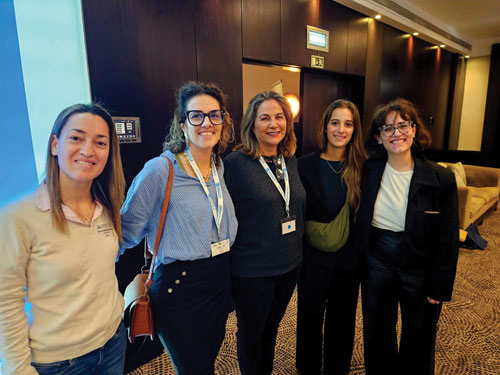
NOWA’s journey started during the June 2023 training in Athens, where eleven women from diverse backgrounds recognised a need for a dedicated, long-term structure to support women across the aquaculture value chain.
Ms Zantioti explains that while fisheries have a longer history of women-led collective organisation, aquaculture is a younger, rapidly evolving sector that has not yet achieved the same level of structured representation for women. The founders, having met through GFCM-led activities and later collaborated on work presented at SOFAS 2023 (International Symposium on Fisheries and Aquatic Sciences in Trabzon, Türkiye) saw a clear “visibility gap” and an absence of professional support tailored to aquaculture. NOWA describes itself as a social entrepreneurship initiative which combines combining mission-driven goals—gender equality, sustainability, inclusivity—with the capacity to deliver services across borders. Ms Zantioti notes that the network is legally established as a French-based association that mobilises resources through memberships, partnerships, and donors.
Building capacity targeted at women
The approach centres on three pillars: capacity building, visibility, and community support and services include training courses and webinars, mentoring, networking opportunities, career-boosting activities, and advocacy and lobbying for gender equality in the sector. In practice, the organisation currently combines open-access activities—such as newsletters and a Women in Aquaculture Spotlight campaign—with member-focused benefits including a dedicated community space for peer-to-peer exchange. Membership is targeted at individuals, businesses, and organisations that share the network’s core vision. Among the benefits is SheSpeaksBlue, an international directory of women experts in aquaculture, the purpose of which is to make it easy for conference organisers, media outlets, and project leaders to find qualified women speakers and experts. The initiative is already being used to support NOWA’s own events and to recommend speakers when partners request expertise. Speaking, publishing, or sitting on advisory boards often unlocks future leadership opportunities, another of NOWA’s priorities. Across the region, women’s participation is growing in technical training and early-career roles, but many struggle to break into middle and senior management roles—where informal networks, sponsorship, and organisational culture play a decisive role. NOWA has identified mentoring as a core strand of its work. However, Ms Zantioti emphasises that the programme is still in development, with the team consulting sister associations and established networks to design a flexible, international model aligned with real needs across the value chain.
A regional movement with global horizons
Although early activities focused on the Mediterranean and Black Sea region, NOWA had global ambitions from the outset. One of its initial activities was an international survey in multiple languages to ensure that the network’s services reflected social, economic, and cultural contexts from around the world. Today NOWA has a growing presence in international boards and platforms, including global youth and underrepresented groups. The story of women in Mediterranean and Black Sea aquaculture remains a blend of progress and unfinished business. Structural constraints highlighted by the FAO—limited access to finance, services, technologies, education, leadership roles, and safe, decent employment—continue to appear in different forms across the region. Addressing these barriers will require more than networks alone. Companies, regulators, research bodies, and producer
associations need to work to improve:
• Gender-disaggregated data, including recognition of the contribution from informal and family labour
• Transparent recruitment and promotion pathways, especially in technical management, health, welfare, and sustainability roles.
• Targeted training and scholarships, that lead to career progression.
• Inclusive representation in conferences, advisory boards, and media, using tools such as SheSpeaksBlue.
The GFCM’s resolution and training programmes provide a strong institutional foundation for these developments. NOWA, in turn, offers a mechanism to translate that foundation into everyday professional support and sector-wide visibility.
A pragmatic approach wins more adherents
The most encouraging element of NOWA’s rise is its pragmatic tone. The network links gender equality to sustainability, resilience, and innovation in aquaculture—a logic that should resonate with industry leaders facing complex environmental and market pressures. If the Mediterranean and Black Sea region is to meet future demand for aquatic
foods while safeguarding ecosystems and local communities, it cannot afford to underuse half of its talent base. The creation of structured, inclusive platforms like NOWA suggests that the sector is beginning to recognise this.