This article was featured in Eurofish Magazine 3 2026.

Caviar Pirinea is at the centre of an important development in Spanish aquaculture. According to Aquaculture in Spain 2025, an annual report on the Spanish aquaculture sector produced by APROMAR, the association of Spanish farmed seafood producers, rainbow trout production in Spain reached 16,693 tonnes in 2024, up 13.1% on the previous year, and the sector is increasingly oriented towards larger fish rather than traditional portion sizes. This trend is linked to value-added channels such as smoking and the HORECA trade, where larger fish are preferred. In this context, Caviar Pirinea, with its production of trout of an average size of 3-4 kg is helping to shape the market.
Production approaches half of national trout output
The company is among Spain’s largest producers of fish. It has roots in Barbastro, Huesca, and farms in the foothills of the Pyrenees. The fish are raised in pure, oxygen-rich mountain water, a condition central to both quality and identity. The business was founded in 2013 by Arnault Chaperon and Laurent Villaeys, two French aquaculture specialists with long international experience. Mr Mendiola emphasises the use of snowmelt water as one of the foundations of the company’s production model. The company now operates 12 aquaculture and industrial processing facilities across northern Spain, with two in Navarra (to where the registered office was moved in 2019), two in Aragón, one in Catalonia, three in Galicia, some new sites near Porto (Portugal), and the most recent acquisition of Normandie Truites (France). Not all sites hold sturgeon, but trout is produced at all the farms.
The assortment includes fresh and processed trout and sturgeon, smoked products, trout roe, semi-preserves and pâtés, under the Pirinea brand, while the Per Sé label is reserved for caviar. However, what was once a diversified premium fish-and-caviar house is today a trout specialist with a smaller caviar arm attached to it. The company’s trout strategy is distinctive because it centres on large fish and in its designation of origin and quality. Mr Mendiola says the standard target is around 3 kg, though larger fish are also produced, and the company can also sell smaller carcasses depending on conditions. Larger trout enable more products, better margins, and stronger market positioning. Small portion-sized trout are largely confined to whole-fish presentations. Large trout, by contrast, can be turned into fillets, loins, or smoked products. They also fit better with premium branding and can be positioned closer to other salmonids. Wider developments in the Spanish market support this focus on larger fish. According to APROMAR, the move towards larger trout is being driven by the stagnation of standard trout prices and by the growth of value-added outlets such as smoking and food service. The report also shows how concentrated Spanish trout production remains in inland freshwater systems, with key producing regions including Castilla y León, Galicia, Catalonia, La Rioja, Aragón, Andalusia, Navarra, Asturias, Castilla-La Mancha, and Cantabria. Trout is therefore a significant part of Spanish inland aquaculture, but still modest in national volume compared with marine finfish species (65,000 tonnes), not to speak of mussels (185,000 tonnes).
Large trout offer the most opportunity for value addition
According to Mr Mendiola, current annual production is roughly 7,500 tonnes of fish and roe, with trout by far the main species by volume and value, and a figure indeed that is expected to increase significantly in the coming years due to the commissioning of several new farms.
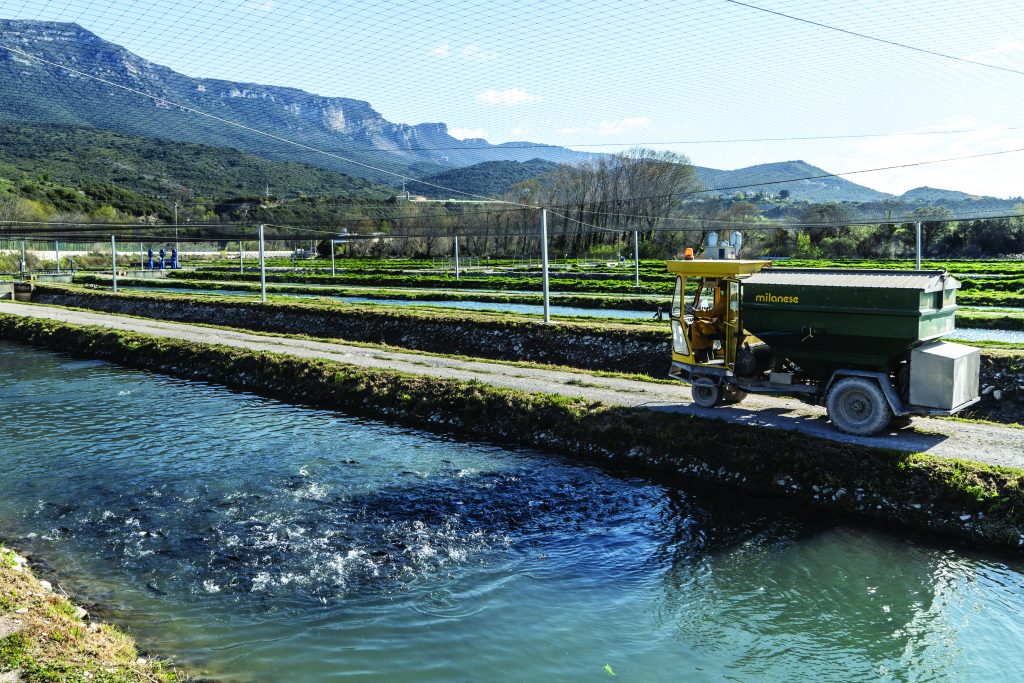
One of the company’s trout farming sites. Altogether Caviar Pirinea has has 12 sites spread over Spain,
northern Portugal, and in La Normandie (France).
The company has recently begun producing smaller fish, typically between 400 g and 800 g, following demand from distributors in Spain and elsewhere in Europe. But this is an extension of the product assortment, not a change of identity. The business remains focused on larger trout because that is where the strongest opportunities lie in differentiation, processing, and margin, he says. On certain markets the company’s products carry the Crianza de Mares y Rios de España (Farmed in Spanish waters) label developed by APROMAR. The label is widely recognised by consumers as testifying to the nutritional and gastronomic qualities of the product. In addition, safety, traceability generator of quality local employment, and respect for primary production are also attributes associated with the label, says Mr Mendiola.
A second pillar of the trout business is roe. Mr Mendiola says trout roe is increasingly important in tonnage terms, with particularly strong demand in France and among hospitality buyers in Spain. The roe is handcrafted within 24 hours of spawning to create a very fresh, tasty and playful product.
Mr Mendiola says that for larger-volume business the company increasingly supplies fresh fish after being slaughtered under the strictest animal welfare standards, destined either for national smokehouses or for facilities linked to the group in France. He also points to a partnership with the Gozoki Food Group in Estillac, southern France, which gives Caviar Pirinea access to higher productivity and commercial positioning but also drives and underpins all industrial development towards smoked products and ready-to-eat formats. Its president, Mr Yann Maus, is a highly visionary leader in the food industry. Caviar Pirinea’s market footprint is national for fresh fish, but wider for premium products.
Mr Mendiola notes that the most sustainable markets for fresh trout are those that can be reached within roughly 24 hours, especially Spain, southern France, and Portugal. Beyond that radius sales are mainly of its processed fish products as well as niche items such as trout roe and caviar. The sturgeon business though minor and becoming less relevant remains part of the company’s public identity. Spain produced only 5 tonnes of caviar and 121 tonnes of sturgeon meat in 2024, according to APROMAR, tiny figures compared with trout, and Mr Mendiola acknowledges that while the sturgeon business at Caviar Pirinea has high added value, it is small in volume and no longer strategic. Even its organic certification for sturgeon and caviar, once important, has become less commercially useful because the market does not pay for it or only very seldom.
Focus on improving what it already does well
Innovation is a priority for the company which is continuously working on productivity improvements, environmental integration, animal welfare, sustainable feed, circular packaging, AI, new products and European climate adaptation projects such as OCCAM, where the company will test new climate-smart technologies and procedures aimed at enhancing fish health and growth under increasing environmental stress. The company has also invested a lot in animal welfare, including effective stunning technologies before slaughter across all production since 2021. Mr Mendiola presents the company as innovation-minded but still focused on practical farming. High quality fish, uniform sizes, year-round availability, and stable pricing are the company’s key selling points and while technology, product development, and convenience formats matter, they must not obscure the company’s main competence: producing safe, nutritious fish well. Caviar Pirinea is a modern trout farming company that uses scale, mountain-water, product diversification, and selective processing to push trout into higher-value territory with products like roe, smoked items, and convenience. As APROMAR points out in its report, the trend in Spain’s trout sector is towards larger fish and more value-added channels, since the price of portion-sized trout is stagnating. With close to half the national production of trout, most of which is large fish, Caviar Pirinea appears to be in a strong position to capitalise on this development.