This article was featured in Eurofish Magazine 1 2026.

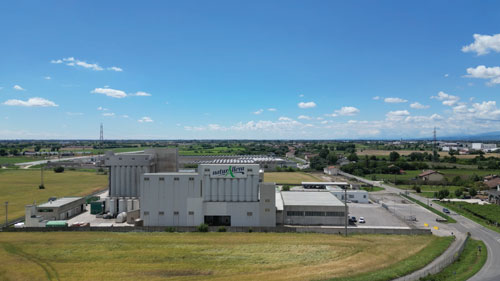
NaturAlleva, part of the VRM Group, is an Italian producer of aquaculture feed. It plays a central role in the group’s fully integrated supply chain that encompasses feed formulation, fish farming, processing, and distribution. This vertical structure enables complete control over the production cycle, ensuring traceability, freshness, and adherence to environmental and ethical standards.
Based in Cologna Veneta, near Verona, NaturAlleva manufactures feed for Mediterranean species such as sea bass (Dicentrarchus labrax) and sea bream (Sparus aurata), which are farmed in VRM’s Civita Ittica (Italy) and Kornat Ittica (Croatia) facilities. The company also produces specialised diets for freshwater and warm-water species, serving markets in Europe, North Africa, and Asia. Through research and development, NaturAlleva optimises feed performance, enhances fish welfare, and reduces the environmental footprint of aquaculture.
VRM’s integrated model, feed production, marine fish farming at sites in Italy and Croatia, fish processing, and distribution, enables complete traceability and quality control from feed ingredients to final distribution. The group produces approximately 30,000 tonnes of feed, 5,000 tonnes of farmed fish, and markets around 10,000 tonnes of seafood annually. This model distinguishes VRM as one of the few Mediterranean aquaculture groups with full vertical integration for sea bream and sea bass.
Feeds for marine and freshwater species
NaturAlleva’s feed production facility is the technological heart of VRM’s operations. The headquarters supplies feed for the group’s own production as well as for external clients (60% of the output) across Europe and Africa. Every stage of the fish life cycle is covered by the feed range—from crumble for fry and juveniles to pellets for on-growing and finishing phases. NaturAlleva formulates diets not only for marine species such as sea bass and sea bream, but also for freshwater species like trout, sturgeon, catfish, tilapia, red drum, and carp. The feed mill’s hallmark is its ASC certification, which recognises responsible sourcing, transparency, and sustainable production practices. NaturAlleva selects raw materials based on traceability and sustainability, sourcing fish meal and fish oil primarily from Spain and Morocco, and using vegetable proteins mainly from European suppliers. The company has reduced its reliance on soya to align with certification requirements.
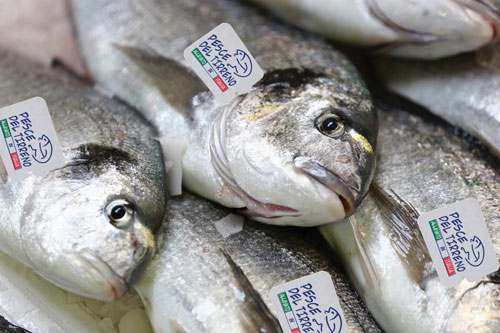
Forty-eight hours after harvest the fish is available at supermarket counters.
Under Fabio Brambilla Ph.D., NaturAlleva’s fish nutritionist, the company has pursued research to minimise dependence on marine resources while maintaining the nutritional integrity of its feeds. Fish meal inclusion has been reduced to 10-15% percent, considered the lowest feasible level without compromising performance. The company actively explores alternative protein sources such as insect meal, bacterial protein, and vegetable concentrates, as well as animal by-products. In 2026, the company signed a partnership to integrate insect meal into its formulations, reflecting a growing commitment to circular-economy principles. Although insect protein remains expensive, it offers a high-quality, sustainable alternative to marine ingredients. The company also incorporates algae-derived oils, rich in EPA and DHA, to ensure that farmed fish maintain omega-3 levels comparable to those of wild fish. These oils are derived from fermentation processes, providing a stable and renewable source of essential fatty acids. Our product is rich in omega-3, says Dr Brambilla, and by using algae oil, we can precisely manage EPA and DHA content to achieve the desired nutritional profile.
ASC certification ensures that feed ingredients are responsibly sourced, free from genetically modified organisms, and traceable throughout the supply chain. The certification complements VRM Group’s ASC-certified marine farm, Kornat Ittica in Croatia, which holds full ASC accreditation for sea bass and sea bream. ASC certification also includes the monitoring of the Fish Feed Dependency Ratio (FFDR), a key sustainability metric measuring the use of wild fish in aquaculture feed. VRM Group’s FFDR for both fish meal and fish oil is close to zero, significantly below ASC limits demonstrating NaturAlleva’s success in reducing wild-fish dependency through innovative feed formulations.
Sophisticated RAS facilities for testing feeds
Located within the NaturAlleva facility, the NextFish Centre is VRM Group’s dedicated recirculating aquaculture system (RAS) research hub. This fully automated facility represents the next step in aquaculture innovation, providing a controlled environment for experimental and applied research. The centre consists of two departments—freshwater and marine—with a total of 48 independent tanks, each equipped with optical sensors, digital flowmeters, and sonar-based water-level systems. Real-time control of temperature, salinity, pH, oxygen, and flow rate, is maintained, while a triple filtration system enables a recirculation rate of over 98 percent. The facility allows the company to test new feed formulations and evaluate their performance before scaling up. Key activities include feed performance evaluation (SGR, FCR, and digestibility); biometric and nutritional analyses, including fillet fatty acid profiles; testing of alternative raw materials and feed additives; and development of species- and environment-specific diets. The centre also functions as a training and collaboration platform, open to universities and research institutions. According to Dr Ugo Biasin, VRM’s CEO, the centre is a strategic asset for the entire VRM Group that, together with the ASC feed certification, represents a concrete step toward modern and responsible aquaculture.
NaturAlleva’s feeds are used at VRM Group’s two farms, Civita Ittica, in the Gulf of Follonica, Tuscany, which comprises 35 cages, and Kornat Ittica, in Croatia’s Kornati National Park, with 100 cages. These farms are designed to ensure animal welfare and environmental protection with low stocking densities (below 15 kg/m³), antibiotic-free rearing practices, and sustainably sourced feed. Both farms benefit from proximity to processing and packaging units, allowing fish to reach markets within 48 hours of harvest, preserving freshness and quality.
A wide range of products based on seabass and seabream
The VRM Group’s processing facility (Meduza d.o.o.), a 2,800 sq. m factory, is located in Croatia and handles gutting, filleting, and packaging of fish in modified-atmosphere formats (MAP). The products are sold under private labels and distributed across Italy and Croatia, including major retail chains such as Lidl Croatia. The company offers whole, gutted, and filleted fish in various sizes, catering to retail, catering, and export markets. All products are fully traceable, GMO-free, and certified under multiple international standards. In 2024, VRM’s sea bass and sea bream were awarded the Superior Taste Award by the International Taste Institute in Brussels, achieving the maximum score of three stars for outstanding flavour and freshness.
Like other European producers, VRM faces competition from low-cost imports, both from within and outside the EU.
Dr Brambilla notes, however that VRM offers a better fatty acid profile and longer shelf life thanks to high-quality feed and rapid distribution whereby fish arrive at the market within 48 hours of being harvested. While southern European retailers have yet to make ASC certification a formal requirement, the company believes its sustainability credentials will offer a future competitive advantage as consumers and large distributors increasingly demand responsibly farmed seafood. Northern and Central European markets, especially Germany and France, already value certified and insect-based feeds, opening new opportunities for VRM’s products.
Science-based research to improve products
NaturAlleva and VRM actively participate in national and European research programmes, including Italy’s iFish project, which integrates artificial intelligence and advanced data management in aquaculture. The company collaborates with several universities—Messina, Parma, Varese and Bologna—on research covering fish nutrition, environmental monitoring, and automation. These partnerships strengthen NaturAlleva’s ability to develop feeds that improve fillet quality, shelf life, water stability, and cooking performance, aligning with market demand for healthy, high-value seafood. Like many Mediterranean producers, VRM’s farms are observing the effects of climate change, particularly rising sea temperatures and the emergence of pathogens new to Mediterranean waters such as Lactococcus garvieae. In response, NaturAlleva’s R&D team is investigating nutritional solutions and feeding regimes to enhance fish resilience and immune response. Seasonal feeding strategies have also been adapted to changing climatic conditions. The summer season has become as critical as winter, says Dr Brambilla, in that the feed is important to give correct energy balance and prevent potential pathogenic risk to maintain fish growth stability throughout the year.
In the coming years NaturAlleva’s priorities will centre on sustainability, quality, and innovation. The company aims to expand production, enhance feed efficiency, and further reduce environmental impact through advanced formulations and digital monitoring.
Ongoing efforts focus on widening the use of alternative raw materials; improving fillet texture and flavour; enhancing feeds for recirculating systems; and increasing collaborations with scientific partners. NaturAlleva’s integrated model exemplifies how circular, responsible aquaculture can thrive in the Mediterranean context. By combining nutritional science, sustainable resource use, and vertical control of the value chain, the company sets a benchmark for modern aquaculture in Europe.