This article was featured in Eurofish Magazine 2 2026.

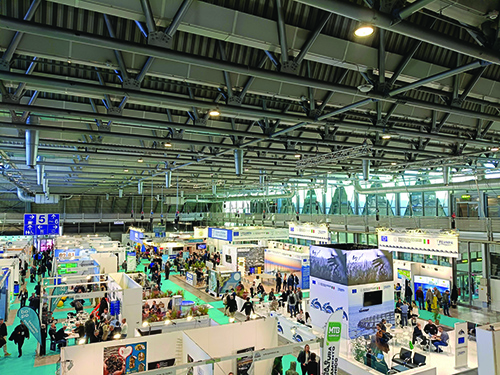
AquaFarm returned to Pordenone Fiere on 18–19 February with a ninth edition covering 6,000 square metres across exhibition and conference spaces. More than 120 exhibitors and represented brands took part, and a programme of 25 sessions featuring more than 100 speakers, including academics, associations, company managers, and international experts.
The event was organised around three areas—AquaFarm, AlgaeFarm, and the new AquaFishery—signalling an expanded perspective in which aquaculture, algae cultivation, and small-scale fisheries come together as interconnected components of the blue economy.
A market reality that is difficult to ignore
Seafood demand in Italy remains strong and continues to rise. Consumption was about 29 kg per person in 2022, and FAO data over a 25-year period show a steady increase from 21.4 kg per capita in 1997. After the inflation-driven disruption of 2022, national monitoring from ISMEA Mercati, indicates a clear rise in food spending among Italian families between 2023 and 2025, alongside higher purchases of fresh fish in the first six months of 2025 (+3.7% in volume and +10.2% in spending) compared with the same period in 2024.
Supply, however, has not kept pace with demand. Italy relies heavily on imports to meet consumption. In 2024, imports of fishery and aquaculture products for human consumption reached 1.11 million tonnes, valued at €7.6 billion. Exports totalled 179,182 tonnes, worth €1.2 billion, resulting in a trade deficit of €6.4 billion1. Against these figures, domestic output remains limited. Fisheries landings amounted to 117,530 tonnes in 2024, valued at €636 million. Aquaculture production reached 129,719 tonnes in 2023, worth €616.3 million, with mussels, clams, and rainbow trout accounting for the largest share1. Because Italy’s seafood market depends primarily on external supply, the sector’s priorities are clear: strengthening domestic production to improve food security, retain more value in the country, and shorten supply chains. Achieving this will depend on easing constraints related to access to space, permitting processes, and the wider investment climate.
Efforts to implement AZAs need to improve across the EU
A first constraint is spatial and administrative. If new farms cannot secure suitable sites, and if permitting remains unpredictable, growth ambitions remain aspirational regardless of innovation on feed, genetics, or system design. In the opening sessions, the Research Director from ISPRA, focused on the process for allocating marine activities across space and time to reduce conflict in increasingly crowded coastal waters and shift decisions away from individual disputes towards a clearer framework for siting, licensing, monitoring, and periodic revision. In theory, this should translate into more predictable investment conditions, fewer conflict with other marine users, and stronger environmental commitment through a more consistent ecosystem-based approach. In practice, progress has been uneven. A 2025 assessment presented to the European Parliament and referenced in the session and concluded that spatial implementation remains incomplete across countries and has delivered only limited measurable impact for fisheries and aquaculture, with persistent obstacles including complex permitting, data gaps, and limited stakeholder involvement.
Italy’s experience with Allocated Zones for Aquaculture (AZAs), highlights a gap between technical capacity and delivery. In fact, ISPRA has developed a technical guide together with a national portal containing 180 data layers to support competent authorities planning decisions. Yet only five out of 15 costal Italian regions have developed these allocated zones, and they are all geographically concentrated in the Adriatic Sea. At the same time the surfaces dedicated to aquaculture in these regions is very limited. While shellfish extend for a larger area, the current total surface identified for finfish aquaculture is 665 hectares, a figure that appears modest against ambitions to strengthen domestic supply in a country heavily reliant on imports. Looking forward, offshore development and co-location models, potentially alongside renewable energy installations, were presented as realistic routes to easing spatial conflict and creating room for expansion. These approaches, however, were linked to a parallel requirement: stronger use of monitoring, sensors, automation, and data integration.
Mislabelling, accidental or deliberate, is a challenge in Ho.Re.Ca.
A central theme was the asymmetry of consumer information across sales channels. In retail, particularly for fresh or chilled, frozen and non-prepacked products, mandatory information requirements are extensive and compliance is routine. In restaurants and catering, by contrast, information is often limited, and the session referred to recurring non-compliance, including mistakes in species identification and uncertainty over whether seafood is wild or farmed.
As explained by the director of FEDEPESCA, roughly half of the seafood eaten in Europe is consumed outside home, in restaurants and catering. The consequence is that consumers can access detailed information in 50% of the cases when buying fish but frequently receive far less clarity when eating out, even though seafood remains the main ingredient. On this note, a recently published FAO report “Food fraud in the fisheries and aquaculture sector” estimates that up to 20% of seafood traded may be affected by fraud. Species substitution and mislabelling are among the most common practices, with consequences for consumer health, fair competition, and environmental sustainability.
The Italy–Spain session on Mediterranean aquaculture at Aquafarm reinforced this concern, identifying Ho.Re.Ca. as an increasingly weak link for transparency. With a substantial share of seafood in both countries originating outside the EU, longer and more complex supply chains raise the risk that mandatory information becomes diluted or lost before products reach consumers. Alongside limited awareness and training, more strategic behaviour was also flagged, such as keeping origin vague where “local” provide access to premium. In fact, selective wording and emphasis can still mislead, and eco-labels only build trust when consumers understand what the certification actually guarantees.
Communication and collective action to convey quality to the consumer
Trout is the main finfish produced in Italian aquaculture with 34.143 tonnes in 2023. However, as in other EU Member States, domestic consumption remains low compared with salmon. In a session with the participation of the Directorate General for Maritime Fisheries and Aquaculture, speakers argued that Italian aquaculture suffers from a persistent mismatch between production reality and consumer perception, and that bridging it will require far stronger coordination across the value chain. Using the example of trout compared to salmon the speaker stressed that salmon is not inherently better, but it has benefited from continuous, well-funded promotion, while Italian aquaculture has rarely communicated its own strengths with the same consistency or visibility.
Several interventions stressed that Italy cannot compete on volume against global suppliers, so it must compete on identity, quality, and verified attributes, and then ensure these attributes survive all the way to the consumer. Here, the discussion returned to traceability and menus. Speakers argued that much of the value created through farming standards, -certifications, and sustainability efforts is lost as products move through wholesale and into food service, where information is often not displayed. They called for a stronger, shared push—across aquaculture and fisheries—for rules that ensure key information is not stripped out along
the chain.
The round-table also highlighted the importance of cooperation. Individual farms can rarely fund research, certification, and promotion at the scale needed to change perceptions, whereas collective structures can pool resources and decide jointly where to invest. The sector also needs clearer messaging about species, origin, and production methods, backed by credible data. The discussion closed on a practical call to create structured dialogue with public authorities, not only on traceability, but also on promotion and support instruments, recognising that sustainability includes environmental, social, and economic dimensions.
AquaFishery demonstrates overlap with aquaculture in terms of gear
AquaFarm 2026 confirmed the fair’s role as a practical meeting point for the sector, with strong participation across both the exhibition floor and the conference programme. The launch of the new AquaFishery strand broadened the event’s perspective, bringing small-scale fisheries into a clearer dialogue with aquaculture and algae production. The sector recognises that 2026 will bring continued pressure from permitting constraints, energy and climate risks, and market challenges, yet the prevailing hope is that by working with all stakeholders the challenges can be surmounted.
Francesca Barazzetta, Eurofish,
francesca@eurofish.dk