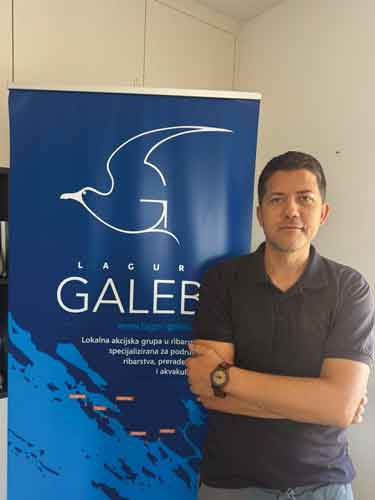
This article was featured in Eurofish Magazine 5 2026.

Community-led local development (CLLD) has long been a pillar of rural development in the EU. Under CLLD, local institutions, municipalities, civic bodies, and citizens come together in a local action group (LAG) to identify the challenges, set priorities, prepare a local development strategy, and implement solutions in their communities. Support for projects is available from EU funds subject to approval by the country’s managing authority.
In Tribunj, Croatia, as along other parts of the coast, fishing communities face several challenges, not least stagnant or declining catches of fish. This has led to calls to process the catch and thereby capture more of its value rather than allowing operators further down the supply chain to play this role. By supporting the creation of infrastructure, the FLAG (LAGUR) Galeb, a fisheries local action group based in Tribunj, has been assisting fishers through their producer organisations to seize more of the value of their catch. Established in 2016, Galeb covers the towns of Vodice and Skradin and the municipalities of Tribunj, Tisno, Murter-Kornati, and Pirovac in Šibenik-Knin County. Its membership brings public authorities and businesses together with civil society organisations, and includes the Adria fisheries cooperative in Tribunj. The FLAG’s role is to translate community-led local development into investments that respond to practical needs in fisheries, fish processing, and the local seafood market.
Ante Sladoljev, the president of Croatia’s national FLAG network from 2019 to 2025, is today the manager of the FLAG Galeb. He says one of the most persistent weaknesses in Croatian fisheries is fragmentation. Many fishers are accustomed to operating independently, even though closer cooperation could improve their bargaining position and access to investment. The advantages of cooperation are becoming increasingly visible, he says, but building confidence in collective structures takes time. Over the years, a growing number of Croatian fishers have recognised these benefits and joined cooperatives, several of which have subsequently obtained recognition as producer organisations. This status provides more favourable conditions for support from EU funds. Rather than treating them simply as organisations eligible for grants, the FLAG sees them as vehicles through which fishers can process and market their catch more effectively, while strengthening their position in the supply chain.
Adding value in Tribunj
The Adria fisheries cooperative provides a concrete example. With €110,000 in public support, a project financed through FLAG Galeb’s community-led local development strategy equipped the cooperative with a smoking chamber, a vacuum-packing machine, worktables, and equipment for hand-salting sardines and anchovies. Workers were trained in the new processes, while product and packaging design were also developed. The investment allowed Adria to introduce smoking and salting, launch new products, create one new job, and retain three existing jobs. More importantly, it addressed a problem Mr Sladoljev sees across much of the sector, namely that fishers often sell whole fish with little or no processing and therefore capture only a limited part of the final value.

With EUR110,000 of public support the cooperative Adria was supplied with several machines
(such as this smoking chamber) that enabled it to add value to the catch which in turn led to higher prices for the fishers.
They return from a fishing trip and then sell the catch without doing anything with it, he says. The result is pressure to catch larger volumes simply to cover costs. Processing the fish, on the other hand, enables the fisher to earn more from the same raw material and also creates products that can be sold beyond the narrow window immediately after landing. The cooperative model gives fishers a structure through which investments can be shared. Mr Sladoljev emphasises that cooperation does not eliminate the independence of individual businesses. Rather, it can provide a platform for activities that are difficult to finance or organise alone. For many fishers, joining a cooperative remains a significant step. Continued outreach is therefore needed to demonstrate that cooperation can strengthen their market position without compromising their individual independence.
Equipping restaurants to deal directly with fishers
One of Galeb’s most successful initiatives helped to retain a greater share of the value of the fish within the local community. To achieve this, the FLAG supported restaurants registered as first buyers of the fish with grants to improve their facilities. Tourism creates strong summer demand for seafood along the Croatian coast, but demand falls sharply outside the peak season. Restaurants may want to buy local fish during quieter months, yet without suitable refrigeration and storage facilities their ability to do so is limited. Galeb responded by allowing restaurants to apply for support to improve their infrastructure for receiving, preparing, processing, preserving, storing, and presenting seafood. The intention was to strengthen the direct relationship between local fishers and an important local market segment rather than sending catches through longer supply chains. The FLAG provided approximately €200,000 for investments in 17 restaurants under the measure. According to Mr Sladoljev, official fisheries data showed the quantity of fish bought by participating restaurants rising from about 4.7 tonnes in 2019 to 8.4 tonnes in 2022, an increase of roughly 79%. For the fishers, the advantage is that restaurants with better storage facilities can purchase fish when it is available, including outside the tourist season, and store it properly for later use. This can improve prices for producers through stronger demand and increased purchases of local fish. More generally it boosted the consumption of locally sourced food, reduced the carbon footprint of the fish due to the short supply chain, and retained jobs.
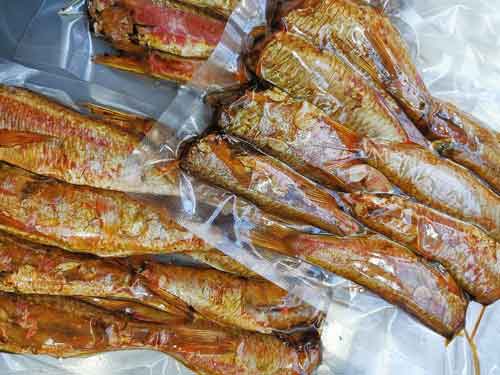
These headed, smoked, and skin-packaged fish were among the products
the cooperative started to sell.
The restaurant measure grew from a much smaller initiative. In 2017, FLAG Galeb launched “Fishermen Recommend”, a pilot designed around the idea that fishers were the ones who knew which restaurants genuinely buy and serve locally caught fish. The initiative created a quality label and a bilingual website presenting participating restaurants together with the fishers and vessels supplying them. The first pilot involved 12 restaurants and six purse-seine fishers targeting sardines and anchovies. Particular attention was paid to small pelagic fish because of their nutritional value and their importance for diversified seafood consumption.
The pilot cost around €5,000, but it attracted wider attention and was later presented as a good-practice example within the FARNET network. By testing the relationship between restaurants and fishers on a small scale, the FLAG identified the practical investment needs that later shaped the grant measure for restaurants acting as first buyers.
Building trust calls for a long-term commitment
That relationship is especially important in a sector where, according to Mr Sladoljev, distrust of outside organisations has often been strong. His own work with fishers, including projects involving WWF, has convinced him that trust is built through long-term involvement rather than one-off advice. Project support can extend from education and preparation of applications through implementation until an investment is completed. The only way to gain the trust of the fishers is to demonstrate that you are as invested in the project as they are, he says, and even then the relationship is fragile. There is considerable potential to develop and implement projects in this sector, as public aid can cover up to 100% of eligible costs for small-scale fishing, except in cases involving engine replacement or the first acquisition of a vessel by a young fisher. This preferential treatment reflects the sector’s social importance, its contribution to employment in coastal communities and the policy objective of encouraging sustainable fishing practices. The network of Croatian FLAGs has expanded considerably. Croatia had 14 FLAGs in the previous programming period and now has 23. He sees that growth as evidence that community-led local development through the FLAGS has been recognised as an effective way to have projects funded for the benefit of the local community. FLAGs, says Mr Sladoljev, have achieved a lot for the sector in terms of creating and retaining jobs as well as of boosting incomes, but the future of the programme is in doubt and in the next programming period it may be that individual countries can decide whether they want to continue with FLAGs or not. He and other FLAG managers are highlighting the programme’s achievements to relevant decision-makers and advocating for its continuation.
For Mr Sladoljev, the continuing challenge is to build on those results while persuading more fishers that cooperation can strengthen their independence as a group. In a fishery facing pressure from operating costs, changing markets, and environmental impacts that may be one of the most important forms of local development the FLAG Galeb can support.