This article was featured in Eurofish Magazine 5 2026.

A new floating research platform near Šibenik, Croatia is intended to study the everyday challenges of shellfish farming. The Smart Mussel Farm “Šibenka”, which officially opened at Martinska Bay on 15 June 2026, is one of the pilot sites being developed by the Centre of Excellence MARBLE.
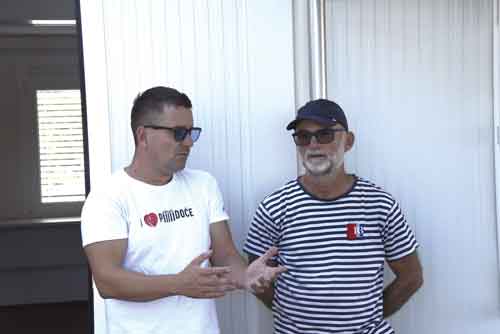
The purpose of Šibenka, a new floating research platform near Šibenik, Croatia, is to provide researchers and producers with a working mariculture site where sensors, underwater imaging, robotics, and experimental farming systems can be tested under commercial conditions. The project brings together the Ruđer Bošković Institute and DIH AgriFood Croatia with MARBLE, while Dalmatia Seafood provides an important link to the farming sector. Krešimir Kovač, director of Dalmatia Seafood, has been working with Neven Cukrov, senior scientist at the institute’s Division for Marine and Environmental Research, to identify the practical questions that the infrastructure should address. For Mr Kovač, the starting point was a list of problems familiar to fish and shellfish farmers in Croatia and elsewhere in Europe. The idea, he says, is to work through those problems one by one and use the MARBLE infrastructure to test possible solutions.
Understanding the factors affecting shellfish growth
This approach is particularly relevant in the Krka estuary, where shellfish farming takes place in a highly dynamic water column. Freshwater from the river lies above more saline water entering from the sea, while the thickness of these layers changes with the season and weather conditions. In winter, freshwater can extend several metres downwards. In summer, reduced river flow can allow warm seawater to penetrate more deeply. For mussel farmers, the choice of cultivation depth is therefore critical. Moving shellfish deeper can protect them from unfavourable surface conditions, but growth may slow because the most productive feeding zone is often closer to the interface between river and sea.
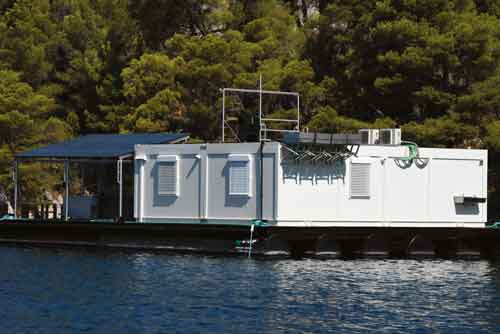
The research platform includes office and workshop space, scientific equipment,
cages for studying fish, and tanks for shellfish.
Understanding this variability is one of Šibenka’s main tasks. The platform is equipped for continuous environmental monitoring and real-time data exchange. Multiparameter probes can record water quality through the water column, while cameras, imaging sonar, acoustic systems, and a remotely operated vehicle provide information from around the farm. The research team can relate changes in temperature, oxygen, chlorophyll, currents, and other environmental conditions to the growth and condition of the shellfish.
A laboratory in the sea
The physical infrastructure comprises a platform of approximately 200 square metres, with an office and workshop unit of about 70 square metres. It is built on high-density polyethylene pontoons and combines solar panels with batteries for long-term energy autonomy. Experimental equipment includes a four-cage aquaculture pontoon and a separate Spanish-style raft from which shellfish lines can be suspended. A crane can lift culture units for inspection, while the remotely operated vehicle (ROV) can be launched for underwater work. The platform is mobile so that, if needed, it can be moved from its current location to take measurements in another part of the estuary.
For Dr Cukrov, an important part of the work is building long term datasets. The Ruđer Bošković Institute’s marine station Martinska near Šibenik has long monitored the estuarine and coastal environment, and its work has increasingly combined geochemistry with biological observations. An underwater camera that was initially used simply to count fish has, with newly developed artificial-intelligence software, become capable of recognising dozens of Adriatic fish species. Such observations, when repeated over several years, allow researchers to identify trends in the occurrence of particular species and to estimate whether populations are growing or shrinking.
Studying seabream predation
The ability to observe can also be applied directly to one of the shellfish sector’s persistent problems—predation by sea bream. Dalmatia Seafood has found that protective measures can work for a time, only for the fish to find a way around them. At Šibenka, cameras and sonar can be combined to detect fish approaching the farm and to study their behaviour. The longer-term ambition is to develop an early-warning system and to test acoustic deterrence methods, including low-frequency ultrasound. The platform will also allow researchers to examine how shellfish respond to different parts of the water column. Mr Kovač describes eight separate experimental tanks that can be supplied independently with water pumped from different depths. Flow and other parameters can be controlled, making it possible to compare the performance of shellfish exposed to different conditions while remaining in the marine environment. This should help establish which depths and flow regimes are best suited to mussels, oysters, or other species at different times of year.
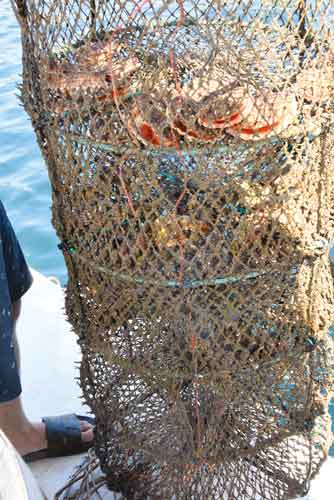
Researchers are investigating whether scallops can be cultivated both for
commercial production and to support the recovery of local biomass.
Biofouling is another practical issue on the research agenda. Organisms growing on ropes, rafts, baskets, and on the bivalves themselves compete for food and can reduce growth rates and meat condition. The platform includes a hot-water treatment system inspired by equipment used in France. Oyster baskets or other culture units can be exposed very briefly to water heated to 80–90°C, killing fouling organisms on the outside while leaving the shellfish unaffected by the short treatment. The researchers intend to test the method with oysters and mussels and assess whether it can improve performance under local conditions.
Exploring the cultivation of other species
The research programme is broader than the name Smart Mussel Farm suggests. Dalmatia Seafood has already carried out small-scale experimental farming of scallops, using spat collected from the wild and growing the animals towards commercial size. The species is native to the area and has historically been abundant in the deeper parts of the Krka estuary, but fishing pressure has reduced stocks. The partners hope that better collection and culture techniques could support production while also contributing to the recovery of local biomass. A Spanish-style suspended-culture raft at the pilot site will allow scallops and other shellfish to be tested under controlled conditions. The work builds on Dalmatia Seafood’s experience of farming mussels and oysters in the estuary. The company has deliberately tried to introduce more scientific monitoring into a sector that has traditionally depended heavily on experience and observation. Temperature, chlorophyll, oxygen, and other parameters are already being profiled through the water column to help explain differences between farming sites and seasons. Mr Kovač points out that neighbouring production areas of similar size can yield very different quantities of shellfish because depth, currents, and local environmental conditions vary considerably.
Šibenka is one component of a considerably larger research strategy. MARBLE, whose full name is the Centre of Excellence in Maritime Robotics and Technologies for Sustainable Blue Economy, is a Horizon Europe project running from 2025 to 2030 with an EU contribution of just under EUR 15 million. It is coordinated by the University of Zagreb Faculty of Electrical Engineering and Computing. Croatian participants include the Ruđer Bošković Institute (IRB) and DIH AgriFood Croatia, while the project has strategic partnerships with the Norwegian University of Science and Technology and Italy’s National Research Council. Its research encompasses maritime robotics, autonomous systems, the maritime Internet of Things, and digital twins, with aquaculture and fisheries among the sectors in which these technologies will be applied. Funding for the construction of the Šibenka infrastructure came through Croatia’s National Recovery and Resilience Plan for 2021–2026. The platform forms part of a network of MARBLE research facilities that also includes the Smart Marina in Rijeka and the IRB marine station Martinska. The latter combines shore facilities with an underwater communications network and equipment for testing autonomous vehicles.
Turning data into solutions
Mr Kovač stresses that the infrastructure has been designed around problems faced by the industry and is intended to remain in operation beyond the lifetime of a typical research project. For producers, that could ultimately mean better information on where to position shellfish, earlier warning of predators, and proven methods for dealing with fouling or changing environmental conditions. For researchers, meanwhile, Šibenka offers a permanent field laboratory where biological processes can be studied alongside new technologies. Scientific studies will help to make shellfish farming more predictable and perhaps lead to the development of tools farmers can use to improve yields which, in the long term, will contribute to a more productive and resilient European aquaculture sector.