This article was featured in Eurofish Magazine 5 2026.

Professor Johan Verreth has spent most of his professional life watching aquaculture change. Now, as European freshwater producers confront warmer water, tighter access to resources, stubbornly flat production, and an increasingly demanding market, his message is less about finding one transformative technology than about changing the way the sector thinks.
The contrast between European aquaculture production and developments elsewhere is stark. FAO estimates that globally farmed output of aquatic animals exceeded 100 million tonnes for the first time in 2024. In the EU, by comparison, total aquaculture output was about 1.05 million tonnes in 2023 and has fluctuated between roughly 1 million and 1.1 million tonnes since 2008. Freshwater fish represented 9% of EU aquaculture output in 2023, and production in that category was 14% below its 2008 level. Europe is also heavily dependent on imported seafood: its self-sufficiency rate for fishery and aquaculture products was only 38% in 2023.
A specialist in aquaculture, Professor Verreth’s career has taken him from Latin America to Southeast Asia and then to Wageningen University in the Netherlands, where he ultimately became chair of the aquaculture and fisheries group. After retiring from the university in 2017 he continued for several years with a WorldFish project and remains involved in academic review and scientific advisory work, as well as specialist publishing. His many years in the sector give him a useful vantage point from which to consider an industry under pressure from several factors, not least climate change, shifting consumer expectations, and the economics of production.
Climate is changing the equation
Prof. Verreth sees cold-water trout production as particularly exposed to impacts from climate change. Where summer temperatures become too high, he expects production conditions to become progressively more difficult, potentially favouring areas farther north. A 2024 study of temperate cold-water farms in central Europe concluded that 37–77% of the facilities examined could face suboptimal climate conditions in the future. Water scarcity is also no longer a southern European problem alone. The European Environment Agency says 28% of EU territory experienced water scarcity during at least one season in 2023, with climate change expected to intensify drought risks. For farms relying on flowing surface water or groundwater, competition for a resource that is also required for households, agriculture, and industry will increasingly influence where, and how, fish can be produced. For carp, the picture may be more ambiguous. A longer warm season could lengthen the period of active growth in ponds, Prof. Verreth argues, though only up to a point. Consumer demand and production economics may matter more than an extra few weeks of growth.
Recirculation aquaculture systems (RAS) can greatly reduce water dependence, give farmers tighter control over temperature and water quality, and improve opportunities to capture waste. But their pumps, filtration, oxygenation, and temperature management require energy, while capital and operating costs remain substantial. Moreover, such systems’ complexity adds to the challenges of deploying them. They are thus of little use for low-value species, but he expects recirculation aquaculture to continue to expand where the economics and fish welfare can justify it.
More research-based production
Along with continued intensification Prof. Verreth expects a shift towards production grounded more deeply in research. Where health management, for example, once centred heavily on pathology and diagnosis, he sees genetics, immunology, prevention, and vaccine development as well as research into feed ingredients becoming increasingly important. These priorities closely match the European Commission’s aquaculture strategy to 2030, which places resilience, environmental performance, knowledge, and innovation among its core areas for action. Yet he is wary of defining innovation too narrowly. Some technologies that could help aquaculture grow may appear further down the value chain. For example, better processing, packaging, and methods of preserving freshness could make farmed fish more convenient and attractive. Digital traceability could provide consumers with information about where a fish was raised and how the product was handled.
These developments could also help counter the reputational burden aquaculture carries in some quarters. Prof. Verreth points to perceptions of antibiotic use that can survive long after practices have changed. But while better communications could help create a more sympathetic narrative around aquaculture, the industry must also respond substantively to concerns over welfare, stocking densities, medicines, and environmental discharges. A study involving Spanish consumers found that science-based information produced a small but significant improvement in perceptions of aquaculture. The latest EU Eurobarometer also indicates that shoppers want concrete information: 69% of respondents considered the date of catch or harvest important, while production method and origin remain among the information they expect to see. At the same time, price has become the strongest influence on seafood purchasing decisions, implying that sustainability must still coexist with affordability.
Research into feed ingredients follows many different strands
When it comes to ingredients for fish and crustacean feeds, aquafeed manufacturers have already reduced the proportion of marine ingredients in many diets and continue to investigate algae, insect meals, microbial biomass, and food-industry side-streams. FAO similarly describes the future feed basket as a mixture of plant by-products, algae, insects, fish and animal by-products, and single-cell proteins. Prof. Verreth is especially interested in giving food-processing residues a second life. Brewery streams, bakery by-products, fish trimmings, and other materials may have potential but, as he says, this depends on more than overcoming the technical challenges of producing them in the requisite quality and quantity and at a competitive price. A recent editorial in One Earth (https://www.cell.com/one-earth/fulltext/S2590-3322(26)00180-6?lid=tk5tvhoynjfp), an online journal, discussing alternative proteins points out that producing protein from legumes, fungi, or fermentation may be technically -feasible but may also result in trade-offs between sustainability and nutritional value.
Circularity is an area where he believes Europe has something to learn from Asian aquaculture. His extensive work in Southeast Asia exposed him to farming systems in which different species or production stages can make use of nutrients generated elsewhere in the system. He cites examples from Vietnam where shrimp production is linked with organisms such as oysters and seaweeds, so that outputs from one stage become inputs for another. The European equivalent is often discussed under integrated multi-trophic aquaculture. Research confirms its potential to recycle nutrients, but commercial adoption in Europe has remained difficult because biological, regulatory, operational, and market constraints vary considerably between sites. Prof. Verreth therefore does not advocate trying to transplant Asian systems to Europe. What Europe should import, he says, is the mindset—a willingness among producers to innovate in their search for greater ecological balance.
A wider range of farmed species will depend partly on consumer acceptance
Diversifying the species mix could help European production expand. He mentions catfish, tilapia, jade perch, and Arctic char as examples of freshwater species that could occupy particular European niches. However, the decisive issue is whether farmers can produce it at a viable cost and persuade consumers to buy it. Europe’s large seafood import requirement creates an opportunity, but not every technically successful species will become a commercial one.
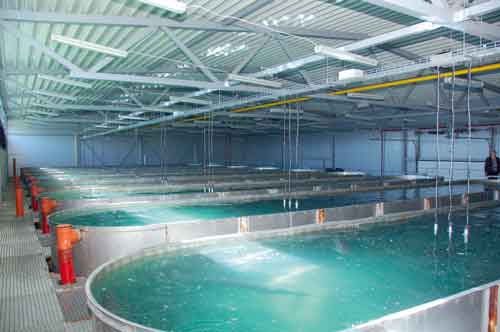
Recirculation aquaculture systems use little water and give greater control over a number of parameters,
but they are energy intensive and expensive to install,
which makes them suitable primarily for high-value species.
Prof. Verreth believes land-based production will expand, but he does not expect production to rival marine cages in volume for the foreseeable future. Among species where production has taken hold on land, he mentions yellowtail kingfish because relatively rapid growth reduces the payback period for the expensive infrastructure and provides the liquidity to cover operational costs. Atlantic salmon presents a tougher financial proposition because capital remains tied up through a longer production cycle. Research has demonstrated that market-size salmon can be produced entirely in freshwater RAS, but other studies continue to flag capital costs, energy demand, and biological problems such as early maturation as constraints. Climate change could nevertheless alter that equation. Cage farming faces its own exposure to warming waters and associated biological changes. RAS should therefore be seen less as the inevitable successor to cages than as one production model whose advantages become stronger under certain environmental, biological, and market conditions.
Other food production systems could be a source of inspiration
A strong proponent of research-based aquaculture, Prof. Verreth mentions several areas including genetics, fish health, nutrition, physiology, welfare, and production-system design, that show promise. Another field he would like to see receive greater attention is the design of more integrated and circular production systems. Here his thinking stretches beyond aquaculture. Looking at developments in terrestrial agriculture in the Netherlands, he sees researchers and farmers reconsidering monoculture and searching for production systems that encourage greater ecological balance. Greater diversity can reduce certain pest pressures and improve the functioning of the wider farming environment. These developments offer lessons for aquaculture and are in keeping with his conclusions from a lifetime in the sector. Namely, to look beyond the borders of aquaculture and not assume that answers must originate within the discipline itself. Examine how other farmers organise biological production, how other industries reuse resources, and how different regions combine species and production processes.