Water quality and flow in filters and fish tanks should be examined visually and frequently.Top plate of traditional trickling filter before water is trickling down through the filter media.

Chapter Five: Running a recirculation system
Moving from traditional fish farming to recirculation significantly changes the daily routines and skills necessary for managing the farm. The fish farmer has now become a manager of both fish and water, and the task of managing the water and maintaining its quality has become just as important, if not more so, than the job of looking after the fish.
The traditional pattern of doing a good day’s job on the fish farm and then going home has changed into tuning a machine that runs constantly 24 hours a day. Surveillance of the whole system ensures that the farmer has access to information concerning the state of the system at all times, and an automatic alarm system will call him if there is an emergency.
Make checklists of routine tasks
The most important routines and working procedures are listed below. Many more details will occur in practice, but the overall pattern should be clear. It is essential to make a list with all the routines to be checked off each day, and also lists for checking at longer intervals.
| Daily or weekly: | Weekly or monthly | 6 – 12 months |
|
Visually examine the behaviour of the fish | • Clean the biofilters according to the manual • Drain condense water from compressor • Check water level in buffer tank • Check amount of remaining O2 in oxygen-tank • Calibration of pH-meter • Calibration of feeders • Calibrate O2 probes in fish tanks and system • Check alarms – make alarm tests • Check that emergency oxygen works in all tanks. • Check all pumps and motors for failure or dissonance • Check generators and make a test-start • Check that ventilators for trickling filters are running • Grease the filter elements and bearings on mechanical filters • Search for “dead water” in system and take precautions • Check filter sumps – no sludge must be observed | • Clean UV sterilizer (see manual), change lamps yearly • Change oil and oil-filters and air-filter on compressor. • Check if clean inside (sump) the cooling towers • Clean biofilter thoroughly if necessary • Renew electrolyte, zinc, and membrane in oxygen probes • Rinse nozzles on drum filters |
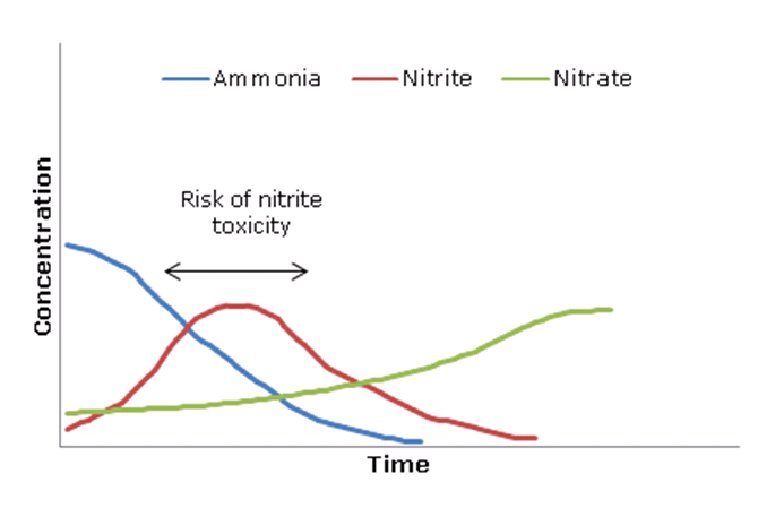
Managing the recirculation system requires continued registration and adjusting to reach a perfect environment for the fish cultured. For each parameter concerned there are certain margins for what is biologically acceptable. Throughout the production cycle, each section of the farm will be shut down and started up again for new batches of fish. These changes affect the system as a whole, but especially the biofilter is sensitive to alterations. In figure 5.3 the effect on the concentration of nitrogen compounds leaving a newly started biofilter can be observed.
| Parameter | Formula | Unit | Normal | Unfavourable Level |
| Temperature | OC | Depending on species | ||
| Oxygen | O2 | % | 70-100 | < 40 and > 250 |
| Nitrogen | N2 | % saturation | 80-100 | > 101 |
| Carbon Dioxide | CO2 | mg/L | 10-15 | > 15 |
| Ammonium | NH4 + | mg/L | 0-2.5 (pH influence) | > 2.5 |
| Ammonia | NH3 | mg/L | < 0.01 (pH influence) | > 0.025 |
| Nitrite | NO2 – | mg/L | 0-0.5 | > 0.5 |
| Nitrate | NO3 – | mg/L | 100-200 | >300 |
| pH | 6.5-7.5 | < 6.2 and > 8.0 | ||
| Alkalinity | mmol/L | 1-5 | < 1 | |
| Phosphorus | PO4 3 | mg/L | 1-20 | |
| Suspended Solids | SS | mg/L | 25 | > 100 |
| COD | COD | mg/L | 25-100 | |
| BOD | BOD | mg/L | 5-20 | > 20 |
| Humus | 98-100 | |||
| Calcium | Ca++ | mg/L | 5-50 |
The impact of fluctuations in different parameters depends on many factors
Fluctuations will occur for many other parameters of which the most important can be seen in figure 5.4. In some situations parameters may raise to levels which are unfavorable or even toxic to fish. However, it is impossible to give exact data on these levels as the toxicity depends on many things, such as fish species, temperature and pH. Adaptation of fish to the environmental conditions in the system will also influence the toxicity. The toxicity of the nitrite peak can be eliminated by adding salt to the system (see also Chapter Two in Eurofish Magazine EM1 2011). An indication of preferable levels for different physical and chemical water quality parameters in a recirculation system is shown in Figure 5.4.