This article was featured in Eurofish Magazine 1 2026.

Microplastics have become one of the most talked-about pollutants in the marine environment, partly because they are difficult to see and, once they are present, difficult to remove. In Albania the issue is being studied and measures to mitigate it are being implemented.
Microplastics are typically defined as plastic particles smaller than 5 millimetres, ranging from visibly small fragments down to fibres that look like specks of lint. These particles can be “primary” (manufactured small, for instance as industrial pellets), or “secondary”, formed when larger plastic items break down under sunlight, wave action, and abrasion. What makes microplastics particularly challenging is that they are durable by design, and common items can persist for decades or far longer in marine conditions. As larger items fragment, the total number of particles rises dramatically, increasing the chance that wildlife will encounter them. At the same time, many plastics contain additives, and they can also carry other pollutants on their surface, raising concerns about wider biological effects beyond the physical presence of a particle.
A product of the gradual disintegration of plastic waste
Microplastics are generated as plastic waste we recognise, such as bottles, bags, packaging, fishing gear, and cigarette filters, breaks down. Rivers and stormwater systems transport this material from towns, farms, industrial areas, and tourist sites to the coast. Once in the sea, microplastics can remain near the shore, settle in sediments, or circulate more widely, depending on currents, wind, and the density of the polymer. Importantly, not all microplastics behave the same way. A short, stiff fragment of polyethylene is not equivalent to a soft textile fibre, and a fresh, clean pellet is not the same as a weathered fragment that has spent years in the environment. This diversity is one reason why perceptions of the threat from microplastics swing widely. Broadly speaking, microplastics are clearly undesirable, they are widespread, and there is strong evidence of harm in many marine organisms, while some questions about long-term, population-level impacts are still being refined.
Marine animals can be affected in two main ways: through direct interaction, and through the knock-on consequences for feeding and health. Direct interaction includes ingestion. Small particles can be mistaken for food or swallowed incidentally when animals feed. Studies and monitoring work in the Adriatic note the broader toll of plastic pollution on marine life, including birds, fish, and marine mammals, and this harm begins with the larger, visible items that later generate microplastics. Once ingested, microplastics may cause irritation, blockages in smaller organisms, or a false sense of fullness that reduces feeding. Even when a particle passes through the gut, repeated exposure can cost energy, and energy is the currency of survival and reproduction.
The second pathway is indirect. Microplastics can interfere with how food webs function, especially when tiny organisms ingest them and transfer them upwards. They may also act as carriers for chemicals, either from additives used in plastics or from pollutants that adhere to their surfaces. However, microplastics are not an acute poison in the way that a spill of a toxic chemical can be. The larger concern is chronic exposure across many species, over time, in waters that are already under pressure from overfishing, habitat loss, nutrient pollution, and warming. In that context, microplastics add another stressor that managers cannot ignore.
Several factors contribute to the incidence of microplastics in the sea
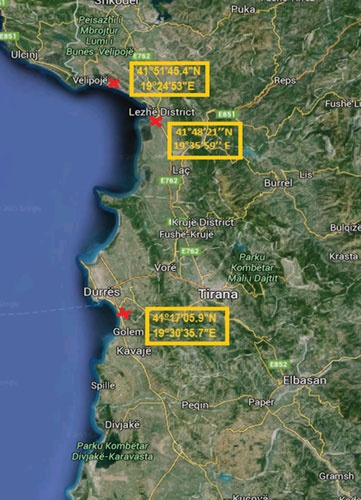
Albania’s coastline on the Adriatic is relatively short compared with some Mediterranean neighbours yet coastal development, growing tourism, and uneven waste management all contribute to the problem. Research in Albania has highlighted the role of major river mouths as conduits for plastic and microplastic pollution into coastal waters, including the Erzeni River delta. Work focused on the Ishmi River likewise underlines the link between heavily polluted river basins and the coastal environment, with the Ishmi described as Albania’s most polluted basin by the National Environmental Agency. A study on the coastline of Durrës documented heavy macroplastic contamination in parts of the area, with the Ishmi beach section classed as “extremely dirty” under a standard coastal litter index, which the authors linked to the proximity of a river outflow. Further north, surveys of Velipojë and Shëngjin, undertaken just before the tourist season, found that plastics dominated shoreline litter, with cigarette butts and single-use items strongly represented. Cigarette filters are an especially stubborn problem: they are widely discarded, they fragment over time, and they contribute directly to the microplastic load in coastal areas.
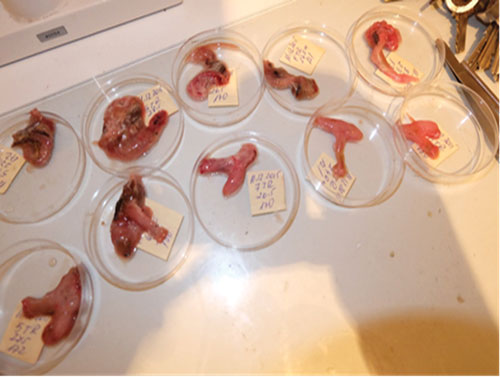
Analysis of fish guts by a team from the Aquaculture and Fishery Laboratory, Agricultural University of Tirana revealed the widespread presence of microplastics.
In Albania several additional factors amplify the issue. One is the persistence of open dumping and insufficient separation of waste streams, which reduces the chance that plastics are captured for recycling before they enter the environment. Another is the density of coastal use in summer, when consumption rises sharply and waste services can be stretched. Beach litter findings from tourist coastlines illustrate how quickly everyday items accumulate when prevention and enforcement are weak. According to the UNEP the Mediterranean is a global hotspot for plastic pollution because it is semi-enclosed, heavily populated along its shores, and subject to intense coastal activity. A study focused on the Ishmi River notes that a WHO-linked assessment placed Albania among the most problematic Mediterranean countries, reporting a very high share of plastic waste left untreated.
Microplastics found widely in fish guts in Tirana university study
A separate Albanian study on microplastics at the Erzeni River mouth reports very large national plastic waste generation, with limited recycling and measurable leakage to the sea via river discharges, capturing the structural nature of the problem. Under the DeFishGear project (2013-15), Jerina Kolitari, head of the Aquaculture and Fishery Laboratory, Agricultural University of Tirana examined the presence of microplastics in the guts of different commercial fish and shellfish species in the Adriatic. She found particles in all the samples irrespective of where along the coast they were caught. The microplastics were categorised into fragments, filaments, foams, granule, pellets and other, and the predominant type found in the samples was filaments followed by fragments. Among her conclusions was that the density of microplastics in the marine environment was a more important factor than the actual fish habitat, e.g. pelagic or benthic.
Reasons for optimism
Albania is not starting from scratch to address this issue. The research base is expanding, with recent studies explicitly describing themselves as early contributions to building the evidence needed for a national picture of microplastics and their sources. Better data makes it easier to prioritise hotspots, track progress, and design interventions that are proportionate. Moreover, Albania has been working to align waste legislation with European approaches, including national planning that sets targets for improved recovery of key household waste streams by 2035. Civil-society and policy analysis also points to strengthened legal measures on plastic waste, alongside efforts to improve enforcement and compliance. In parallel, Albania has introduced restrictions on certain single-use plastic bags, a practical step aimed at cutting one of the most visible, easily avoidable sources of leakage.
International and regional frameworks also benefit Albanian efforts. The Mediterranean has a dedicated regional plan on marine litter under UNEP/MAP, designed to coordinate action across countries that share the same sea and the same currents. Much of the value of cleaning up is lost if prevention is not widespread across the region, and much of the benefit of prevention grows when neighbouring countries collaborate. There is also an opportunity to connect marine protection with economic interest. Tourism depends on clean beaches, and fisheries depend on healthy ecosystems. Studies of Albanian tourist coastlines stress the importance of competent monitoring and local stakeholder engagement in reducing plastic pollution. Practical measures, such as better bins and collection schedules in peak season, targeted campaigns to reduce cigarette butt litter, improved riverbank management upstream, and support for recycling markets, can reduce the flow of plastics into rivers and, ultimately, into the sea.
Albania’s waters will not become microplastic-free overnight, but the direction of travel is clear. The combination of growing scientific attention, clearer policy, and more visible public discussion creates a realistic basis for progress, provided that enforcement, infrastructure investment, and everyday behaviour move together rather than in isolation.