This article was featured in Eurofish Magazine 6 2025.
Although there has been considerable success in efforts to make fishing more sustainable, it has not yet been possible to significantly reduce the proportion of overfished stocks worldwide. Design changes to fishing gear can help achieve this urgent objective. Sometimes even small changes to the nets are enough to make them more selective. What ideas are currently emerging?
Fisheries make an important contribution to the humanity’s protein supply, but they should be operated more sustainably. This means organising fishing pressure and catch volumes in such a way that the reproductive capacity of fish stocks is ensured, the environment is not irreparably damaged, and fishing methods are improved to reduce unwanted bycatch. Around the world, the fishing industry and the scientific community are collaborating to develop solutions that make fisheries more sustainable, as well as socially and economically equitable. A key focus of these efforts is the reduction of bycatch, pursued through two
main approaches:
- Reorienting fisheries management to better preserve the reproductive potential of fish stocks, for example, by imposing restrictions on fishing effort or implementing spatial and temporal closures of certain marine areas and habitats, such as seagrass beds.
- Introducing technical improvements to fishing gear and methods to enhance their selectivity.
In some sectors of the fishing industry, such as shrimp trawling – where unwanted bycatch is often high – bycatch reduction devices (BRDs) are already widely used in fishing gear. These devices typically consist of diagonally arranged, fine-meshed barrier grids or nets positioned within the tunnel just before the codend. While allowing slender shrimp to pass through, they prevent larger bycatch species from entering and guide them out through escape hatches. BRDs come in various sizes and designs, tailored to the specific fishery and the potential bycatch species found in a given fishing area. However, such modifications are not always practical or feasible. For instance, no effective BRD has been developed for driftnets, which were commonly used in tuna fishing in the past. These nets – often stretching several dozen kilometres and drifting like impenetrable walls in the ocean – frequently became lethal traps for countless fish, seabirds, and marine mammals. Sharks, albatrosses, sea turtles, dolphins, and other species have become entangled in the nets, often dying in agony. As no solution to this problem was found, driftnets were banned for deep-sea fishing in 1992 by a United Nations (UN) resolution, which has also been enforced in European Union (EU) waters since 2002. Although violations of the ban are still occasionally reported (e.g. in the Indian Ocean), the driftnet issue has largely been resolved, contributing to a slight improvement in the sustainability of fishing.
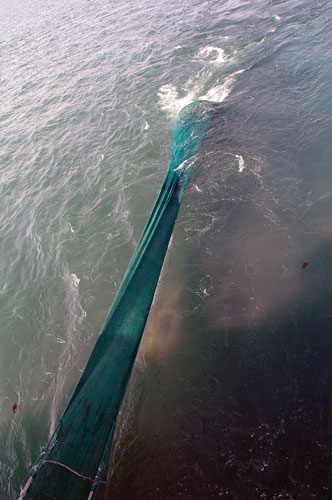
In trawling, bycatch rates vary depending on the area of operation and the target species.
They are generally higher near the seabed than in pelagic fishing.
Regional gillnets, often considered a smaller version of driftnets, are now facing similar criticisms. Unlike driftnets, which typically drift freely in the sea, gillnets are anchored in a specific location. In fact, gillnets have several positive characteristics that are quite desirable. They fall into the category of “passive” fishing gear, meaning they do not require energy to be dragged through the water, making them more climate-friendly. They are also relatively selective, as the size range of the target species can be predetermined by the choice of the mesh size (although it remains possible to catch fish of similar size and shape). Criticism of gillnets in the Baltic Sea is primarily driven by the occasional bycatch of diving seabirds (such as auks, common scoters, long-tailed ducks, and common eiders), which forage for mussels and other organisms near the seabed or hunt for fish, as well as seals and porpoises. Their feeding grounds are also key areas for gillnet fisheries. Even dolphins and porpoises, which use acoustic signals to navigate underwater in a manner similar to bats, do not perceive the nets as an impenetrable barrier, as their thin nylon threads produce only a very weak echo. This increases the likelihood of them becoming entangled and drowning.
Solutions should be as simple as possible
One approach to better protecting the porpoise, also known as the harbour porpoise, is to improve the reflective properties of the nets so that they can be recognised as barriers. In the practical implementation of the project, researchers came up with the idea of gluing small transparent acrylic beads, about the size of a chickpea, at regular intervals onto the nets. This significantly enhances the echo of such ‘pearl nets’, allowing marine mammals to avoid these dangerous obstacles.
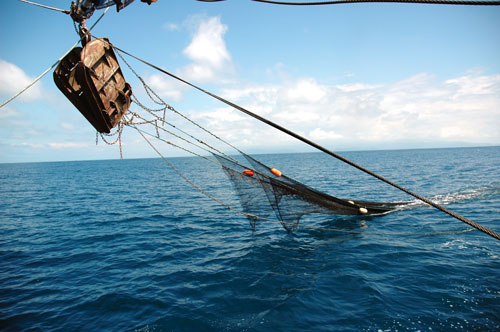
Shrimp fishing in tropical waters is typically characterised by particularly high bycatch rates.
In extreme cases, 1 kg of shrimp may be accompanied by up to 15 kg of bycatch.
Another way to make bycatch-intensive fishing gear more visible in the water is through the use of light. A comparative study of unlit and lit gillnets over several months demonstrated that green LED lighting significantly reduces nocturnal bycatch. Lighting the nets led to a 95% reduction in shark bycatch biomass, an 81% reduction in Humboldt squid, and a 48% reduction in unwanted species. Nearly twice as many loggerhead sea turtles were caught in conventional nets compared to those with lighting. Additionally, there was another benefit: lighted nets could be collected much more quickly in the dark of night. Operational efficiency is crucial, as it may encourage fishers to switch to lighted nets. Although these nets are easy to handle, the situation is not so straightforward, as they are relatively expensive and require constant recharging during operation. Nevertheless, the study has compellingly demonstrated that green LED lighting could be a viable technology for reducing bycatch in gillnets.
Regional solutions to a global problem
Bycatch is indeed a global problem. Regardless of the fishing method, nearly every fishery has to contend with it. The Food and Agriculture Organisation (FAO) of the United Nations estimates that almost 7 million tonnes of fish bycatch are caught unintentionally and discarded every year worldwide. As previously mentioned, the bycatch rate in industrial shrimp fishing in tropical waters is particularly high, accounting for more than a quarter of all discards globally. It is therefore unsurprising that research and development efforts are focused on this sector of the fishing industry, although many ideas and solutions can, of course, be applied to other fisheries. Some ideas are relatively simple and easy to implement, while others are more demanding and technically complex. For example, almost all larger Australian shrimp trawlers have water tanks on the back deck to keep the fish alive during sorting. This way, the unwanted bycatch has a better chance of surviving after being discarded into the sea.
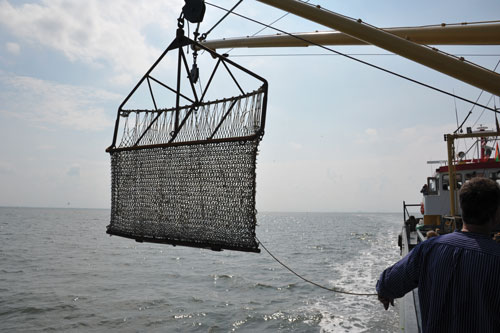
When collecting oysters, scallops and mussels, dredges are commonly used,
which are towed close to the seabed.
Of course, it is even better if bycatch is already sorted in the fishing gear and does not come on board in the first place. Fishing experts have developed various devices to allow so-called ‘non-target species’ to escape from trawl nets. These range from larger mesh sizes, through which small fish can escape, to grid frames made of vertical bars that prevent larger fish and other protected species from entering the net, instead guiding them out through escape hatches. In this way, for example, the capture of sea turtles in trawl fisheries has been significantly reduced. All sea turtle species are considered highly threatened or endangered, with six of the seven species worldwide having been on the International Union for Conservation of Nature (IUCN) Red List of Threatened Species since 2003. The mandatory use of Turtle Excluder Devices (TEDs) in shrimp fisheries in the Gulf of Mexico and the south-west Atlantic has ensured that at least 97% of turtles are safely released from trawl nets. Similar efforts are being made in other regions of the world. For example, the Southeast Asian Fisheries Development Centre (SEAFDEC) has developed the Thai Turtle Free Device (TTFD), a specially designed escape hatch better suited to local shrimp fishing conditions. It is already in use in several Southeast Asian countries, including Thailand, Indonesia, Malaysia, and the Philippines.
Greater focus on species-specific behaviour
Optimising the selectivity of fishing gear is a key aspect of sustainable fisheries management. The main challenge is to minimise bycatch as much as possible without reducing the catch potential of the gear, i.e. without significant losses of target species. Moreover, the practical adoption of new gear depends on its ease of use, efficiency, durability, and affordability for fishers. From a fishing technology perspective, major breakthroughs are rare; often, small adjustments produce the desired effect. Therefore, technical improvements primarily focus on refining mesh sizes and shapes to better match the size and body contours of target species. Juveniles with round-oval body cross-sections can only pass through the mesh if it remains fully open and does not become compressed into narrow slits under pressure when the net is pulled. The placement of escape hatches in the trawl is also crucial. For some species, larger meshes and escape grids positioned towards the front of the net are most effective, while for others, they work better when placed closer to the codend. There is rarely a single solution that meets all requirements; instead, a series of small modifications can collectively achieve the desired outcome.
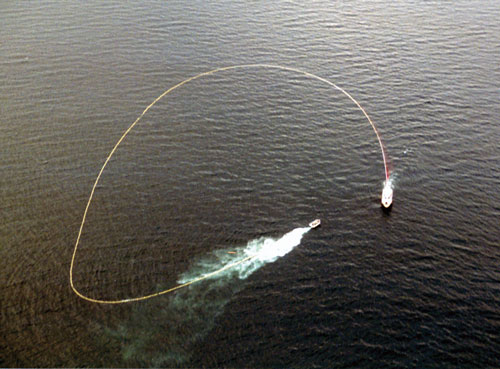
The use of purse seines requires the precise location of rewarding schools of fish,
which are then encircled with the surrounding net.
Some fishing gear innovations are based on the different behaviour of fish species. For example, cod tend to swim upwards in a trawl, whereas flatfish swim downwards. This insight has led to developments such as CODEX (COD EXcluder), where a guide net within the trawl tunnel directs cod upwards towards an escape opening in the upper section of the tunnel. Another example is the ROOFLESS net, in which the net in the upper part of the tunnel has been completely removed, creating an escape opening several metres wide. Tests have shown that nearly three-quarters of the cod escaped through the open roof of this convertible net, while flatfish, the actual target species, remained largely unaffected, with minimal loss of catch.
Innovative smart trawls that integrate artificial intelligence, stereo camera technology, and selective fishing mechanisms represent the state of the art of bottom trawl fisheries. Together, these components have the potential to drastically reduce bycatch while significantly enhancing both the profitability and sustainability of fishing operations. The smart technology is positioned just before the codend of the bottom trawl, where every fish approaching is captured by the camera. Using image recognition, the AI identifies the species and determines its size. Based on this analysis, the system then decides whether to open the rotating gate of the codend or to divert unwanted species away from the net. Currently, this system can process up to 100 fish per minute. While smart trawls are not yet fully ready for large-scale practical application, the technology has the potential to revolutionise the industry. Whether it will be suitable for mass production in the future will, of course, depend on its purchase price and operating costs.
Advantages and disadvantages combined in one fishing method
Depending on the technique used, angling can be both a sustainable fishing method and a high-risk source of bycatch. For instance, trolling and pole-and-line fishing, both of which are individually and manually controlled, are considered stock-friendly and environmentally responsible. Each fish is brought on board individually, removed from the hook immediately, and any unwanted bycatch can be quickly returned to the water. Seabirds often mistake the baited hooks for prey as the gear is deployed or hauled in, becoming entangled in the lines and drowning. Albatrosses, petrels, and several other bird species are particularly at risk. A relatively simple, effective, and inexpensive method of protecting these birds is the use of bird-scaring lines, which act as flapping deterrents. Brightly coloured streamers are deployed from the stern of the ship, creating a curtain over the area where the longline with hooks and bait is set and retrieved. The several-metres-long, wind-driven streamers deter birds and prevent them from accessing the baited line beneath. In Namibia’s hake fishery, where demersal longlines are used, the introduction of these streamers – a relatively straightforward measure – has reduced seabird mortality by 73–95%.
Purse seines often exceed their reputation
Less successful, but still quite effective in protecting birds, is the Scarybird – a simple device that has been tested in the Portuguese artisanal purse seine fisheries. The Scarybird is a bird of prey-shaped flying object, akin to a kite that children and surfers enjoy flying in the wind. The device can be attached either to the fishing vessel itself or to a buoy, which is then placed within the purse seine. As soon as the silhouette of the supposed predator starts to hover over the fishing gear, many birds are deterred from the “dangerous” area. In practice, it has been shown that the number of gulls can be reduced by more than half, and the number of gannets approaching the vessel and equipment can be reduced by almost three-quarters. This deterrent is effective and can significantly reduce bird bycatch.
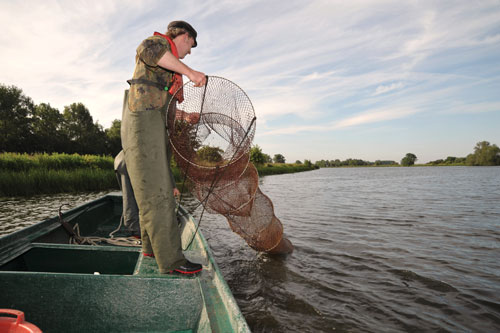
Basket traps work according to the trap principle. The catch is taken out of the water alive so that unwanted bycatch can be released back into the sea unharmed.
Purse seines are often criticised by environmental activists, particularly in connection with fish aggregating devices (FADs), which attract many marine species. However, they are more selective than is often assumed. On the one hand, purse seines are only deployed when a sufficiently large and rewarding aggregation of animals from the target species has been located. On the other hand, there are now methods that allow accidental bycatch, such as dolphins, small cetaceans, and sea turtles, to escape from the encircling net. The backdown method, for example, is quite effective in providing these animals with a safe escape route, especially when combined with a small-meshed net liner (medina panel). In this method, the net is stopped, and the motor is switched into reverse, creating a current that reshapes the net into a long channel in the water, through which unwanted species can escape. The backdown method has contributed significantly to the reduction of bycatch mortality of small cetaceans in purse seine fisheries in the eastern tropical Pacific. For smaller target species in purse seine fisheries, such as herring, mackerel, or anchovy, larger meshes in the upper part of the net wall allow undersized juveniles to escape as the net bag becomes more constricted when the fishing gear is hauled in.
There is, therefore, not just one solution for all problems in fisheries, but rather numerous possibilities for making fishing gear more selective and sustainable. However sensible such developments may be in theory, they can only be effective in practice if they are applied as widely as possible. This is usually best achieved through participatory approaches, where fishers are involved in the projects from the development phase. After all, the success of many good ideas ultimately depends on their willingness to abandon their usual and familiar methods in favour of new fishing gear. A great idea is only great if it is accepted and actually adopted in practice.
Manfred Klinkhardt