

 Capital: Rome
 Population: 58,9 million (2025, Eurostat)
 GDP: €2,20 trillion (2024, Eurostat)
- GDP/capita: €37 310 (2024, Eurostat)

Overview of the Italian fisheries and aquaculture sector



Marine fisheries

Italy’s coastline spans 9.136 km, making up 8,75% of the total EU coastline. The surface of the coastal regions, in line with the Eurostat definition, is 181.289 km, approximately 10% of the EU total and 60% of the national territory. Although the fishery sector’s contribution to national GDP remains limited, a little over 0,05%, it is more significant in certain regions, particularly the south.
Fishing in Italy takes place along the entire coastline. In 2024, national catches accounted for 117.530 tonnes worth €636 million. The size of the Italian fleet decreased steadily over the last decade; however, numbers have been levelling out recently. In 2024, 11.565 vessels were registered. The fleet is highly diversified with a broad range of vessel types targeting different species, predominantly in the Mediterranean Sea. Over two thirds of the fleet is made up of small vessels, less than 12 meters in length.
Small-scale fishers use passive gears and make day trips with a crew of one or two. The gear types that are most commonly used are: surrounding nets, bottom trawl nets of different dimensions, midwater trawls (volanti), towed dredges (draghe idrauliche), and trammel nets. Traps and longlines are also used by the small-scale fisheries fleet, including drifting longlines which are widely used today to catch large pelagic fish.
Crustaceans and molluscs are the largest contributors to turnover with 25% of the total value. Other valuable species groups are cephalopods (14%), and small pelagics (11%).
About 28% of the landings in 2024 consisted of molluscs, predominantly striped venus (Chamelea gallina). Other important commercial landings included small pelagics (25%) with anchovy being the main landed species followed by sardines as well as crustaceans, such as deep-water rose shrimp (Parapenaeus longirostris) and spottail mantis shrimp (Squilla mantis) as well as cephalopods mainly cuttlefish, squid, and octopus. Tuna also plays an important role in catches. The landing composition of marine fisheries is very heterogeneous, reflecting both the different gears in use, various fishing grounds, and the high biodiversity of aquatic resources.
Aquaculture
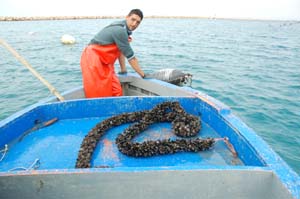
Aquaculture in Italy is based on a long tradition and history. It is characterized by a high level of specialisation and large-scale production. Out of 30 species, production is dominated by Mediterranean mussel (Mytilus galloprovincialis), Japanese carpet shell (Venerupis philippinarum), and rainbow trout (Oncorhynchus mykiss). Italy is a major producer of Japanese carpet shell in Europe. European sea bass (Dicentrarchus labrax) and gilthead sea bream (Sparus aurata) are the major marine-farmed finfish species.
Traditional extensive aquaculture is still carried out in the “valli”, brackish lagoons – especially in the northeastern regions. More modern aquaculture techniques for marine species include onshore intensive farms, cage systems in the sea (mariculture) and in the case of shellfish, cultivation on ropes and bags (mussels) or directly on the intertidal substrate (clams). Marine aquaculture includes both shellfish (mussels and clams) and finfish, freshwater aquaculture mainly consists of rainbow trout farmed in raceways. Aquaculture is developed all along the Italian coasts, with higher density along the Adriatic.
High levels of specialisation and know-how, a high degree of industrialisation and large‐scale organisation are key features of the Italian aquaculture sector.
In 2023, the total output of the Italian aquaculture sector amounted to 129.719 tonnes worth €616,3 million. In the shellfish sector, Mediterranean mussel contributed to 44% of the total aquaculture volumes and 14% of the value, while Japanese carpet shell contributed to 17% volume and 32% value. Finfish farming is divided into freshwater fish species and marine species. Freshwater finfish farming takes place in the north and central regions of Italy. The output of freshwater farmed fish amounted to 37.334 tonnes, most of which was rainbow trout (34.143 tonnes), followed by sturgeons (1.098 tonnes). Production of marine farmed fish amounted to 13.219 tonnes with gilthead sea bream (7.482 tonnes) and sea bass (4.821 tonnes) as the main farmed species.
In 2023 the number of aquaculture enterprises (including hatcheries, fattening for consumption, sport fishing lakes, breeding fish and nurseries) totalled 3.690, located mainly in Veneto, Emilia-Romagna, Piedmont, and Lombardy. Farms intended for fattening for consumption numbered 1.505, of which 63% are oriented towards the production of molluscs, 36% fish and 1% crustaceans. At a territorial level, in addition to large farms located in Veneto (molluscs and fish), shellfish farms emerge in Emilia-Romagna and Puglia. Italy’s aquaculture sector is dominated by small enterprises with less than five employees.
Processing
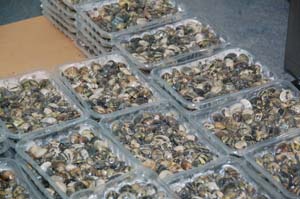
Italy’s fish-processing industry plays a significant role in the national economy. In 2023, it was valued at €1,8 billion and produced 224.932 tonnes of fish products. Key outputs include processed tuna, totalling 82,550 tonnes, with canned tuna particularly popular, alongside canned anchovies. Frozen whole marine fish also represents an important segment. Within the finfish category, species such as salmon, herring, anchovies, and sardines are processed in a range of formats mainly for fillet production, but also include products combined with other foods. In 2022, the number of processing companies was 445, and 6.745 people were employed in the sector. More than half of the companies are concentrated in the southern regions of Italy, led by Sicily. While among the regions in the north, Veneto has the highest number of processing companies.
Trade
Italy is one of the largest markets for fisheries and aquaculture products in Europe, and the country meets the majority of its demand through imports. In 2024 it was the fifth largest market for imported fish and seafood in the world in terms of value, and the second largest among European Union (EU) countries behind Spain. Imports of fishery and aquaculture products for human consumption reached 1,11 million tonnes with a value of €7,6 billion in 2024. Spain is the main supplier of fisheries and aquaculture products for the Italian market with a 22% share of total import value in 2024. Sweden (7%), the Netherlands (7%), France and Denmark (5%) were also important EU suppliers. Salmon is the main imported product with 17% of value, followed by squid (8%), and skipjack tuna (7%).
The trade balance is heavily negative at €6,4 billion, as exports only reached 179.182 tonnes with a value of €1,2 billion. Germany (12% of value), Spain (11%), France (8%), and Croatia (5%) received the vast majority of Italian exports of fisheries and aquaculture products in 2024. The main exports from Italy in terms of value are skipjack tuna (20%) and prepared/preserved fish products (9,3%). Trout and gilthead seabream are the most significant live/fresh fish exports.
Consumption
In 2022, consumption of fish and seafood products amounted to 29,0 kg per capita. Gilthead seabream, mussels, salmon, and European seabass are the five main fresh species consumed by households in Italy. Yellowfin tuna, squid, skipjack tuna and cod are other commonly consumed products.
Publications
Useful Links for Italy
- Ministry of Agriculture, of food sovereignty and forests
- Association of Italian Aquaculture
- National Institute of Statistics
- EuroFishmarket
- National Research Council for Marine Science
If any of the above listed links do not work or if you have a relevant link to add, please send us an email here.