This article was featured in Eurofish Magazine 4 2026.

On the northern tip of Denmark, where the Skagerrak and Kattegat meet, Skagen Salmon is attempting to prove that salmon can be successfully farmed on land using a business model that delivers high quality with low environmental pressure.
Globally, only a handful of companies currently produce market-sized salmon on land. BCG, a consultancy, estimated in a 2024 report1 that there were some 100 projects worldwide of which only a minority had completed a harvest or even reached construction. Atlantic salmon farmed in sea cages makes up more than 90% of the roughly 2.7m tonnes of salmon farmed around the world. The technology is tried and tested and has shown itself to be commercially viable.
Farming salmon in cages has environmental costs
However, over the years it is increasingly apparent that farming salmon in marine cages has several negative environmental impacts. Researchers from the University of Exeter in a 2024 paper2 point to, among others, the local build-up of uneaten feed and excreted wastes leading to eutrophication, the accumulation of parasitic sea lice, and the influence of drugs used in the production on non-target species. Moreover, escapes from the cages may affect wild salmon populations. Farming sites at sea are often far from markets, adding to emissions generated by the transport of fish. For producers, climate change is also a risk factor as it causes water temperatures to rise which in turn increases the risks from parasites and diseases as well as harmful algal blooms. Weather patterns have also become more unstable, with more frequent and intense events such as storms and heatwaves. In the Norwegian salmon industry the Norwegian Veterinary Institute3 estimated mortality from all causes among fish transferred to sea at 15.4% in 2024. There are thus several reasons to consider other production models, of which RAS (Recirculation Aquaculture Systems) are the most widespread.
At Skagen Salmon in northern Denmark, Jacob Veiss, the CEO, hopes that successfully farming salmon in RAS will not only benefit his investors but also serve to inspire other companies to grow salmon this way. A cleaner way to farm salmon has limited value if it remains a niche project. The company produces around three thousand tonnes a year, he says, a tiny fraction of global salmon supply. The positive environmental effect will therefore be modest unless global production using this technology can be scaled up. The broader ambition is to demonstrate that land-based salmon farming can work technically, commercially, and environmentally. If investors, producers, retailers, and consumers accept the model, the effect could spread far beyond Skagen. There are two things we need to prove, says Mr Veiss. One is that we can produce salmon in a way that is as sustainable as possible, with good quality. The other is that it is financially sustainable. If we fail on either count, there is no case. But the omens are good. The BCG report estimates land-based volumes to reach close to 200 thousand tonnes by 2030 or 5-6% of global volume.
RAS technology enables control of all production parameters
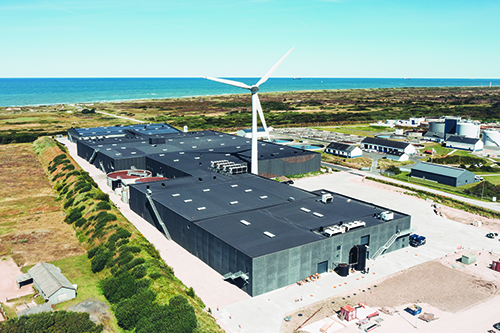
In Skagen, the company’s 28,000-square-metre facility is built around RAS technology. Seawater is taken from the Skagerrak, cleaned, circulated through the farm, and discharged after treatment. Freshwater from the municipal water supply is used in the hatchery. The land-based system gives the company far greater control over waste, water quality, disease risk, and escapes. The water is recirculated, with a small share of fresh water introduced in each cycle. Waste, uneaten feed and excreted matter from the system, is collected and supplied to a nearby biogas plant to produce energy. There are no sea lice treatments, no escapes, and no antibiotic use in production. The fish are vaccinated before entering the saltwater phase to reduce the risk from viruses, but primarily it is the controlled environment that sharply reduces exposure to many of the disease and parasite challenges associated with open sea farming. On the other hand, the cleaning and filtration systems are complex, expensive to install and operate, and sensitive. They lie at the heart of Skagen Salmon’s production and malfunctions here, which have been known to occur at other producers, can have huge repercussions.
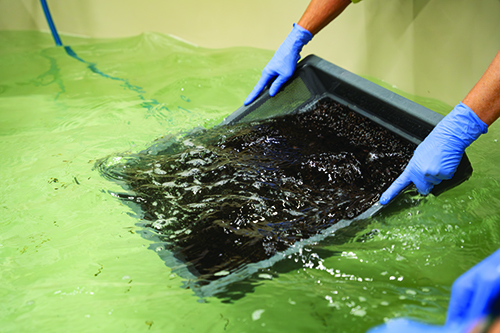
From the hatchery to the start feed area salmon fry are moved manually.
All subsequent transfers of the fish use systems of pumps and pipes.
The company holds ASC certification for both production and chain of custody, and the production procedure allows it to claim an exemption from the Danish Veterinary, Food, Agriculture, and Fisheries Agency’s freezing requirement when, for example, the fish is destined for sushi. Mr Veiss connects these qualities to the production system itself. In tanks, the current can be controlled. Making the fish swim against the water flow influences muscle development and fat content. We can exercise our salmon through the full life cycle, he says, resulting in a shorter, more muscular fish with leaner flesh and, for some, better organoleptic properties. Mr Veiss acknowledges that the concept of product quality depends partly on the customer. For instance, a sushi chef who prefers fattier fish may not share the view that leaner salmon is better, while for other customers the reverse may be true. The company’s target for its production is those consumers, chefs, and retailers who are prepared to pay for a fish that differs from conventionally farmed salmon in eating quality and environmental profile.
A premium branded product rather than an anonymous generic
Mr Veiss argues that salmon has long been treated too much like a commodity. Skagen Salmon wants its name visible on packs, menus, and processed products, either as a brand or through co-branding. The company sells head-on gutted fish from its own slaughterhouse, but it has chosen not to build filleting or smoking facilities on site. Space in Skagen is too valuable, he says, so if the company expands physically, it will most likely use the land for growing more salmon. Processing is therefore handled through partners. In Denmark, the company works closely with a processor in Hirtshals. In Sweden, a partner sells a range of products including fillets and smoked items under, or alongside, the Skagen Salmon name. In Germany, the company is working with Peter Niemann, a Michelin-starred chef with access to higher-end foodservice channels. The strategy is to find partners who share the same values, help them with logistics and product form, and ensure the Skagen Salmon identity reaches the end customer. A high quality, premium priced product is the inevitable consequence of farming in a RAS, a system that requires high capital investment for heavy equipment, pumps, filtration, cooling, oxygenation, monitoring, and strict compliance with environmental regulations. These costs need to be covered by the price otherwise the production is not viable.
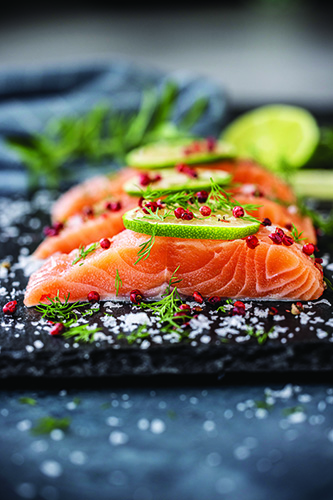
Among the company’s customers are up-market restaurants,
where chefs create signature dishes from the high-quality fish.
In terms of challenges energy is the sharpest for this type of venture. The company can clean water and reduce marine discharges, but producing salmon on land consumes large amounts of energy. Skagen Salmon is conscious of this and therefore generates part of its electricity through solar panels and its own wind turbine. The next stage in addressing this challenge, Mr Veiss suggests, may involve batteries, allowing the plant to store power when it is cheap, and to use the stored power when energy from the grid is expensive. Cooling also consumes energy. Salmon grows well at controlled temperatures, and Skagen Salmon keeps the grow-out water at about 12 degrees. In summer, incoming seawater may be much warmer, and the recirculated water also gains heat from fish metabolism and system operation. Cooling is therefore essential. Here the company has found a local industrial partner that can use the heat generated from cooling the water to supply around 900 households in the area.
Effects of changes in production plan take two years to manifest
The salmon has a two-year growth period from egg to harvest. A change in production planning made today may not show its full effect until 2028. Skagen Salmon’s first full production year with both farm and own slaughterhouse running at capacity was 2025. The company has since changed its production plan, moving from a 12-week cycle towards a seven-week cycle. The aim is to smooth biomass across the facility, reduce stress, improve growth conditions, narrow the size spread, and lift average harvest weight closer to four kilos. The change required only limited physical alteration, mainly around light control in the freshwater phase, but the full biological and commercial effect of the change will only be visible in two years. Until then the company will seek to increase production by optimising its operations but will not invest in a new facility until it is confident that all systems and procedures are mature enough to “press copy”. This can only happen once the operation can no longer spring surprises, all the data generated by the system are being captured and analysed, and the brand is widely known and trusted. The company is working on a digital strategy, that will allow data currently stored in different systems to be linked and provide information that can be used to predict outcomes such as flesh colour, or fat content.
Initiatives to promote not just the company brand but also the importance of sustainability include a visitor centre with a shop and guided tours of the facility that attract several hundred visitors a year. Consumers need to understand,
Mr Veiss says, why a land-based salmon costs more, why production method affects welfare and environment, and why a premium product can still represent value.
If Skagen Salmon succeeds in persuading its customers to pay a premium for the high quality and environmental credentials of its products it will achieve commercial success. If this success in turn inspires others to establish facilities to farm salmon in RAS, it may over time lead to Mr Veiss’ vision of a sector where a measurable proportion of farmed salmon originates from sustainable sources.
1 S. Martinsen, H. Vedeler & N. B. Sætre (2024), Boston Consulting Group (BCG)
2 A. Ross Brown, Rod W. Wilson & Charles R. Tyler (2025), Reviews in Fisheries Science & Aquaculture
3 T. Moldal, J. Wiik-Nielsen, V. H. S. Oliveira, J. C. Svendsen, I. Sommerset (2025), Norwegian Veterinary Institute