
This article was featured in Eurofish Magazine 5 2026.

In Vodice on Croatia’s central Adriatic coast, the Tuna Adria fishing cooperative shows that small-scale fisheries can secure more value from their catch by doing more than simply landing fish. Established in 2020, the cooperative brings together seven fishermen who operate their own vessels and share an interest in strengthening their position in the market. Its slogan, “One hook, one fish at a time”, highlights the selective fishing approach used to catch tuna.
The Tuna Adria cooperative was formed because small-scale tuna fishers in Croatia had limited collective representation. At the time it was established, existing cooperatives and producer organisations were largely associated with purse seiners (small pelagics) and trawlers (demersal fish), according to Suzana Srdarev, the secretary of the cooperative. Tuna Adria’s members all operate vessels under 12 metres, and four hold quotas for bluefin tuna and swordfish under ICCAT rules. The vessels may be small, but they can operate offshore for several days typically with two people on board. For 2026, their combined bluefin tuna quota is close to 42 tonnes while for swordfish it is 20 tonnes. The fishers target wild bluefin tuna in the Adriatic with hook-and-lines, while swordfish is caught mainly on longlines. The tuna fishery is particularly selective as unwanted fish can generally be released alive. The other three members catch demersal species including hake, lobster, seabream, mullet, and octopus. According to Ante Sladoljev, the manager of the Fisheries Local Action Group (FLAG) Galeb, there are 17 small scale tuna fishers in Croatia in total. Tuna Adria is hopeful that the 13 who are not members will realise the advantages of membership and join the association at some point in the future. But before that we want to stabilise our operations, says Ms Srdarev, as new members are likely to be a distraction.
Controlling the links in the value chain
For Tuna Adria, catching the fish is only the start. The cooperative’s main strategic objective is to control more of what happens further down the value chain. If you don’t have a brand, if you don’t process, it’s impossible, says Ms Srdarev, as fishermen face an increasingly fast-moving market. By pooling catches and sharing processing, marketing, and sales functions, the association aim to improve its bargaining power and, importantly, offer a better price to the fishermen. To achieve this, it has invested in a processing and education facility in Vodice. The project covers reception, storage, cleaning, filleting, freezing, packaging, and further processing of wild-caught bluefin tuna, together with a sales point and tasting facilities. The investment was close to EUR1m of which over 80% was supported by the EU fisheries fund. While the processing section is now operating, some of the remaining facilities will be completed later in 2026.
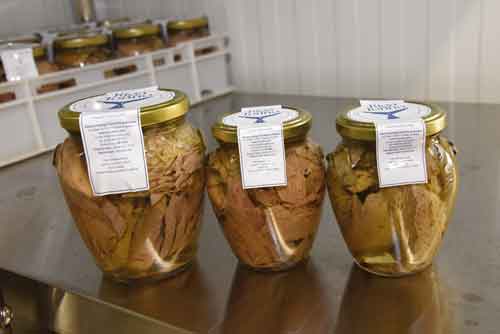
Bluefin tuna in jars is among the products Tuna Adria offers for sale.
Handling quality is critical for a high-value species such as bluefin tuna. Fish arriving at the plant are chilled, inspected, and processed quickly. Whole fish are packed in boxes with ice separated from the fish by paper, while fresh fillets are wrapped and vacuum packed. The cooperative also has deep-freezing capacity at 60°C for products intended for longer storage and export. Products are assigned a barcode that provides traceability from catch to delivery. Fresh fish, however, remains the preferred product in Croatia and roughly 90% of the production is sold fresh. Local consumers and restaurants account for much of the market, and direct sales can generate better returns than export. Small quantities have gone to Italy and Germany but, Ms Srdarev, says export prices have not always justified the trade. The product range is expanding beyond whole fish and fillets. Tuna Adria produces bluefin tuna fillets preserved in sunflower oil, with a limited version in olive oil for the Christmas period. The cooperative sees these products as a way to extend the value of the catch and, with its brand, build a recognisable identity around Croatian wild tuna.
Outreach efforts with children to promote their interest in fish
The processing facility is also intended to bring consumers closer to the fishery. Visitors can observe processing operations through a window, watch how tuna and swordfish are handled, and then move to an education centre with a kitchen and tasting area. Demonstrations are planned around both raw tuna and Croatian preparations to diversify people’s idea of bluefin tuna away from sushi. The cooperative is also working with schools and kindergartens. To stimulate their interest, children are allowed to help unload fish, weigh it, and pack it on ice—they are not, however, involved in knife work. Culinary students are another target group, and plans include hosting classes offering instruction on how to prepare sushi. This educational role reflects a concern that knowledge about preparing fish is being lost. Ms Srdarev argues that busy households increasingly want fish that is already cleaned and easy to cook, while younger consumers may no longer learn traditional preparation methods at home. Selling cleaned fish, demonstrating recipes, and introducing children to wild seafood are therefore different strands of a strategy to make fish easier to use and to create future customers.
Members of the cooperative are also involved in pesca tourism, giving visitors a chance to experience fishing at sea. The cooperative’s facility is close to local wine and olive oil producers enabling tourists to experience all three primary products in a food-tourism offer. As a Croatian saying, quoted by Zoran Srdarev the chairman of the supervisory board, puts it, fish swim three times, first in the sea, then in olive oil, and finally in wine. A longer-term ambition is to certify Croatia’s hook-and-line tuna fishers to the MSC standard that vouches for the sustainability of the stock, the fishing method, and the catch volume.
A complementary range of activities
Tuna Adria is still a young organisation, and its development has coincided with the pandemic, inflation, higher fuel and construction costs, and uncertainty in catches. Staffing is another challenge; four people currently work with Ms Srdarev in the cooperative, but another five will be needed when the facility is fully operational. But with the help of European funding the cooperative is building a model in which selective fishing, processing, direct marketing, and consumer education reinforce one another for the benefit of its members.