This article was featured in Eurofish Magazine 6 2026.

Support for the sector in the next programming period, and simplifying the rules regulating fisheries and aquaculture are among the priorities of the Lithuanian Presidency.
Lithuania takes over the Presidency of the Council of the European Union in the first half of 2027. This will be the second time the country holds this office. Its fisheries agenda will focus on decisions that will shape the sector for years to come: the framework for EU support after 2027, simpler and more effective rules, and the EU’s role in international fisheries governance.
For fishing businesses, aquaculture producers, and seafood processors, these discussions will help determine the conditions in which they operate and invest. Lithuania will work with Member States, the European Commission and the European Parliament to advance practical solutions that protect marine resources while sustaining a competitive European fisheries and aquaculture sector.
Financing the sector’s future
A central priority will be the regulation setting out the conditions for EU support to the Common Fisheries Policy, the European Ocean Pact and the Union’s maritime and aquaculture policies for 2028–2034. Under the Commission’s proposed funding architecture, support would be delivered mainly through overarching National and Regional Partnership Plans, replacing separate national programmes for individual sectors. The overall financial envelope will depend on agreement on the EU’s next Multiannual Financial Framework.

Building on the Council’s partial negotiating position agreed in September 2026, Lithuania will seek progress in negotiations with the European Parliament. The aim is a clear and predictable framework that gives businesses the confidence to invest and helps fishing communities adapt. Fleet modernisation and the energy transition will be important considerations, alongside the development of aquaculture. Support should help enterprises improve energy efficiency, introduce innovation, and strengthen their resilience, while safeguarding fish stocks. Making funding accessible and practical for beneficiaries will be essential to translating these objectives into investment.
Making fisheries rules work better today
Work on future funding must go hand in hand with improvements to the rules governing the sector today. Building on the Commission’s evaluation of the Common Fisheries Policy, Lithuania will promote simpler rules, more effective implementation, and a reduction in unnecessary administrative burdens. In this context, the Lithuanian Presidency will seek rapid progress on the proposed amendments to the European Maritime, Fisheries and Aquaculture Fund Regulation. These discussions offer an opportunity to improve the use of existing funding and respond to the sector’s immediate needs, including investment in competitiveness and energy transition.
Subject to the presentation of the Commission’s proposal, the Presidency will also take forward work on amendments to the multiannual fisheries management plans for the Baltic Sea, the North Sea and the Western Waters. These plans establish the framework for managing key fish stocks, including the setting of fishing opportunities and measures to support stock recovery. Lithuania will seek workable solutions that uphold conservation objectives while addressing the practical challenges facing fishers.
Balancing sustainable imports and industrial competitiveness
Access to raw materials is crucial for Europe’s seafood processing industry, which relies heavily on imports. Autonomous Tariff Quotas allow specified fishery products to enter the EU at reduced or zero customs duties within defined quantities, helping processors obtain supplies that EU production cannot provide in sufficient volumes. The next stage of this policy will involve discussions on sustainability criteria for these tariff preferences. The Commission plans to present its proposal in the first quarter of 2027, bringing the issue onto the agenda during Lithuania’s Presidency.
Lithuania will work to build agreement among Member States on a framework that balances the supply needs of processors with the interests of EU producers. The challenge will be to strengthen environmental and social sustainability and promote fair competition, while considering the effects of new requirements on the availability and cost of raw materials. The reform could also contribute to wider efforts to prevent fish caught by Russian vessels from entering the EU market, including through processing in third countries. Stronger traceability and eligibility requirements should help ensure that such products do not benefit from EU tariff preferences.
Strengthening international fisheries cooperation
The EU’s fisheries interests extend well beyond its own waters. International cooperation is essential to the sustainable management of shared resources and to the activities of European fleets operating in distant waters. Lithuania will seek to strengthen this external dimension of the Common Fisheries Policy, including in discussions on the Commission’s Vision 2040 for fisheries and aquaculture. As Presidency, Lithuania will coordinate the preparation of EU positions for relevant meetings of Regional Fisheries Management Organisations and work relating to Sustainable Fisheries Partnership Agreements with third countries. It will also cooperate closely with its Presidency trio partners to ensure continuity across the international agenda. The focus will be on science-based management, sustainable fishing opportunities, and fair conditions of competition for EU operators. Effective partnerships should support responsible fisheries and the long-term viability of the fleets and communities that depend on them.
International fisheries diplomacy in Vilnius
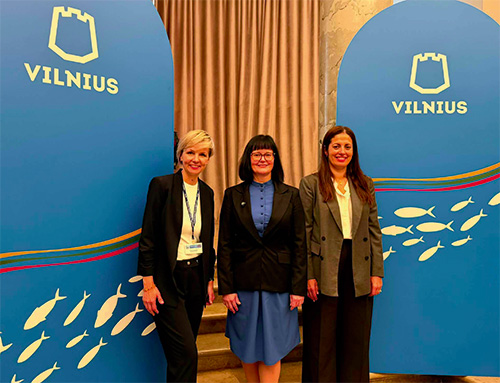
Lithuania’s preparations draw on its experience of hosting the 48th Annual Meeting of the Northwest Atlantic Fisheries Organization in Vilnius on 21–25 September 2026. It was the first time the organisation’s annual meeting had been held in Lithuania, bringing international fisheries negotiations to the country ahead of its Presidency. The meeting delivered concrete decisions, including the reopening of the Northern shrimp fishery in Division 3L, management measures for Atlantic halibut and the extension of closures protecting vulnerable marine ecosystems until the end of 2028. These outcomes illustrate how international cooperation can combine fishing opportunities with the protection of marine resources.
For Lithuania, which has longstanding fishing interests in the Northwest Atlantic and participates in NAFO through the EU, hosting the meeting was also valuable preparation for the diplomatic and organisational responsibilities of the Presidency. Throughout its Presidency, Lithuania will work to translate these priorities into progress on the files before it. Its ambition is to help provide the European fisheries and aquaculture sector with clearer rules and a dependable framework for investment, while ensuring that healthy marine resources continue to support food production and livelihoods.