This article was featured in Eurofish Magazine 6 2026.

The Organization of Sturgeon Fish Producers has launched a campaign combining culinary heritage with shorter supply chains that aims to give sturgeon meat a market of its own.
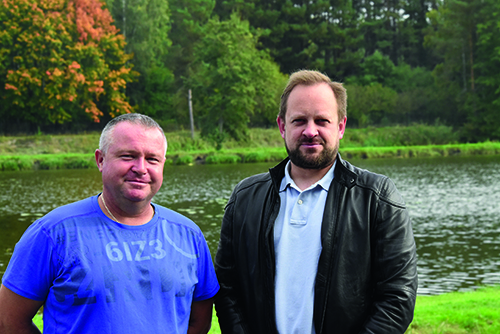
While sturgeon roe or caviar is associated with luxury, the fish’s meat is unfamiliar to many consumers in Poland today. But wild sturgeon once inhabited the Vistula, and old recipes recall an era when it was served at distinguished tables. Tomasz Ciesielski, president of the Organizacja Producentów Ryb Jesiotrowatych (Organization of Sturgeon Fish Producers), hopes to connect that history with the modern fish farm. Appropriately, Mr Ciesielski himself recalls a family photograph showing an uncle with an enormous sturgeon caught in the Vistula. Today the organisation’s priority is to create demand for farmed sturgeon as food, especially among consumers who have never cooked or tasted it.
A collective voice for producers
Based in Toruń, the Organizacja Producentów Ryb Jesiotrowatych (Organization of Sturgeon Fish Producers) was established in 2010 and entered Poland’s register of recognised fish producer organisations in August that year. Mr Ciesielski has served as president since 2022. Its members include growers and processors, and its remit covers production and marketing of sturgeon farmed in Poland. The association seeks to improve market access and profitability while encouraging common production standards and cooperation between farms. The organisation comprises roughly 28 farms with different business models, some sell whole fish, others processed products; some concentrate on fish for consumption, while others also work with caviar or juvenile fish, supplying the latter to other farms where they are grown to adults.
Mr Ciesielski sees promotion as the immediate task. Carp and trout are well represented in Polish fishmongers and kitchens. Like those two species, sturgeon too needs to establish a distinct identity, he argues. The objective of the campaign is a strong generic reputation for Polish farmed sturgeon.
Scope for expanding production—if the market allows
There is a substantial production base on which to build. Eurostat figures put Polish farmed-sturgeon production at approximately 1,253 tonnes in 2024, against 19,531 tonnes of common carp and 18,642 tonnes of rainbow trout. The figures for sturgeon reflect both fish that are used for meat and those used to produce caviar. Asked how much sturgeon Polish consumers eat and Mr Ciesielski suggests that consumption is effectively invisible in available statistics thanks to a fragmented and poorly understood market. Supermarkets sometimes stock sturgeon products, yet he doubts that large retail chains, with their pressure on prices, offer the best future for small specialist farms. A further challenge is competition from meat obtained after female sturgeon have been harvested for caviar. Mr Ciesielski fears that cheaper meat from these older fish can shape consumers’ first impressions of sturgeon. He believes fish raised specifically for eating offer a different product.
Teaching consumers to cook sturgeon
The response is Król Jesiotr — King Sturgeon — a marketing initiative supported by the European Maritime, Fisheries, and Aquaculture Fund. Activities include films showing the work and traditions of farms, appearances at fairs, and cooking demonstrations. The organisation is also organising Akwakultura Polska conferences between 2025 and 2027, reflecting its wider sectoral interests. The most direct way to build a market may be through the kitchen. Mr Ciesielski says about 1,300 people participated in culinary workshops during one year of the campaign. The response has been encouraging. Some participants upon learning how to prepare the fish, immediately asked where they could buy it. The organisation also wants to reach chefs, whose menus can introduce a little-known species to customers who might hesitate to cook it at home.
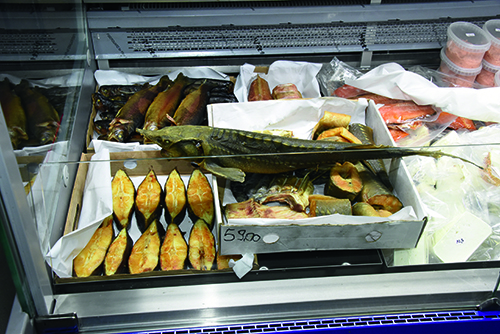
The shop on Mr Bejger’s farm, Gospodarstwo Rybackie, where he sells products made from the fish grown on the farm.
Moreover, with food historian Professor Jarosław Dumanowski and a group of chefs, the organisation is preparing a cookbook that adapts historic sturgeon dishes for present-day kitchens. Recipes once written for fish weighing as much as 200 kg must be reworked for farmed specimens of perhaps four or five kilograms. At a Polish embassy reception in Luxembourg, sturgeon was presented to an international diplomatic audience, some of whom, according to Mr Ciesielski, were tasting it for the first time.
A platform for direct sales is in the offing
Promotion alone cannot solve the question raised repeatedly at workshops, namely, where can the fish be bought? The association is developing an ordering platform intended to link buyers with participating producers and collection points, using location to identify a suitable supplier. Customers would order in advance and collect fresh fish on an agreed date, rather than expect it to be available everywhere every day. Although it calls for planning in advance and thus disadvantages the impulse buyer, the arrangement is designed to supplement, not replace, sales at farm shops and existing distribution channels. Producers would retain responsibility for their own prices and offerings, which extend from fresh (live, gutted, table-sized) to processed (smoked, dried, preserved) products, while the association would help potential customers find them. The platform is expected to go live by the end of 2026 if not earlier.
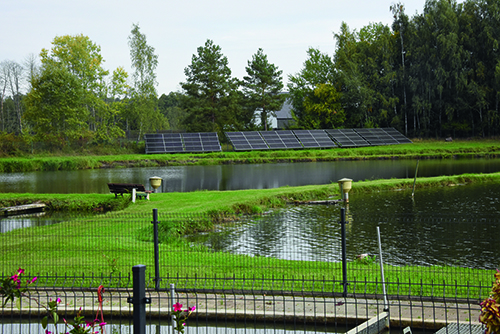
Investments in solar panels have helped trim energy costs at Gospodarstwo Rybackie.
Piotr Bejger, a member of the organisation, raises sturgeon alongside other species, including carp and trout, and sells some of his fish through a shop located on his farm, Gospodarstwo Rybackie. He describes how visitors who had attended local cooking workshops subsequently came to buy the fish they had learnt to prepare. His conclusion was that promotion can generate business, provided there is a convenient sales channel. Initially doubtful about finding time to be an active member of the organisation, Mr Bejger now values the relationships it has created. When one farm has too little fish for an order, he says, another may be able to supplement it; when a producer has a surplus, contacts made through the organisation can help find a buyer. A restaurant attracted by sturgeon may also become a customer for a farm’s other species. Membership thus confers benefits beyond those derived from the generic marketing of the fish.
Quality faces practical constraints
Mr Ciesielski’s preferred sales channels for the fish are restaurants, hotels, and direct sales, where producers can explain their product and preserve its value. Supermarket chains tend to squeeze the producers on price, which can have an impact on the quality, so he prefers selling through the other channels. The next step is to become an EU-recognised producer organisation, a status that entitles the organisation to apply for project funding at favourable rates of cost coverage. In the meanwhile, however, production itself is facing pressures. Mr Ciesielski points to low river levels and high water temperatures as growing concerns. Recirculating aquaculture systems can reduce water requirements, but their installation and electricity costs are substantial. Investment in renewable energy may improve resilience, but not every farmer can finance it. The organisation itself relies heavily on externally supported projects for activities, such as the promotion campaign, that individual members would struggle to fund alone.
For now, Mr Ciesielski’s ambition is primarily domestic. He wants Polish consumers to recognise sturgeon as fine eating. They should also learn to distinguish between meat from a fish produced for eating and that from one produced for caviar. If the campaign succeeds as he hopes, sturgeon should gain a regular place on Polish menus.