This article was featured in Eurofish Magazine 6 2026.

As Polish producers encourage consumers to rediscover sturgeon meat, Ryszard Szczepaniak’s small, experimental fish farm shows how quality starts long before a fish reaches the kitchen.
For many consumers, sturgeon means caviar. Its meat, once a familiar part of Polish culinary heritage, has a much lower profile even though it makes excellent eating. The lack of awareness about sturgeon can partly be attributed to the absence of wild fish in Polish waters. Overfishing, dam building, and the deterioration of river habitats have eliminated the native Baltic population from Polish waters. Today, the Baltic sturgeon remains the subject of long-term restoration efforts. In September 2026, for instance, 15 sturgeon juveniles and several thousand younger fish were released into the river Ina in Goleniów. The released fish were from a hatchery managed by the Polish Angling Association, but farms producing sturgeon also often contribute young fish to restocking efforts while at the same time supplying the market with sturgeon meat.
An interest in fish farming leads to a change in career
One of the producers contributing to the revival of sturgeon is the farm, Gospodarstwo Rybackie Sugajno, near Brodnica in the Kujawsko-Pomorskie region in northern Poland. Its owner, Ryszard Szczepaniak, move-d to aquaculture from a career in finance some two decades ago. The change was driven by a desire to work less as well as to spend more time on something he was passionate about. His farming facility today draws water from an adjacent lake to feed a series of tanks that hold sturgeons of different species and ages. Sugajno specialises in producing young fish for other farms, rather than simply growing fish to table size. Mr Szczepaniak puts its output at approximately 40 tonnes across the different species, of which fry and juveniles account for one half and market-sized fish for the other. He estimates that only around a tenth of the sturgeon juveniles are retained for further growing, with most sold to other producers. The ponds devoted to rearing occupy around 1.5 hectares and, alongside Russian and Siberian sturgeon, the farm works with other species including -European catfish, zander, and tench.
Experiments conducted to optimise growth
At the farm Mr Szczepaniak is also conducting research. Although not strictly scientific the results from his experiments indicate ways to optimise production. For example, he is exploring the potential of polyculture, that is, keeping compatible species together so that their different feeding behaviours and use of space may improve growth rates. Mr Szczepaniak has tried combinations of sturgeon and European catfish, as well as sturgeon and zander. In his view, sturgeon can help clear uneaten feed from lower levels of a system, while other fish exploit the higher strata of the water column. Mr Szczepaniak has observed that Siberian sturgeon learns to reach food near the surface more readily than Russian sturgeon. This can affect zander’s access to feed and explains why choosing which sturgeon species to combine with zander can matter just as much as deciding whether to combine them at all.
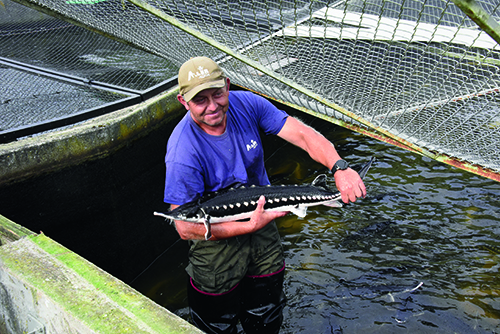
Ryszard Szczepaniak breeds different species of sturgeon primarily for sale to other famers to on-grow.
He is similarly cautious about pairing predatory catfish with smaller fish. Stocking size must be considered carefully, with survival and growth assessed at the end of a production cycle. Another trial with tench kept on their own, rather than in polyculture with other species, explored whether dedicated production could yield a marketable fish. He found that fish initially weighing about 70 g reached roughly 350 g during the growing season. In another experiment he plans to extend the diameter of an existing eight-metre unit to 16 metres. He reasons that in addition to feed quality and water cleanliness, low stress levels are also likely to contribute to better flesh texture. The larger tank will generate additional capacity, but will also be maintained at a lower density. Not all these ideas are established industry practice, and Mr Szczepaniak recognises that persuading other farmers to try unfamiliar combinations is difficult. Nevertheless, he sees growing interest among a younger generation of Polish aquaculture producers that is keen to experiment and exchange results and experiences with their peers.
Solar panels and windmills contain energy costs
The water feeding the growing tanks moves through separate circuits and holding tanks, with pumps supplying oxygen where required. Some circulation uses gravity to move the water around, in other circuits there is no alternative to pumping, while a settling pond helps collect solids. Smaller tanks allow Mr Szczepaniak to monitor feeding and fish condition closely. Solar panels and windmills help the business address the electricity costs associated with pumping and aeration, although they do not entirely cover the facility’s electricity requirements. Temperature, oxygen, and stress are central concerns in sturgeon farming. Mr Szczepaniak says providing relatively warm water while keeping it sufficiently oxygenated is a challenge as warmer water can hold less dissolved oxygen. At Sugajno, decisions about stocking densities and winter management are made with those conditions in mind. In winter when feeding activity is lower, fish can be combined in fewer tanks to reduce costs.

Solar panels and windmills generate much of, but not all, the electricity the farm consumes. The remainder comes from the grid.
Convincing people to eat sturgeon requires attention at the other end of the supply chain. Sturgeons take time to rear. In an interview with Polish media Mr Szczepaniak says that the journey from hatching to the dinner plate can take three to four years. In contrast, rainbow trout takes about a year to reach market size. He has likened the product to slow food, an apt description of the patience and resources it takes to produce. This long cycle makes consistent quality and an adequate selling price particularly important. Sturgeon offers cooks some practical advantages. Its firm, delicate flesh has few fine bones, and it lends itself to smoking, roasting, poaching, and gentle frying. Mr Szczepaniak himself favours smoked sturgeon and points out that trimmings can make an excellent stock. At events organised at Sugajno, discussions of product quality extend to handling before slaughter, chilling, and the texture of the meat all of which is useful information for consumers who are unfamiliar with the fish and how to prepare it.
Contributing to awareness building
The farm already participates in introducing sturgeon to local audiences. In 2025, Sugajno provided samples for tasting after a nature-themed conference and at a local fair celebrating organic production. The Organization of Sturgeon Fish Producers (OPRJ) also identifies the farm as a source of fresh sturgeon sold directly on site, offering customers an alternative to supermarket supply chains. OPRJ initiatives to promote sturgeon include free hands-on classes for chefs and consumers, films about farms, and appearances at trade events. Its organisers want more restaurants to feature sturgeon and more households to feel confident preparing it. They also argue that Polish producers face price pressure from imported fish, making a recognisable regional identity and reliable quality especially valuable.
Mr Szczepaniak’s passion has resulted in a sturgeon farm breeding juveniles of different species of sturgeon mostly for onward growth at other farms. His experiments with the conditions under which the fish grow have had some interesting results which may result in higher growth rates or lower costs. He retains a fraction of the production that he grows to market size himself for sale and contributes to efforts to generically market sturgeon which should help make the fish more popular among Polish consumers. If sturgeon meat is to return to Polish tables, successful promotion must be matched by farms able to deliver fish people will want to buy again.