This article was featured in Eurofish Magazine 6 2025.

From stock assessment to recirculation aquaculture system pilots, the Fisheries and Aquaculture Laboratory at Klaipėda University’s Marine Research Institute is building practical solutions for the Baltic region and beyond.
The Fisheries and Aquaculture Laboratory sits within Klaipėda University’s Marine Research Institute, a research-intensive hub on the Lithuanian coast. The lab’s remit spans from classic fisheries science—collecting biological data, assessing fish ages, and supporting stock assessment for national and EU obligations to applied aquaculture—designing, testing, and teaching about recirculation aquaculture systems (RAS) that reduce waste and use water and energy efficiently.
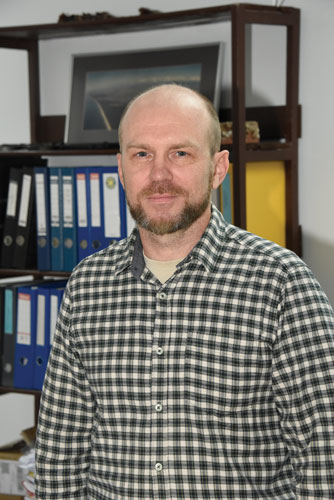
Facilities are tailored to these goals, says Nerijus Nika, the head of the laboratory. A dedicated specimen age-reading room and wet labs allow the team to process Baltic and inland-water samples, while small RAS units and aquaponic set-ups provide an experimental area for students and researchers. Tank arrays house salmonids, sturgeons, and crayfish, among other species, so that husbandry variables can be trialled under controlled conditions. Because teaching is part of day-to-day research, cohorts of 10–16 students get direct exposure to the tools and methods used—valuable experience for future jobs on farms, in laboratories, and administrations.
From stock assessment to systems thinking
Researchers sample the Baltic Sea each year, recording length, weight, sex, maturation stage, and health indicators, and preparing otoliths, scales, or spines for age determination, Dr Nika explains. These datasets underpin assessments for pelagic species such as sprat and herring, and brackish water stocks and show students how field biology, laboratory analysis, and computation fit together in modern fisheries science. While the monitoring programme contributes to good policy, the aquaculture programme aims to make production itself cleaner and more efficient by using waste from one process as an input in another.
One way is to expand conventional aquaponics by adding a third trophic level—crustaceans—to the usual fish-and-plant pairing. Work package 3 of the Interreg South Baltic project, AquaLoop, is led by Dr Nika. He conducts trials pairing rainbow trout or Siberian sturgeon with narrow-clawed crayfish and leafy greens, the crayfish unit sits where solids accumulate. The crayfish consume the sludge before the water continues to biofilters and plant growing beds. Early cycles showed a roughly 40–50 per cent reduction in sludge mass passing downstream, a material improvement in the system. However, the researchers also observed slower crustacean growth, a hint that sludge alone lacks the nutrients needed for fast gains.
Students and researchers are also testing defined diets against sludge fractions in crayfish-holding boxes quantifying consumption and growth. The question is not simply whether crayfish can eat sludge, says Dr Nika, but if they can do so efficiently, If the results suggest a reduction in waste disposal costs as well as a new product (the crayfish) it is likely to be of interest to fish farmers. A complementary experiment explores the production on waste streams of insect-larvae as a circular feed ingredient for fish or crayfish.
Blending geothermal brines is more cost efficient than buying salt
Another experiment conducted under the Interreg BSR TETRAS project tackles the cost and practicality of inland saline aquaculture. Whiteleg shrimp and certain marine finfish perform best in brackish or full-strength marine conditions, but making artificial seawater inland can be expensive depending on the mineral salts used. Researchers have therefore been testing a more economical approach using highly mineralised geothermal brines from western Lithuania, diluted and balanced to the target salinity. For shrimp, the laboratory typically targets ~16‰ salinity so protein skimmers work efficiently (at lower salinities they are less efficient). Traditional salt mixes can be a significant expense, whereas tailored blends of commodity mineral salts bring this to much more manageable levels per m³. When compatible geothermal brine is available, for example, as waste from a powerplant, the economics could improve further. Trials with rainbow trout in freshwater, natural Baltic brackish water (~6‰), and brine-derived brackish media showed similar growth across treatments, but blind taste tests suggested better texture and flavour in brackish water-reared fish. Whiteleg shrimp showed good growth and survival performance in geothermal brine-based saltwater and could be a suitable solution for inland marine aquaculture development.

Basel grown as part of an aquaponics trial involving fish and crayfish,
where the crayfish feed on the sludge from the fish tank.
Another project ProRMAS run with Klaipeda Science and Technology Park focuses on sludge from marine RAS. German partners have grown polychaete worms on sludge from shrimp tanks, converting it into alternative protein biomass which was blended into shrimp feed. The project consortium now plans to test this feed, while the Italian partner will test if the wastewater, which is saline, can be used to grow halophytes, salt-tolerant plants, such as salicornia. If successful, the loop would substitute part of the imported marine ingredients in feed with a coproduct grown on site, simultaneously reducing disposal volumes and closing the nutrient cycle.
Skills that industry needs now
A distinctive strength of the Klaipėda lab is how thoroughly teaching is woven into research. Rather than passively observing, students build and run small systems, track water quality through sedimentation, biofiltration, and plant beds, and keep mass balances for nitrogen and solids. They learn how to plan experiments, document routines, and respond when alarms go off. As the team notes, the region faces a shortage of fish-health and aquaculture skills, so courses emphasise health checks, biosecurity, and the safe handling of live animals. By training students to walk into a plant and keep it stable, Klaipėda University is addressing one of the most pressing bottlenecks to growth in European aquaculture: competent, systems-literate staff.
Aquaculture trials show what is economically feasible
The economics of inland marine RAS are often forbidding. Feed often accounts for around half of operating costs; energy is the other major expense; and salts can also be a significant budgetary post. Experimenting with other sources of salinity may result in reduced costs without compromising performance, but in general such systems are usually only viable with high-value species such as whiteleg shrimp. Trials in Lithuania for this species as well as modelling suggest producers would need at least ~€40/kg to be viable, positioning the product as a premium, ultra-fresh alternative to frozen imports that retail at €12–€16/kg. There are markets where live or harvest-to-order shrimp can command really high price, but these are niche channels and require tight logistics. The results from these trials could show enterprises what they need to calculate in terms of costs and market positioning for a viable business plan.
Three features distinguish research at the laboratory. It prioritises interventions that RAS farms can deploy with existing equipment without needing investments in complex new systems. Claims are tested with replicated trials and when early results are positive (e.g., sludge reduction), the next question is always whether the effect survives contact with economics and scale. Moreover, students graduate with hours spent at the laboratory on pumps, filters, and biosecurity protocols giving both them and their future employers a competitive advantage. The Fisheries and Aquaculture Laboratory’s work on recirculation systems and circularity answers a need for systems characterised by low impact on the environment and high product quality. Scaling such systems to commercial levels would enable the aquaculture industry, particularly in Europe, to finally fulfil the promise it has shown for years but has yet to realise.