This article was featured in Eurofish Magazine 1 2026.

As seafood demand rises and quotas tighten, processors everywhere face a difficult question: how do you grow value when volumes stagnate?
Finnish food-tech start-up Hailia, founded in 2021, believes the answer is not in catching or farming more, but in using what we already have far better. By transforming underused side streams into high-value, fillet-like products, Hailia is quietly redefining seafood processing.
Who is Hailia?
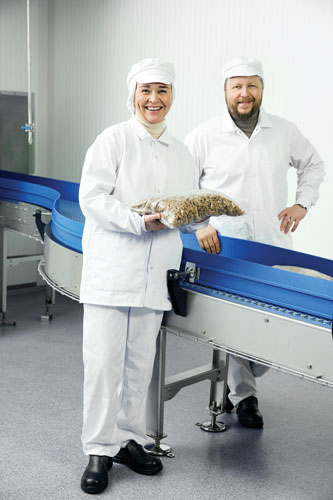
Co-founded by Michaela Lindström and Otto Kaukonen, Hailia is a Finnish food-tech company that focuses
exclusively on seafood. It combines experience from the plant-based protein sector with a deep understanding of the challenges facing modern seafood processors. Hailia sees its role as a partner for secondary seafood processors—the companies that fillet, portion, and prepare fish for retail, food service, and industry. Its ambition is to make on-site upcycling of side streams into food an industry standard, not a niche experiment. At its core, Hailia helps processors turn parts of the fish that are usually destined for low-value outlets such as feed, oil, or biogas into versatile, convenient food products. These side streams include trimmings, frames, heads, and other pieces that are perfectly edible but rarely presented directly to consumers in European markets, where the fillet still dominates the chilled cabinet.
Using Hailia’s process, these side streams are transformed into cooked, ready-to-use products with a texture similar to a fish fillet. The resulting ingredient can be used in retail, food service, and food industry applications. These applications range from chilled or frozen pieces, canned products, or as an ingredient in ready meals, soups, fillings, or toppings. Crucially, the products are heat-stable and easy to handle in large kitchens, making fish as simple to use as, for example, chicken strips. But what made Hailia and its solutions possible? Hailia’s story begins outside the seafood sector.
Ms Lindström and Mr Kaukonen previously worked with plant-based proteins, where they saw how raw materials like fava beans could be turned into sophisticated foods that convincingly mimic mince or other meat products mouthfeel. This background gave them two things they have now brought into seafood: an obsession with texture, and a product-first mindset.
Before they had a processing line, they had a clear idea of what they wanted the end products to be convenient, tasty, fish-like, and easy to integrate into professional kitchens. They also engaged actively with large food-service operators and food industry customers from the outset, discussing concepts and needs long before the technology was built. This early stakeholder dialogue ensured that the solution was designed around real-world menus, prices, and sustainability targets. At the same time, attitudes within the industry have evolved. When Hailia started in 2021, Ms Lindström recalls that many processors doubted whether consumers would accept foods made from side streams. Today, especially in Finland, she sees a very different picture as end-consumers simply call the idea “smart”, and public food-service providers with CO₂ targets are actively looking for Hailia’s solutions.
The concept behind Hailia’s side-stream utilisation solution
Hailia’s concept is deceptively simple: takes side streams, handles them with the same care and hygiene as fillets, and converts them into high-value food under the processor’s own roof. The process starts by collecting side streams from the filleting line and homogenising them. Depending on the species and the composition of the side streams, the raw material is blended to achieve a suitable base. Around 90% of the final product is fish side streams, utilized with an exceptionally high yield rate (85-100%) thanks to special know-how developed by Hailia. The remainder consisting of binders such as potato starch, plus seasoning as required.
The next critical step is texturization: Hailia has developed process and recipes to recreate a texture like cooked fish fillet, both in mouthfeel and appearance. The result is a fully cooked, heat-stable product that can be portioned, flavoured, and packed for a range of applications from taco-style seasoned fish strips to neutral, versatile pieces for soups, salads, and ready meals. Here the long standing and close partnership with Dana Technology have been a key factor in making Hailia texturization process a reality, with Dana’s Rotary Disc Texturizer (RDT) machine. This is one of the machines that makes Hailia’s texturization process possible and as Ms Lindström states: We believe in collaboration in Hailia. As a startup you bring solutions to the table, but you need close collaborations with different stakeholders to succeed.
But what is unique about Hailia’s solution? Side-stream utilisation itself is not new. Many companies already render trimmings into oil, meal, or functional ingredients that can be blended into patties and other processed products. What Hailia brings is a process that delivers a fillet-like, chewable structure, not just a minced or paste-like ingredient.
Ms Lindström has not seen other companies texturising side streams in quite the same way. This structural quality is what allows processors to move beyond “economy fish cakes” towards more premium products while still competing on price with affordable proteins such as chicken. At the same time, using bones and other hard tissues can significantly increase nutritional value with calcium levels up to twenty times higher than in ordinary fillets, depending on the composition of the side streams.
How the solution changes the traditional processing approach
Traditionally, many processors have treated side streams as a separate, low-value by-product stream. Trimmings are collected, chilled, and sold to external companies for fishmeal, oil, or pet food production. Only the fillet is managed as a premium food product. Hailia’s approach changes this logic. Its solution is designed as a processing set-up that e.g. can sit next to the existing filleting line essentially an add-on module. Side streams are handled immediately, with the same care and food-grade standards as fillets and transformed on site into finished food products under the processor’s own brand. The capacity of the texturizing machine in the line is around 500 kg of side streams per hour. For many Nordic and Mediterranean processors, this is a realistic threshold, meaning the concept is not limited to only the largest factories. In fact, the system is modular so capacity can be scaled by adding units. In business terms, this turns a cost and logistics item into an in-house value-adding activity that expands the product portfolio rather than creating a separate, unrelated business such as fish meal or oil production.
So far, adoption has been strongest in Finland, where Hailia has collaborated closely with processors and retailers. One partner, for example, now offers products made with Hailia’s technology in both retail and food-service channels. Finland’s largest retailer, S-Group, was keen to be the first to bring such products onto supermarket shelves, underlining the commercial appetite for this type of innovation. Today, Hailia is in discussions with numerous processors in Europe and beyond, with several testing programmes and partnerships already under way. For processors, the most immediate impact is improved raw material utilisation and new product lines at different price points. In one Finnish case, the share of a rainbow trout that ends up as food increased from 70% to around 90% using Hailia’s technology for side streams that previously went into low-value items such as animal feed. This expanded product portfolio allows processors to serve both premium fillet markets and more cost-sensitive segments. Food-service operators and industrial kitchens can incorporate fish into dishes where they might otherwise choose cheaper proteins, because the side-stream-based products can compete on price while maintaining good eating quality. Process efficiency also improves, as side streams are handled in-line rather than stored and transported for external processing.
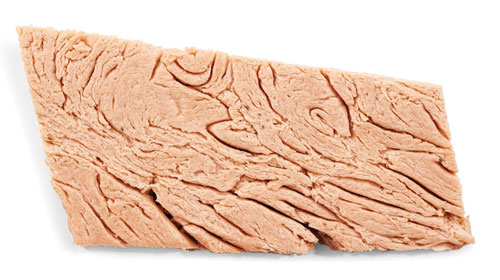
One of the final side-streams products after Hailia’s texturization process.
The side-streams that have been used here are from salmon.
In addition, the environmental gains are potentially significant. Globally, an estimated 24 million tonnes of seafood side streams are currently “lost” to lower value uses from a human nutrition perspective. With seafood demand expected to double by 2050, and quotas already tightening, using more of each fish for food is an obvious way to reduce pressure on marine resources. Life-cycle calculations carried out in Finland indicate that products made via Hailia’s process can have a very low CO₂ footprint in some cases lower than many plant-based protein products. Efficient processing technology and the use of side streams are key drivers of this result. For processors, on-site upcycling also reduces the overall footprint per kilogram of edible product produced, helping them meet increasingly demanding climate and sustainability targets.
What does the future hold for Hailia’s solutions?
Looking ahead, Hailia’s main priority is to scale what has already been proven in Finland. The company is actively seeking strategic partners in Europe and further afield to demonstrate that its side-stream solution can work with different species, markets, and regulatory contexts. The vision is that, over time, it becomes normal for processors to install such modules alongside filleting lines, and for a much larger share of side streams to be upcycled into food rather than diverted into feed or energy. In practical terms, that means expanding into new seafood side streams i.e. different species, more product formats, more customer types, etc. rather than jumping immediately into other food industries. Hailia expects the largest volumes to come not from retail, but from food service and food industry clients: canneries, ready-meal producers, sandwich and sushi manufacturers, industrial kitchens, and others who need stable, easy-to-use fish ingredients at competitive prices.
If Hailia succeeds, tomorrow’s seafood processing plant may look quite different from today’s. Instead of a premium fillet line and a side-stream outlet, processors could operate integrated factories where almost every part of the fish becomes food supporting better margins, stronger brands, and a more sustainable use of marine resources. For an industry under pressure to do more with less, that is a transformative proposition.
Søren E. Schrøder, Eurofish,
soren@eurofish.dk