This article was featured in Eurofish Magazine 2 2026.

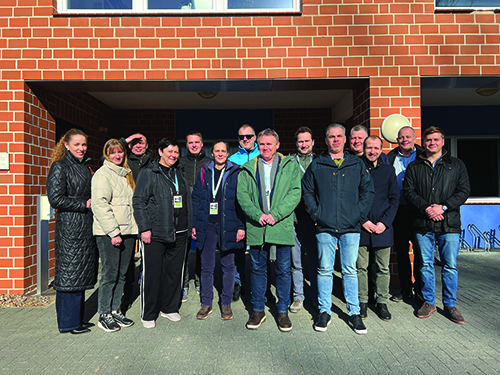
From 3–5 March, EUROFISH organised a study tour on freshwater fish processing in northern Germany, bringing together 11 producers and governmental officers from Latvia, Ukraine, and Hungary. The programme offered an excellent opportunity for participants to exchange experiences, explore innovative technologies, and strengthen cooperation across the freshwater aquaculture value chain.
The three-day programme included visits to farms, technology providers, research institutions, and industry partners in Germany. The tour demonstrated how cooperation between producers, technology developers, and researchers can help address the technological and market challenges faced by freshwater aquaculture in Europe.
A diverse group representing the freshwater sector
The study tour gathered participants representing commercial fish farms, sector organisations, and governmental bodies responsible for fisheries and aquaculture development. Participants from Hungary included Bajcshal Ltd., which operates both African catfish recirculating aquaculture systems (RAS) and traditional pond production facilities; Szarvas-Fish Ltd., the largest African catfish producer in Hungary with an annual production of around 3,000 tonnes and operator of the country’s largest freshwater fish processing plant; and Szabolcs Fish Ltd., a pond fish producer located in the north-eastern part of the country specialising in traditional freshwater species. The Hungarian delegation also included a representative from the Ministry of Agriculture of Hungary, responsible for fisheries and aquaculture policy and
sector development.
The Latvian group included representatives of Blue Circle Ltd., a company engaged in the production and marketing of Arctic char in recirculating aquaculture systems (RAS), and Purvīņi Fish Farm, which operates pond aquaculture alongside African catfish production in RAS. Moreover, the Latvian Aquaculture Association and the Ministry of Agriculture of Latvia were also represented.
From Ukraine, the delegation included representatives from the State Agency of Ukraine for the Development of Melioration, Fisheries and Food Programs, together with a representative from PJSC Khmelnytskrybhosp, a private pond fish farm producing around 1,500 tonnes of common carp, bighead carp, and crucian carp. The diverse composition of the group led to discussions on practical production challenges, processing technology needs, policy frameworks supporting the development of freshwater aquaculture, technological innovation, and opportunities for
international cooperation.
Visiting farms, technology providers, and research institutions
During the tour, the group visited several farms, research institutions, and industry partners. At Heidefisch GmbH, participants observed how large-scale trout farming and processing can successfully comply with very strict environmental regulations, enabling sustainable production and processing. The visit offered insights into integrated trout production, modern processing practices, and environmental management. Particular attention was given to water treatment and effluent management systems that allow the company to operate at a large scale while meeting strict environmental standards. At Baader, one of the world’s leading fish processing technology providers, the group had the opportunity to discuss directly with company representatives the technological challenges arising from freshwater species which often require specialised equipment due to their anatomical characteristics and the typically smaller production volumes.
At the University of Rostock, Professor Harry Palm presented an excellent overview of the latest scientific developments related to circular economy approaches in freshwater aquaculture and fish processing. The presentation highlighted how research contributes to improving nutrient recycling, water reuse, and the utilisation of by-products in aquaculture systems. Participants also discussed the potential of new species such as giant gourami, which could support circular production systems due to their ability to utilise plant-based feed resources efficiently. The tour also included an in-depth technical exchange with the team of Nutrition&Food, where participants explored innovation pathways for African catfish production, processing, and market development in Europe. The discussion focused on the development of new value-added products and strategies to strengthen the position of African catfish in European seafood markets.
Key discussions and lessons learned
The central focus of the study tour discussions was the processing of freshwater fish, which remains one of the main technological and economic bottlenecks limiting the growth of the sector in Europe. While freshwater aquaculture production is developing steadily, the processing segment often lags due to technological constraints and limited volumes. Participants emphasised that European consumers increasingly demand processed and convenient fish products, including fillets and ready-to-cook items. However, many freshwater fish species are still processed manually or with limited mechanisation, which increases production costs and limits the competitiveness of European products compared with imported fish.
This challenge is particularly evident in the processing of African catfish, a species that is rapidly expanding in European aquaculture due to its excellent growth performance and high product quality. Despite its strong production potential, efficient industrial processing technology, especially reliable filleting machines, are still under development. The relatively small size of the European freshwater aquaculture sector makes it difficult for equipment manufacturers to justify large investments in developing specialised processing technologies, an issue that was discussed at Baader. The company is currently working on processing solutions specifically designed for freshwater species, including automated filleting technology for African catfish, with promising initial results.
Alongside processing technologies, participants also discussed the importance of circular economy approaches in freshwater aquaculture. Fish processing generates by-products such as heads, frames, skins, and viscera, which are valuable biological resources rather than waste. These materials can be utilised in multiple ways, ranging from nutrient recycling in aquaculture systems and agriculture to the production of fish oils, protein ingredients, pet food and even innovative food products for human consumption. Better utilisation of these resources can significantly improve the economic performance and sustainability of freshwater aquaculture operations. By transforming by-products into valuable raw materials, producers can create additional revenue streams while reducing environmental impacts. At Heidefisch, participants observed how advanced effluent treatment systems allow large-scale trout production with strict environmental regulations, demonstrating how technological innovation can directly support environmentally responsible aquaculture development.
Cooperation for a stronger freshwater aquaculture sector
The study tour demonstrated production technologies and processing solutions in operation allowing stakeholders to better understand how innovations can be applied in their own production systems. In addition, participants learnt from each other and expanded their professional networks, thereby strengthening cooperation across the value chain and contributing to the long-term development of the European seafood industry.
Tamas Bardocz, Eurofish,
tamas@eurofish.dk