Izmir aquaculture sector hosts women’s group

This article was featured in Eurofish Magazine 2 2026.
The General Fisheries Commission for the Mediterranean (GFCM) with the support of the Federation of European Aquaculture Producers (FEAP), has over the last four years implemented a programme to promote the role of women
in aquaculture.
Each edition of the programme is supported by an aquaculture association from the host country. The fourth edition took place in January 2026 in Izmir, Türkiye thanks to the support of the Aegean Exporters Association. This organisation brings together 12 sectoral associations (fruits, cereals, fisheries products, olive oil, textiles, etc.), representing more than 7,500 producing and exporting companies, facilitating their access to and growth in international markets.
Study tour programme builds a lasting network for women in aquaculture
Türkiye is one of Europe’s leading agricultural and livestock producing countries and the continent’s largest aquaculture producer. In addition, the country’s culture, gastronomy and the hospitality of its people made it an extraordinary location to develop this programme for women.
For those wondering what an aquaculture programme that brings together women from different countries consists of, it can be broadly summarised as a 3 to7 day study tour with scheduled visits to companies, research centres and service providers related to aquaculture—in short, businesses involved in the farming of fish, molluscs, and algae. During these visits, women with different background, context, and culture share their stories: how they developed their business ideas, what their university research focuses on, and what their professional experiences have been as women in the sector. This enables participants to broaden their perspectives, discover new aquaculture-related activities, gain tangible examples of professional pathways, and feel empowered to turn their own projects into reality—just as others have done. It also creates an atmosphere of trust and mutual support. Following the experience, participants become part of an international network that includes members of the institutions that have organised the four programmes so far, more than 50 participants, and a wide range of contacts across different aquaculture fields in nearly all GFCM member countries—that is, throughout the Mediterranean and Black Sea region. This network helps them pursue their future goals and share their concerns and aspirations.
Three-day immersion in Türkiye’s aquaculture sector
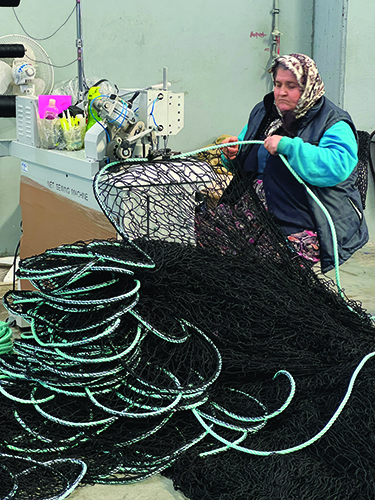
During the three-day programme, participants visited the Ilknak and -Akvatek hatcheries, where seabass and seabream are reared in the earliest stages of life. They also visited Marex, a company producing high-quality frozen ready meals based on traditional family recipes originally served in their restaurant—naturally centred around fish. They toured Emel, a net manufacturing company whose founder supplies high-quality nets, in collaboration with Norway, to countless marine farms not only in Türkiye but worldwide, becoming a true driving force for the net industry in her country.
Participants also visited the Ertug processing plant, where women work to exceptionally high quality standards; Izmir University, whose researchers generate important knowledge for the sustainability of the sector; and the headquarters of the Exporters’ Association, a powerful example of collective work leading to global export success. Access to these experts and facilities was, in itself, a privilege the participants will never forget—nor will they forget the generosity and hospitality with which they were welcomed. The learning and exchange environment was truly exceptional.
Focus on female entrepreneurship
Each edition of the programme has had a specific focus. In this case, it was oriented towards investment and business creation, with the aim of championing women entrepreneurship. While women account for around 30% of aquaculture jobs overall, the percentage of women business owners or in top management positions is below 5%. For this reason, the organisers held a competition during the programme in which participants, working in groups, developed a cross-border business idea led by women—one that we hope to see brought to life under their leadership in the future.
Garazi Rodríguez Valle, APROMAR,
garazi@apromar.es