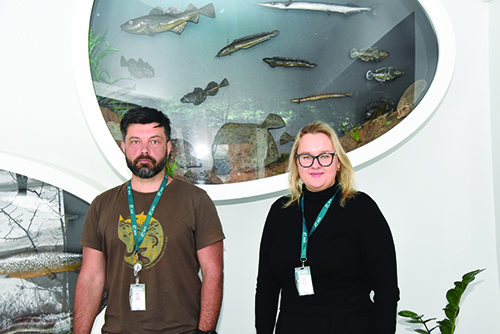
This article was featured in Eurofish Magazine 2 2026.

RoundGoby is an Interreg Baltic Sea Region project that aims to help authorities improve the legal framework for round goby fisheries and to guide enterprises in developing appropriate fishing gear and products for local markets. It runs from November 2023 to October 2026.

On parts of Latvia’s coast, the invasive round goby has moved from being an ecological concern to becoming a resource for small-scale fishers. This shift can be attributed to Latvia’s willingness to experiment, adapt, and, in practical terms, learn how to fish round goby in a selective way so that other species are not caught as by-catch. The Interreg project RoundGoby starts from this Latvian experience and attempts to answer a question of relevance to the entire region: if the invasion cannot be reversed, how can the region reduce harm while creating value?
A significant part of coastal landings
Round goby was first recorded in Latvian waters in the Gulf of Riga in 2002 and near Liepāja in 2004, after which it became established along the coastline. The species appeared in commercial catch statistics in 2006 at a negligible level, then climbed year on year until 2018, when landings peaked at 1,113 tonnes. Loreta Rozenfelde and Eriks Kruze, scientists at the Latvian Institute of Food Safety, Animal Health, and Environment (BIOR), describe recent annual catches as in the 500–700 tonne range, making it the second most important coastal species after herring. In many places, the round goby is primarily considered a threat because it destroys features such as mussel banks, altering the ecosystem both physically and biologically as species that feed on mussels move away. On the other hand, as the round goby has become more established, other carnivorous species have adapted to it. In coastal areas, cod, turbot, perch, and pike perch prey on it, as do cormorants. There is also evidence to suggest that they make up a significant part of grey seals’ diets. Importantly, in Latvia, it is also an established component of coastal landings. The project’s purpose is therefore not simply to remove but to manage the species under conditions where some livelihoods now depend on it. Dr Kruze calls it a “bio-economic paradox”: the same fish is both an invasive predator and a business opportunity.
Latvia’s coastal fishery is small-scale, generally operating to around 20 metres depth, and using passive gears such as gillnets and trap nets. A key feature is that fishers and scientists have co-developed gear that targets round goby more selectively, including specialised gillnets and trap nets. In some of the countries involved in the project, gill nets are not encouraged because of the risk of trapping birds. In Latvia, Dr Kruze states, few studies have been done on the effect of gill nets on marine birds, but their popularity among fishers is declining because they attract seals, which feed on the catch and destroy the gear. Increasing the catches in a bid to exterminate the fish is not an option as—now that the fish has proven to be of commercial value—it needs to be managed like any other resource rather than be overfished, says
Dr Kruze. Besides, if fishing pressure rises without control, the risk of by-catch rises too, including undersized fish of commercially desirable species. The fishery is regulated through limitations on the number of gears per municipality and with temporal restrictions rather than through a catch quota. Ms Rozenfelde explains that the cleanest fishing window is the spring-summer spawning period, when round gobies are active and easier to catch, and unwanted bycatch is lower. Autumn fishing was curtailed, she adds, after test activity showed unacceptable by-catch of other species, such as small-sized cod, flounder, and vimba bream.
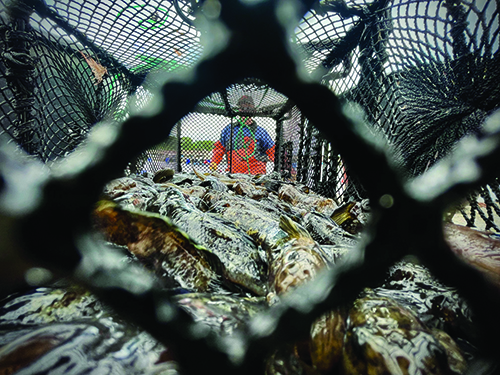
More selective fishing gear being tested
A Latvian-specific complication is that the peak round goby season overlaps with herring spawning in the Gulf of Riga, creating mixed catches that reduce value because of the labour needed to separate the fish. This has an impact on prices and provides an incentive to develop more selective trap nets that reduce herring by-catch. Even if there is a by-catch it can still be released alive from the trap net. The project’s test fishing work is designed to provide recommendations for cost-efficient fisheries that fit national legislation, rather than pushing a single method across
the region.
Latvia does not have a domestic market for round goby, so catches are exported. The main sales channels in the Baltic Sea region are Latvian and Estonian processors, who freeze whole fish and sell it onward. Prices vary from €0.70 per kilogram for smaller fish, and around €1.20 per kilogram for larger fish, suggesting the importance of adding greater value to the raw material. Latvian landings are also exported frozen at around €0.70/kg, mainly to Ukraine. Round goby has in recent years become a key species for Latvian coastal fishers, partly because Eastern Baltic cod stocks have declined. At BIOR, Ms Rozenfelde says, chemical analyses of the fish flesh revealed a protein content of 15-20%, a fat content of 1%, and no toxins such as heavy metals. The latter can partly be attributed to its relatively short lifespan of
6-8 years. This nutrient profile makes it a potentially valuable species for human consumption as well as for pets. The lack of toxins in the flesh should also mitigate concerns about a species that feeds on mussels or lives near ports. A review of products and processing methods across the Baltic Sea Region found that round goby products are rare in regional retail, with no locally produced human-food products identified, and only one locally produced pet product found during the market observation period. The few round goby products available are seasonal, and even the prominent canned product sold in several countries is produced outside the region. Latvia’s experience shows that catching the fish needs to be followed by creating a stable demand that pays for handling and processing.
Without that, the fishery risks becoming dependent on commodity exports that are price-sensitive and do not reward quality differentiation.
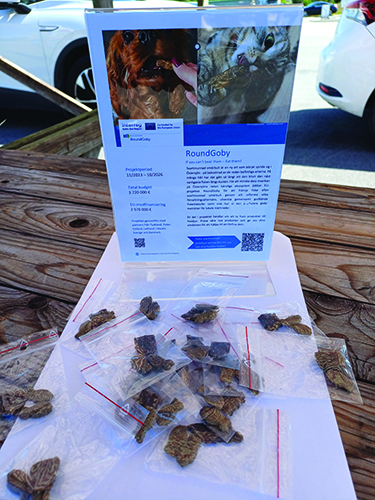
Products for humans and their pets
Processing round goby is challenging because of the large size of the head. The small size round gobies do not lend themselves to filleting by machine, while manual filleting is difficult because the flesh is fragile and the fish is small and slimy. One way of treating the fish is to therefore mince it and use the mincemeat to develop patties and other formed items. Project partners have also discovered that round goby meat can lose its integrity in canned products, which consumers may find unpleasant, and that consumers appreciated fried round goby most in the products assessed. A commercially available fried round goby in tomato sauce was perceived as mushy, implying that preparation or packaging methods may need adjustment if that product type is to succeed.
Work in the project has determined that the pet food market is structurally similar across Baltic Sea Region countries, and that demand trends support growth. Dr Kruze feels that smaller fish sizes that are impractical to fillet could be turned into pet snacks, where processing can focus on drying or other formats that do not require delicate filleting. Partners are carrying out consumer research on dog snacks made with round goby, even as they trial round goby in public kitchens and among chefs to build familiarity with the species, which may, over time, lead to the creation of a domestic market for the fish.
Lessons from the Latvian experience
The round goby project has produced valuable results. Latvia was among the first countries in the region to experience the depredation wrought by the fish, to develop a management strategy, to experiment with selective gears, and to build a market for it, says Dr Kruze. This knowledge can be shared with the other participating countries through the round goby project. The Latvian partners in the project have also discovered that moving up the value chain calls for a sustained effort to promote the fish to consumers and to develop products that meet their requirements. Without this, the fish will be treated as a commodity sold in bulk for a low unit price. While round goby catches in Latvia seem to have plateaued, the fish is spreading northwards in the Baltic sea and other countries can therefore learn from the
Latvian experience.