This article was featured in Eurofish Magazine 3 2026.


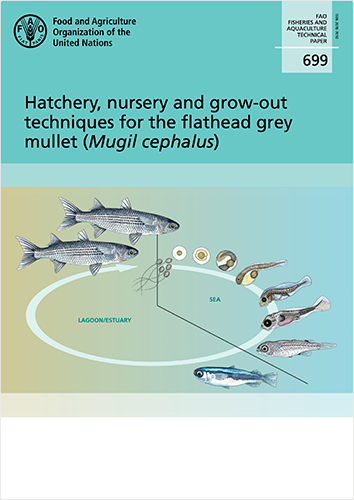
Global production of flathead grey mullet, Mugil cephalus, is rising, highlighting its increasing value in aquaculture. A recent manual from FAO, one under its series of Fisheries and Aquaculture Technical Papers, brings together current knowledge on the species’ biology, life history, hatchery design, and operational management, insights support effective culture practices. The flathead grey mullet is considered a promising low-trophic species for the expansion of global aquaculture due to several desirable traits, including its adaptability to a wide range of rearing conditions, tolerance to challenging environments such as high temperatures and low dissolved oxygen levels, omnivorous feeding habits, and the high nutritional value of its products, including smoked fillets and fish roe (bottarga).
The manual also examines hatchery site selection, system design, and infrastructure, covering open, semi-closed, and closed systems, seawater supply, live feed units, and facilities for larval and juvenile rearing. Operational guidance includes microalgae, rotifer, and Artemia production, alongside broodstock capture, maintenance, nutrition, handling, and spawning under controlled conditions. The production cycle is outlined from egg incubation to post-larval culture, with attention to environmental parameters, feeding, growth, weaning, and behavioural changes during metamorphosis. Health management, diseases, and parasites are also reviewed. The manual is designed to assist practitioners in the field as well as those embarking on the farmed production of Mugil cephalus for the first time.
The volume can be freely downloaded from the FAO knowledge repository using the link, https://openknowledge.fao.org/handle/20.500.14283/cd9536en