This article was featured in Eurofish Magazine 6 2025.




Round goby (Neogobius melanostomus), an invasive Ponto-Caspian fish now widespread in the Baltic, presents both ecological risks and a commercial opportunity. The Interreg Baltic Sea Region project RoundGoby (2023–2026) brings together authorities, researchers, and companies to pilot viable fisheries, gear, and products. Lithuania’s Kaunas University of Technology (KTU), together with the processing company Baltijos Konservai, leads the development and upscaling of canned, minced, and spreadable round goby foods.
Round goby is the archetype of a successful invader: highly adaptable, fast-reproducing, and now present across most Baltic coastal waters. Its expansion has driven ecological concerns and bycatch challenges, but it also represents a potential blue-economy resource if harvesting and processing can be organised responsibly. The project’s first major study synthesises global experience—from the native Black Sea and the North American Great Lakes to the Baltic—setting out both risks (e.g., parasites, contaminants) and market opportunities (e.g., minced meat, canned products, pet food). It concluded that the Baltic Sea Region is largely an untapped market where targeted product development and supply chains could unlock ways of profitably converting an invasive species into a resource. The project’s mandate includes helping authorities adapt regulation, trialling appropriate fishing gears, and guiding enterprises in producing suitable food and pet products for local markets.
From lab concept to factory line
KTU’s Food Institute leads efforts within the project to develop canned, minced round goby products. In this it partners closely with Baltijos Konservai, a processing company in Klaipeda, to move promising recipes from lab autoclaves to industrial canning. One of the constraints is that round goby is very lean (≈1–2% fat), which can make heat-processed products dry, crumbly, and bland unless the formulation compensates for fat loss and texture breakdown. In early trials, KTU established that adding an appropriate vegetable oil (sunflower oil performed best) improved mouthfeel and flavour; versions with ulva seaweed were also prototyped for added healthfulness. When taste panellists liked the flavour but not the texture of whole-piece packs, KTU switched to minced and spreadable formats, where delicate flesh becomes an asset rather than a drawback. These are now being prepared for upscaling at Baltijos Konservai.
KTU’s samples were prepared at a pilot-scale in-house canning to iterate quickly and deliver factory-ready processing protocols, while acknowledging that full industrial runs are essential for precise temperature–time controls, filling behaviour, and consistency. This lab-to-plant pathway is a good example of collaboration between scientists and industry to create commercially viable products. Although round goby is edible and widely consumed in its native range, Baltic products must comply with EU food safety regulations. In KTU’s work, Lithuanian investigations found no heavy-metal presence that exceed safety thresholds in local goby. Tests included dioxin screening (initially via Polish labs) which showed results within regulatory limits. Dr Narkevicius explains that these were single-trial checks and that expanded, comparative analyses by partners in Latvia and Denmark are part of the project plan.
The project’s testing of fishing gears in Sweden and Denmark is designed to build a stable supply for processors such as Baltijos Konservai. Ready-to-eat round goby products are still rare in Baltic retail. One canned product is sold in parts of the region, which is why the analysis broadened to other small white-fish categories for inspiration. In taste trials fried round goby scored highest with consumers while canned whole-piece goby was penalised for fragile texture that breaks into flakes—precisely the problem KTU addressed by moving to minced and spread formats where texture is controlled by binding agents and fats.
Processing constraints—and the opportunity in mince
Round goby presents atypical processing challenges. Manual -filleting is troublesome due to small size and strong bones; machine filleting solutions adapted from herring and sprat do not transfer well. Industry consultations with producers of processing equipment show that heading and gutting can be mechanised, but industrial-scale filleting remains problematic, so producing minced meat after heading and gutting is currently the most promising route. This validates KTU’s strategy to focus on minced, canned, and spreadable products rather than chasing a fillet market. Round goby availability is seasonal and spatially variable with aggregations in some areas such as the northern part of the Lithuanian coast. Cans with their long shelf life emerge as the logical preservation method to smoothen fluctuations in raw material availability and ensure year-round supply.
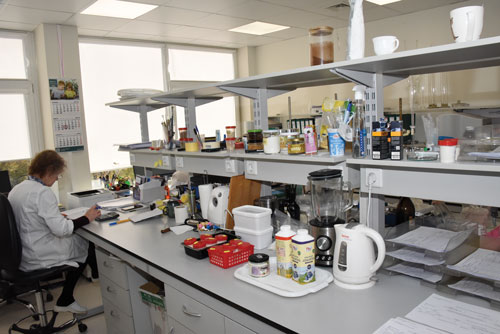
At the Food Institute, laboratories are accredited to the ISO 17025 standard demonstrating their competence.
KTU has tested freeze-drying, fermenting, and smoking (e.g., sausages). These underscore the fat limitation once more, without added fat, dried or fermented goby can be too hard and dry. While these are not target deliverables for the current pilot, the trials broaden the options available for future, higher-value variants if fat systems compatible with curing can be identified. Parallel efforts in the consortium include pet-snack development, where consumer tests suggest dogs are the primary opportunity, and culinary pilots in Sweden to increase consumer awareness via dishes such as fish fingers and burgers. KTU’s food-technology know-how complements these by delivering the long-life formats necessary for retailers and export.
KTU’s Food Institute links science, industry, and supermarket shelf
There are several aspects to the RoundGoby project including fishing gears, regulatory guidance, consumer acceptance, and business models. KTU’s Food Institute provides the process and product engineering that turns a predatory invasive species into foods that the regional market can stock and consumers can trust. KTU’s pilot directly answers the project’s central challenge: making it technically feasible and commercially attractive create products for human consumption from a pest. If successful, the Baltic gains a new, climate-smart, circular protein; coastal communities gain a new product line; and the ecosystem gains a modest lever to rebalance food webs—a practical materialisation of the project’s motto: If you can’t beat them, eat them