
A Croatian producer of seabass and seabream has used a high quality product and good service to create a reputation on the Italian market.

Italy is the biggest market in the EU for seabass (Dicentrarchus labrax) and seabream (Sparus aurata). Domestic production of the two species is relatively modest at about 12,000 tonnes, a number that has remained stable for several years. To meet demand therefore Italy imports large quantities of these two species. Since 2010 Italian imports of seabream have increased by 15% to almost 26,000 tonnes in 2014, while seabass imports increased by 4% to 22.5 thousand tonnes over the same period, according to data from Ismea. Among the countries exporting seabass and seabream to Italy is Croatia, where the biggest producer is Cromaris.
Twenty-four hours from cage to counter
Croatia has a geographical advantage over other major European exporters of seabass and seabream such as Greece and Turkey. Fish from Croatia can be on supermarket counters within 24 hours of being harvested, a significant benefit when the product is as delicate as fresh fish. Cromaris has its farms in the central and northern part of the Adriatic and harvests, processes and ships its fish directly to the customer every day. However, the freshness of the product and the speed of delivery are only part of the formula. Another ingredient, says Davide Furlan, who is responsible for Cromaris Italy, is that the company makes no demands for a minimum delivery. A customer does not have to order a truck of fish or even a pallet. We will deliver even a single box if that is what the customer orders, says Mr Furlan.
Freshness and quality are key attributes in any food-related business and even more so when it comes to sensitive perishables like fish on ice. The Italian market is also highly demanding; customers are used to buying very fresh fish, which they recognise and appreciate. At Cromaris the whole production and delivery process is geared to meet these stringent market requirements. The company is fully integrated with its own hatchery and broodstock; production both on the farm and in the processing plant is certified to multiple standards including HACCP, ISO, IFS, Global G.A.P., and Kosher; and for its distribution the company uses its own trucks as well as those of partners. The logistics are planned so that the fish leaves the farm in the evening and early the next morning is delivering all along the Italy’s eastern seaboard – Trieste, Venice, Chioggia, Porto Viro, Goro, where all the biggest seafood companies are located. For the moment the company supplies the northern and the central parts of the country up to Ancona in the east and Rome in the west. The south, says Davide Furlan, calls for another employee.
Using television to target end consumers
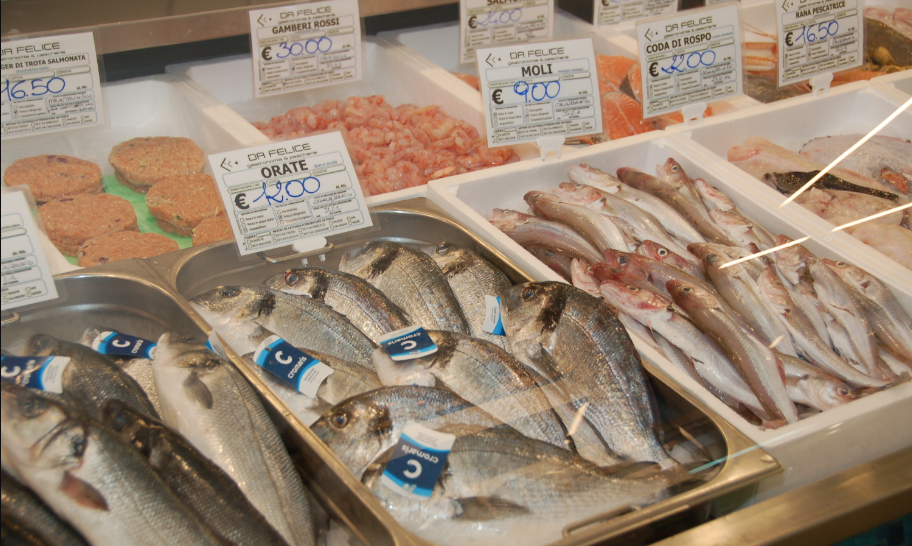
In anticipation of greater sales Cromaris is ramping up production currently at 6,500 tonnes to 10,000 tonnes in 2018. While a large fraction of this comes to Italy, the company also has other markets in Europe including in Germany, France, Poland, the Czech Republic, Hungary, and Albania. As the most important market Italy has been the focus of marketing campaigns on television, the next one of which will be going live shortly. While a previous promotion effort focused more on creating awareness, the new one is directly consumer focused and will explain why Cromaris’ fish differs from the alternatives, why it is more expensive, and why customers should look for it despite the higher price. This type of exercise is relatively unknown for this kind of product (fresh fish) and the company went to great lengths with marketing experts, psychologists, and focus groups to tailor the right message. AS far as I know only the Norwegian Seafood Council has done something similar, says Mr Furlan, but that is generic marketing, while ours is for the Cromaris brand. Identifying Cromaris’ fish at a supermarket or fishmonger is easy thanks to the tag that is stuck into each fish. Campaigns alone, however, are not enough to persuade consumers. One of the biggest challenges facing producers is the quality and quantity of information provided to consumers by sales people in stores. This can either be inadequate or occasionally even incorrect. The company therefore invited all the store managers from a big supermarket chain in Italy to visit its production facilities in Croatia to show them the whole production process.

Meagre steaks to tempt private consumers
In addition to seabass and seabream Cromaris also started the production of meagre (Argyrosomus regius) some years ago. A fast-growing fish with firm white meat meagre is a relatively new species to be farmed in the Mediterranean. It is characterised by a large head and tail so that the fish needs to grow to a large size for a good yield of meat. The company is growing the fish to 2-3 kg and selling it to the hotel, restaurant, and catering sector, however this size is too large for private consumers. To them the company is offering a new product, meagre steaks. At 60-70 g a piece a consumer can buy as many of them as necessary without having to deal with a whole fish. Meagre however does suffer the disadvantage of whitish flesh that is less attractive than the meat of salmon or seatrout which is a more attractive colour. Production of meagre is still modest compared with that of seabass and seabream and the company is still ironing out kinks in production, but expectations from this fish are high.
Last year Cromaris launched the production of organic seabass and seabream which are being farmed at its site in the Lim bay close to the border with Slovenia. This fish is sold mainly on markets in Germany, Austria, and Switzerland, where awareness of and demand for organic products are very high. These are also markets that can afford to pay the premium associated with organic fish, which in Cromaris’ case costs about 30% more than conventionally farmed fish. The reason is the feed, which is more expensive, as well as the lower density at which the fish are farmed, and not least the cost of certification. The production is certified to different standards including BioSwiss, AB, Naturland, Global G.A.P. and Friend of the Sea and is farmed at a density of around 10 kg per cubic m as opposed to 70 to 100 kg per cubic m for conventionally raised fish.
| Cromaris Italia SRL | |
|
10, via delle Industrie Tel./Fax: +39 0422 786948 | General Manager: Davide Furlan Products: Seabass, seabream, conventional and organic; meagre, mussels, oysters Product forms: Fresh fish, fresh fillets, MA packaged fresh fish, smoked, marinated Markets: Italy, Germany, Austria, Switzerland, Poland, Albania among others |
Wide range of products
The company emphasises the Adriatic origin of its fish. A new hatchery, now going on stream, is claimed to be the biggest in Europe for seabass and seabream, and the broodstock is from the Adriatic, further differentiating the fish from that farmed in other countries. At the other end of the production chain the range of products extends to fresh fish, fresh fillets, MA packaged fresh fish, and smoked and marinated seabass and seabream products. The Italian market, already the company’s biggest, is likely to get more important still.