
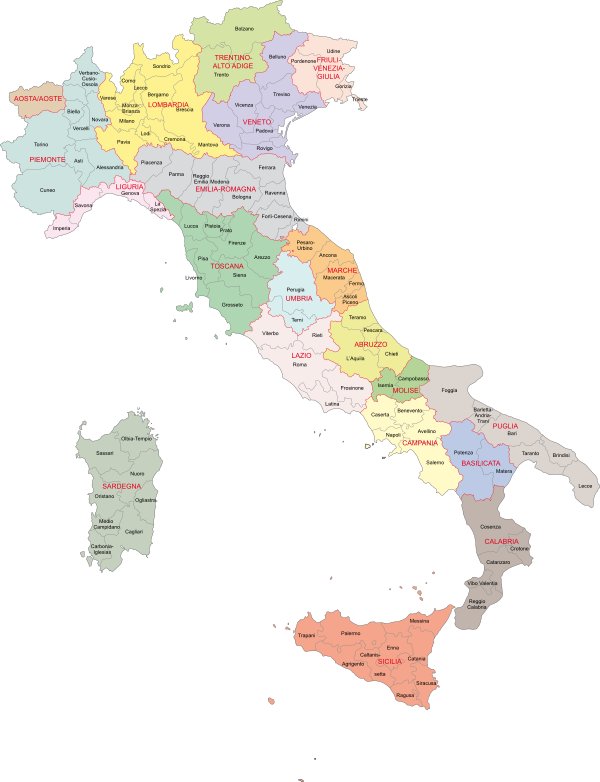
Fabio Fiorentino of the Institute for Coastal Marine Environment on Sicily, discloses that the Sicilian fleet accounts for almost 25% of the total value of Italian fishing landings.

In contrast to fisheries in the North Atlantic fisheries in the Mediterranean are characterised by the multitude of species and the varieties of gear that are used to target them. Italian catches in the Mediterranean (together with Turkey’s) are the biggest of the approximately 30 countries whose fleets fish these waters.
One of the most important fisheries in Italy is the deep-water crustacean fisheries which takes place in a very large area of the Mediterranean from the Channel of Sardinia, between Sardinia and Africa, to the Aegean Sea and further east to the Levant Sea. The target species are mainly deep-water crustaceans, deep-water rose shrimp (Parapenaeus longirostris), which is the most abundant, and giant red shrimp (Aristaeomorpha foliacea). The latter is caught in water up to 800 m in depth. The main commercial bycatch species is European hake (Merluccius merluccius), catches of which averaged 1,500 tonnes between 2012 and 2014 and were valued at EUR8m in 2014. Other species are Norway lobster (Nephrops norvegicus) and violet shrimp (Aristeus antennatus).
Important crustacean fisheries in the Strait of Sicily
Fabio Fiorentino is a researcher at the Institute for Coastal Marine Environment of the National Research Council (IAMC-CNR) at the division in Mazara del Vallo on Sicily, a key region in the Italian fisheries sector. Sicily is home to the largest Italian fleet, which accounted for 17% of all Italian landings in 2014 with a value of almost a quarter of the total – more than any other region. As in the rest of Italy, the Sicilian fleet has undergone significant reductions. In Mazara del Vallo for example in the 90s there were more than 250 trawlers, a number that has shrunk to about 80 today. The increase in fuel prices was one of the reasons. Most of the vessels were built 40 years ago, a time when fuel prices were much lower. Many of these vessels target shrimp. Dr Fiorentino points out that the crustacean stocks are shared between Italy (mainly Sicily), Tunisia, and to a lesser degree Malta, which has a very small fleet. The most valuable of these species is the deep-water rose shrimp. Italian catches in 2014 amounted to just under 7,700 tonnes with a value of almost EUR50m. The Italian fleet is responsible for about 80% of the total catch while Tunisian vessels catch the remainder. Over the past years, however, trawlers from Mazara del Vallo operating in the Strait of Sicily have changed their target to red giant shrimp from deep-water rose shrimp, while the smaller vessels have shifted their target from fish to deep-water rose shrimp.
There are a couple of reasons for this shift, according to Dr Fiorentino. One is the higher price that fishermen can obtain for crustaceans has been an incentive for them to switch targets. Yet another reason has been the presence of other nations’ fishing vessels in the Strait of Sicily. These vessels target mainly fish, such as red mullet (Mullus barbatus). In past years this species had also been targeted by the distant water trawlers (over 24 m) based in Mazara del Vallo and to avoid conflicts the Italian vessels shifted to other species such as crustaceans. The crustacean fishery is technically more demanding, requiring better equipment and greater expertise and there was less likelihood of conflicts. There were also commercial reasons to switch to other species as Greece, the main market for mullet, was suffering from the effects of the financial crisis and was no longer as lucrative. These big trawlers can stay at sea for over a month without returning to port, and they freeze their catch on board. Smaller trawlers, those between 12 and 24 m, are based in the harbours along the southern coast of Sicily and generally operate close to the coast spending 1-2 days at sea. These vessel too have started fishing in deeper waters changing their target from finfish and cephalopods to deep-water rose shrimp, which are typically landed fresh.
A regional management plan gradually takes shape
The solution to the problem in the future may be a long term management plan that is currently being discussed among others by the Italian ministry for agriculture, the GFCM, FAO, and research bodies. This will cover deep-water rose shrimp, the stock status of which has been assessed and the assessment endorsed by the scientific advisory committee of the GFCM, and will also consider the effect of this fisheries on associated species, such as hake. The plan will be a regional plan covering all the countries that share the stock, Italy, Tunisia, and Malta, but also other countries. The first step towards this management plan was taken with a request from the General Fisheries Commission for the Mediterranean (GFCM) which at its last meeting asked all the Mediterranean countries to present a list of trawlers that operate in the Strait of Sicily. This is the initial phase of an effort to monitor and control the activities of the vessels in the area. It is needed, as Dr Fiorentino observes, because stock assessments suggest that the current exploitation of the stock in the Strait of Italy is not optimal. The stock is still being overfished due to a bad exploitation pattern with a lot of undersized shrimp and hake. The proposed management plan will be a tool to regulate the fishery and lay down some common rules with the objective of exploiting the stock sustainably. It should include measures to improve the exploitation pattern of deep-water rose shrimp and associated species.
|
Packaging on board Adding value can compensate for lower volumes 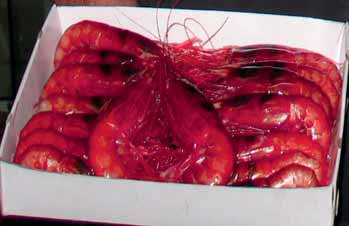
Gioacchino Bono at the Institute for Coastal Marine Environment on Sicily is looking at packaging technology that can be used on board demersal vessels catching high value products such as crustaceans. The aim is to give the fisher a better price for his catch and compensate for lower catch volumes. One of the ideas he is working with is the use of modifi ed atmosphere (MA) to package the product. Currently, a vessel catching shrimp in the eastern Mediterranean has been installed with a trial machine that can either use MA or skin packag
|
Reducing catches of undersized fish and shrimp
Almost the entire yield of the deep-water rose shrimp comes from the Strait of Sicily, the channel between Sicily and Tunisia. Among the measures being considered in the management plan is the adoption of fishery restricted areas, that is, banning trawling in areas where juveniles aggregate after recruitment. The current legal minimum mesh size at the codend of trawls in the Mediterranean is 40 mm opening square or 50 mm opening diagonal. This enables the capture of several species including shrimp, but also undersized hake (and undersized shrimp). The challenge is to find some way to reduce the vulnerability of the juveniles to this gear and closing off nursery areas in the Strait of Sicily to fishing by trawlers is a possible solution both for shrimp and hake. These two often occur together as juveniles and nurseries of hake are often also nurseries of deep-water rose shrimp.
Other measures to improve the sustainability of demersal fisheries include limiting and controlling the fishing effort either by reducing the fishing capacity (the number of vessels) or the level of activity (days at sea) or by some combination of both. However, both fishing capacity and activity in the Italian fleet have been declining for years and experts agree that there is only limited scope to make further reductions. Dr Fiorentino favours the spatial closure approach as some of his early research supports its efficacy. Looking into the management of fish mortality he simulated two different scenarios. The first was the classical reduction of fishing mortality through the reduction of fishing effort, the other was not to touch the fishing effort, but to close nursery areas. The results were very interesting and particularly for deep-water shrimp, because maintaining the fishing effort, but reducing the impact of trawling on nurseries, produced a reduction of fishing mortality on the stock that is similar to that obtained by reducing the fishing effort by 10%. The results showed that it was possible to obtain a more sustainable fishery, modulating not only the fishing effort, but also the action of the fishing effort in space.

Rules applicable to all fishers in the area
Whatever the measures agreed upon vessels from all countries fishing in the area would be subject to these common rules. The current fishing effort and the current exploitation pattern are leading to over-exploitation of the stock. To reach MSY for deep-water shrimp, the current fish mortality needs to be reduced by 20-30%. To achieve MSY for hake, which reaches first maturity at 4 years and can grow to a size of 1 m and has thus a completely different biology from the shrimp, mortality needs to be reduced by 70%.
The FAO MedSudMed Project will make a significant contribution to the Central Mediterranean demersal fishery management plan. As the stocks involved are shared by different countries, EU and non-European, FAO MedSudMed Project provides a neutral forum where the issues can be discussed. In addition, the stocks of the deep-water rose shrimp and hake are regularly assessed with the support of the regional FAO project, MedSudMed, and the assessments are discussed and endorsed by the Scientific Advisory Committee of the General Fisheries Commission for the Mediterranean. This technical assistance project started with the aim of increasing scientific cooperation and developing capacity in the region so that countries could gather, analyse and share data on their fisheries and fisheries resources. Enrico Arneri, the FAO coordinator of MedSudMed, says that increasingly the focus of this project is moving from fisheries research to support to fisheries management and its impact not only on the fish but also on the fishermen. With the approval by countries the GFCM recommended the establishment of a list of authorised vessels fishing in the Central Mediterranean area and fixed a minimum length of some target species like deep-water rose shrimp as first measures to reduce fishing mortality. Dr Fiorentino pointed out that one further way could be spatial closures to trawlers of nursery areas. Clearly this is a measure that would work if the vessels have a vessel monitoring system (VMS) on board, but since many at present do not, it may not be immediately effective. In other words, designing a management plan that fits countries that are hugely different in many senses, economically, politically, and socially, is going to be a challenging task.
Landing obligation for demersal more problematic than for pelagics
Among the new elements introduced by the reform of the Common Fisheries Policy are the discard ban and the landing obligation. In the Mediterranean discards are estimated to amount to be around 230,000 tonnes annually or just under a fifth of average annual catches, according to a recent paper* in the ICES Journal of Marine Science. The discard ban came into force for the small pelagic fishery from the start of 2015. In the Italian small pelagic fisheries discards are less of an issue as catches tend to be uniform with little or no bycatch and the target species tend to be of a similar size. Only specimens that are less than the minimum size qualify as discards. For the demersal fishery the landing obligation will be phased in over two years to cover all species subject to a minimum size by the beginning of 2019. The demersal fisheries in the Mediterranean are highly complex with a multitude of vessels, gears, and species that result in very mixed catches. Discarding may be for any one or more of a number of reasons, including economic (the lack of value of some of the species caught, or high grading), legal (fish caught are under the minimum size), commercial (when catches may affect market demand in some seasons), technical (lack of selectivity of gears or inadequate storage capacity on board), biological, environmental, or due to poor enforcement.
The Mediterranean is in a state of flux
Improvements in technology have sometimes resulted in lower discard rates. The use of lighter ne
ts, for example, in the Sicilian distant water trawlers originally introduced to reduce fuel consumption also resulted in less megabenthos (starfish, sea urchins, algae, sea cucumbers etc.), says Fabio Fiorentino. As a result discards in the shrimp fisheries came down from about 50% to 30-40%. Some scientists think that discards play an environmental role, providing feed for seabirds and other scavengers that prey on the discards. The Mediterranean is an oligotrophic sea and Dr Fiorentino feels that preventing discards removes a source of nutrients from the water at a time when other changes may also be making the sea less productive. For example, the flow of rivers into the Mediterranean has decreased, and this freshwater, which used to be a rich source of nutrients, has a lower content of nitrogen and phosphorus than before and a higher content of chemical pollutants. Another impact is that of climate change which, in some areas, may be slowing down the mixing of surface water and bottom water in winter making the sea less productive. But climate change also seems to have some positive effects. While increases in the water temperature has made the Mediterranean less attractive for some species like sardine, mackerel, and blue whiting, it has had a positive impact on others. The population of deep-water rose shrimp, for example, a species that prefers warmer water, is increasing in the north and in the Ligurian Sea. Other species are entering the Mediterranean from the Red Sea drawn by the warmer water and as a result the species composition in the eastern basin is changing. These changes point to a sea that is in the process of evolving and the challenge is to adopt fisheries strategies that take these modifications into account.
Banning discards vs preventing them in the first place
Discards however are a waste of resources and they also damage the environment and are seen to be incompatible with responsible fishing. Overall, they have also been increasing, according to the authors of the ICES Journal of Marine Science paper, due partly to improvements in technology that enabled fishing in areas that were once inaccessible, changes in demand for certain varieties of fish, and environmental changes among others. The authors note that greater prosperity also seems to lead to higher discards as societies become more fastidious about what they will eat, while in times of poverty a larger variety of species and sizes is acceptable. For fishermen too first catching and then handling discards are a cost in terms of time and money. More generally, conservation organisations have highlighted the problem of discards guiding public opinion against the practice. The introduction of the discard ban and landing obligation has provoked concerns that landing undersized fish, which can be used for the production of fishmeal and fish oil may result in the creation of a market for this fish and negate the point of the ban. Other scientists have concluded that the landing obligation may increase the costs to fishermen for handling and storing the fish on board, and processing it in ports. The infrastructure for managing discards does not exist in most Italian ports and will need to be created, leading to higher costs. A study coordinated by CIBM in Livorno and involving colleagues from CNR-ISMAR of Ancona, COISPA of Bari and NISEA of Salerno suggested that the landing obligation in the short to medium term risked making demersal fisheries economically unsustainable. In the Mediterranean the discard ban and the landing obligation are viewed with a degree of scepticism not only by fishers but also scientists and policy makers, who would rather see greater focus on the use of spatial and temporal closures of certain areas such as nurseries that would contribute to the prevention or reduction of unwanted catches in the first place.