This article was featured in Eurofish Magazine 3 2026.

A project is working towards increasing the sustainability of fishing by reducing catches of sensitive species and juvenile fish while at the same time optimising fishing operations.
Every day, millions of fishing vessels head out to sea to feed the world. More than three billion people rely on seafood as a significant source of protein in their daily diet. In the EU, 44% of fish stocks are still overexploited and coastal habitats are under increasing threat. MarineGuardian is an EU-funded research and innovation project bringing together researchers, gear manufacturers, fishers, processors, policymakers and ecolabelling bodies to accelerate the transition towards more sustainable and economically viable fisheries.
What is MarineGuardian?
The project is part of the Mission Ocean portfolio and runs from 2025 to 2029. It has 21 partners from nine countries across the Atlantic and Arctic sea basins. The project is developing several innovative technologies to reduce and prevent incidental catches of sensitive species and juveniles, combined with decision-support systems offering both optimisation of fishing operations and mitigation measures to protect sensitive species. These technical solutions, more than 30 in number, are designed for use across both small-scale and large-scale fisheries. Beyond the technical solutions, MarineGuardian is also developing policy briefs, training modules and an online course to ensure that the knowledge generated reaches fishers, managers and decision-makers alike.
The project is demonstrated across six case studies spanning the Atlantic and Arctic, from the coast of Newfoundland, Canada, to Greenlandic waters, the coast of Norway, Iceland, west of Scotland, and the Bay of Biscay and Iberian waters, covering a wide range of fisheries.
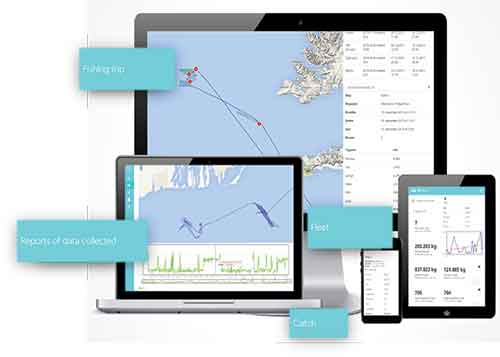
Presentation of the Hafsýn software, a tool to produce bycatch predictions on demand
and thus allow skippers to mitigate the risk.
Drawing of a time-tension cutter, a device designed to cut
a rope if an animal gets entangled in it before lasting harm is done.
MarineGuardian is one of three complementary EU projects covering European seas, alongside ECO-CATCH (Baltic and North Sea) and Sea4Future (Mediterranean), all recently endorsed under the UN Ocean Decade’s Gear Up Towards Sustainable Fisheries action, led by ICES. The project has now been running for one year and multiple exciting results demonstrate a reduction in bycatch of both sensitive species and juveniles. Three of the solutions have reached significant milestones in their development.
Protecting dolphins during beach seine fisheries on Portuguese beaches
Beach seine fishing is deeply embedded in the coastal culture of Portugal: nets are cast from the beach into the sea and hauled back by hand, a practice passed down through generations. This fishery inadvertently catches common dolphins and Iberian harbour porpoises, two species that are listed as endangered on the IUCN Red List. During the first tests conducted in summer 2025 by the team at the Centre of Marine Science of Algarve (CCMAR), two different brands of commercial pingers were tested on the fishers’ vessels, following interviews with fishers to identify the highest-risk beaches. Preliminary results were striking: an estimated 87% reduction in dolphin bycatch rate was recorded during the trials. As this fishery is highly seasonal, the next steps will take place during summer 2026, when the pingers will be tested on more vessels and the first designs for potential exclusion devices, to allow the live release of animals, will be developed.
Protecting marine mammals (whales) from vertical buoy lines
Marine mammals, and specifically whales, are often entangled in the vertical buoy lines attached to baited pots (snow crab fishery in Newfoundland). To prevent this, the team at the Marine Institute – Memorial University of Newfoundland has developed a time-tension line cutter which automatically detects tension caused by an entangled animal and cuts the rope before serious injury occurs. After one year in the project, 400 bench-top experiments have been carried out. These revealed that 70% of the cutters maintained consistent performance after repeated use. Moreover, the researchers found that cold water increases cutting time, a key parameter to be taken into account when adapting the tool for use in northern waters. In 2026, the first tests will be carried out at sea.
Reducing the bycatch of sensitive species in trawl fisheries
In trawl fisheries, one of the main challenges faced is the bycatch of sensitive species. In redfish fisheries in Newfoundland, this issue is becoming increasingly problematic as one of the main species bycaught is the white hake (Urophycis tenuis), an endangered gadoid in parts of Canada. The team in Newfoundland evaluated whether switching from a standard mesh (T0) to a rotated mesh (T90, where the mesh is turned 90 degrees, creating a more diamond-shaped opening) would reduce white hake bycatch and allow for the capture of only larger redfish. The tests conducted in November 2025 confirmed that using the T90 mesh selects for larger redfish, while results for white hake were less clear, despite indications that larger mesh sizes might reduce bycatch. The next steps will include new designs and flume tank tests during 2026 to evaluate the best approach to reducing white hake bycatch.
Pinger trials in the Portuguese beach seine fishery led to an 87% reduction in the bycatch of dolphins.
Support systems for smarter decisions
As more data is collected during fishing operations, the logical next step is to transform it into actionable knowledge, helping skippers improve efficiency, reduce fuel use, and steer clear of areas where bycatch risk is highest. Multiple partners in MarineGuardian are working towards this goal. However, as these solutions require more development time, results after one year of the project are less advanced.
Understanding where bycatch rates are highest
Imagine having access, while at sea, to a map showing the areas where bycatch risk is highest for a given species and season. This is the solution the team at AZTI is working on. Having started with the demersal trawl fleet in the Bay of Biscay, the group hopes to extend it to other local fleets as data availability improves. By gathering and compiling fisheries-dependent and independent data, as well as dynamic and static data, they are now selecting the species most suitable for modelling based on data availability, and will begin integrating them into spatio-temporal models to enable a risk assessment of areas with the highest bycatch and encounter probabilities. The tool will ultimately be made available as an application to assist skippers reduce bycatch risk in real time.
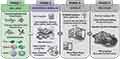
Overview of the workflow steps to build the bycatch risk map. The map would help skippers avoid areas
where the risk of bycatches is higher.
Optimisation of fishing efficiency and reduction of environmental impact
In Iceland, numerous fishing vessels are equipped with Hafsýn, a decision-support system developed by another project partner, Trackwell. This system is fully operational but will be extended during the project to allow fishers to monitor their impact and avoid bycatch and sensitive areas. The first prototype has been developed and is already producing live bycatch predictions on demand. It has been validated on 12 years of data and has been demonstrated for cod catch and the bycatch of juvenile cod. It will progressively be expanded to cover more species and bycatch scenarios, trained on environmental and oceanographic data.
How these solutions matter for the future of fisheries
Fisheries policy is evolving, and fishing more sustainably is becoming a requirement. The Landing Obligation under the Common Fisheries Policy increasingly requires that bycatch be reduced and, where unavoidable, landed and accounted for. However, new tools and solutions developed solely by scientists for scientists rarely work in practice and are unlikely to be adopted in commercial settings. In MarineGuardian, fishers are co-designers, not just end-users. Solutions will be tested under real operational conditions where feasible, refined based on user feedback, and built to be transferable and cost-effective. When the project concludes in April 2029 some solutions will be close to commercial readiness, while others will still be in development. To follow the project’s progress, visit www.marineguardian.eu or find it on LinkedIn, Facebook (@-MarineGuardian) or Instagram (@MarineGuardianProject), where the project’s contribution to more sustainable fisheries will be clearly evident.
Cecile Dargentolle, Matis,
cecile@matis.is