This article was featured in Eurofish Magazine 5 2026.

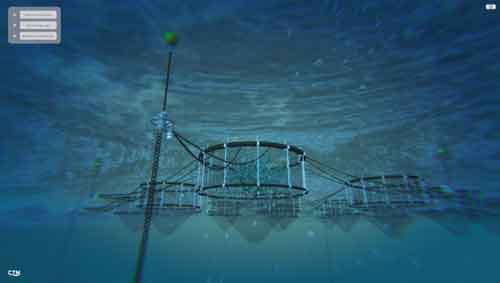
The proliferation of data generated by fish farms can be used to virtually reproduce a farm site where students of aquaculture learn to manage production without risking the stock.
Aquaculture is increasingly moved by data. Sensors, connected equipment, and automated systems have become daily tools, while artificial intelligence and predictive models are gradually changing how farms are monitored and managed. This shift creates an obvious challenge for education: how can students be prepared for increasingly digitalised production environments when access to commercial farms for practical training is necessarily limited?
At the Centro Tecnológico Naval y del Mar (CTN) in Murcia, Spain, digital twins and immersive training environments are being explored as part of the answer. The objective is not to replace practical experience on a farm. Instead, these technologies can help students arrive better prepared—familiar with the infrastructure, processes, and decisions they will encounter once they enter a real production environment.
José Luis Sáez Martínez, strategic partnerships manager in aquaculture and fisheries at CTN, emphasises that a visit to a working aquaculture facility will always have an impact that a virtual environment cannot fully reproduce. Digital training can, however, help students make better use of the limited time they have in real facilities.
More than a digital model
A digital twin goes beyond monitoring or visualising production data. At CTN the model combines an accurate 3D representation of the physical asset with real-time data from sensors, connected through IoT and cloud-based systems. A full digital twin can also communicate in the opposite direction, sending commands to actuators in the real facility. This bidirectional link is what distinguishes it from a conventional monitoring platform.
Artificial intelligence and predictive models add simulation capabilities, allowing the system not only to show current conditions but also to anticipate how the farm or infrastructure may respond to future scenarios. The data required depend on the application: offshore farms may monitor waves, currents, oxygen, salinity, and structural loads, while computer vision, hydrophones or structural sensors can provide information on biomass, feeding activity, mooring tension or net deformation.
From data to prediction
Artificial intelligence becomes useful when relationships between variables are too complex for simple rules or traditional models. Deep-learning approaches can analyse large datasets and combine different types of information, including time series, images, audio, text, and structured production data.
CTN has applied these principles in aquaculture. One example is SICA-SAVEFEED®, an intelligent feeding control system that uses hydrophones to detect the noise produced by fish during feeding. Human observation is initially used to label feeding behaviour alongside the acoustic data. Once sufficient data have been collected, the model can learn to identify when fish stop feeding and help operators avoid unnecessary feed input.
Another example is DigiSafeCage, where environmental information such as waves and currents is combined with structural measurements from offshore aquaculture infrastructure. By relating these conditions to mooring tension and net deformation, predictive models can estimate how the structure may respond to future sea conditions. Short-term weather forecasts can then be used to anticipate structural stress and support maintenance decisions before problems occur.
This shift from monitoring to prediction is one of the main advantages of digital twins. However, Mr Sáez stresses that this should not remove the operator from the decision-making process. Under a Human-in-the-Loop approach, AI can automate routine or low-risk tasks and provide recommendations, while decisions affecting animal welfare, safety, compliance, or farm operations remain subject to human validation. Uncertainty should also be clearly communicated. Predictions should include confidence levels, uncertainty ranges, and information about their limitations rather than being presented as definitive answers.
Preparing students before they reach the farm
These technologies have clear applications in vocational education. An immersive environment can reproduce an aquaculture facility and break down complex procedures into manageable tasks, allowing students to practise routine operations, and to understand how individual actions fit into the wider production system, says Mr Sáez. Exercises can include measuring water quality with a multiparameter probe, removing mortalities, controlling feeding, carrying out maintenance, repairing nets, or responding to changing environmental conditions. One of the main advantages is repetition. Procedures that may be difficult to practise several times during a short placement can be repeated multiple times in a virtual environment without interfering in production or affecting infrastructure.
CTN’s immersive training environment can also develop broader skills. Multiuser functions allow students to complete tasks collaboratively, supporting teamwork and coordination, while detailed 3D environments help them develop spatial awareness of the installation. Assessment is based not only on correct answers, but also on time spent on activities, tasks completed, accuracy, and the reasoning behind decisions. Students may also be required to consult technical documentation and justify their choices. Artificial intelligence could further personalise this process. While dynamically adapting complete 3D scenarios remains technically difficult, AI can analyse student performance in theoretical modules and adjust subsequent questions or learning materials to individual progress.
Keeping education aligned with technological change
As technologies such as AI, IoT, and digital twins continue to develop, vocational education has an opportunity to evolve alongside them. Rather than trying to teach every new technology as it appears, Mr Sáez highlights the importance of developing transferable skills such as data interpretation, critical thinking, decision-making, and the ability to work with uncertainty. Teachers do not need to become AI specialists, but they should have enough digital competence to integrate these tools effectively into training. Wider adoption will also depend on practical factors such as the cost of sensors and infrastructure, access to operational data, interoperability between systems, and connectivity. Addressing these challenges can help digital tools move beyond individual pilot projects and become more widely available.
Successfully implementing the technology will require continued investment in teacher training, and close cooperation between companies, technology centres, public authorities, and educational institutions. Integrating digital tools directly into curricula will also help ensure that they become a regular part of aquaculture training. The outcome should be professionals who understand the systems they work with, can interpret digital information critically, and know when human judgement is required.
Ixai Salvo, Eurofish, ixai@eurofish.dk