This article was featured in Eurofish Magazine 2 2026.

In Romania’s Dobruja region, between the Danube and the Black Sea, small-scale fishing has shaped local economies and food cultures for centuries. A local restaurant is building on this heritage to encourage the consumption of fresh locally-sourced fish.
The identity of communities such as Ghindărești, a village on the lower Danube with a predominantly Russian-Lipovan population is shaped by the water, and they have developed culinary traditions closely linked to fishing practices. In recent decades, however, this way of life has come under pressure. Imported fish products, changing consumer preferences, and environmental pressure affecting fish stocks have reduced both the economic viability of traditional fisheries and the visibility of local fish in modern gastronomy. While Romania possesses extensive inland and coastal aquatic resources, local fish is increasingly absent from everyday consumption.
La Grisha, a family-run Local Gastronomic Point established in Ghindărești in 2022, was created as a practical response to this challenge. The project combines traditional fishing, local gastronomy, and professional communication strategies to restore value to Danube fish and to the communities that depend on it. Its experience offers a relevant case study for how strategic storytelling and direct-to-consumer models can support small-scale fisheries, rural development, and sustainable gastro-tourism.
Fine dining in a renovated ancestral home
La Grisha operates under Romania’s Local Gastronomic Point (LGP) framework, a relatively recent legal model that features short supply chains, and supports rural entrepreneurship, and culinary heritage. Unlike conventional restaurants, LGPs are small-scale units located in private homes or farms, serving limited numbers of guests and relying primarily on local, seasonal ingredients.
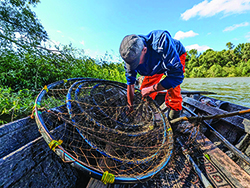
Much of the fish served is caught by small-scale fishers using traditional gears.
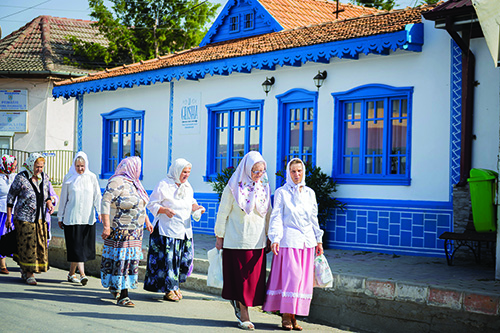
For the Matei family, this meant restoring their ancestral home – a century-old house with iconic blue-and-white lace woodwork – and opening it to visitors. They operate strictly by reservation and are open only on weekends. This creates an environment that feels more like a private invitation than a commercial transaction. With a rotating daily menu dictated by the day’s catch and staffed almost entirely by the family, guests are welcomed not as customers, but as old friends. This intimacy is the foundation of the brand. It allows the story, the food, and the people behind it to remain inseparable, and creates “scarcity value” that a traditional high-volume restaurant can never achieve.
Traditional recipes made with fresh ingredients
The menu draws on the robust culinary heritage of Dobruja, a region defined by the confluence of the Danube and the Black Sea, on family recipes and the fresh fish brought in by the village fishermen. Many consumers, particularly those from urban centers, are wary of river fish. They are often intimidated by their complex bone structures or hold prejudices about the flavour profile. At La Grisha, the kitchen serves as a laboratory to disprove these myths, elevating species like common carp (Cyprinus carpio), catfish (Silurus glanis), pike (Esox lucius), Pontic shad (Alosa pontica) and smaller white fish into rich delicacies. For example, guests may begin with an assortment from the family pantry: hand-whipped fish roe, smoked and marinated fish, preserved using techniques passed down through generations. They might continue with saramură, a rustic dish of grilled fish served with polenta or storceag, a creamy sturgeon soup. While wild Danube sturgeon is strictly protected, La Grisha uses legally sourced aquaculture sturgeon, preserving culinary tradition while communicating the importance of conservation measures. Other dishes, like spadlivka, a slow-cooked catfish stew or malasolka, a winter specialty of salt-cured pike are often discoveries even for Romanian guests.
Making a remote village visible
The founders quickly realised that serving exceptional food was only the first step. Ghindărești is a village of only 2,000 inhabitants, far from established routes and with no tourist infrastructure. From the outset, visibility was the primary barrier. La Grisha approached communication not as promotion, but as business strategy. The restaurant was marketed as a family home where three generations lived, and where the youngest son, Grisha, restored the house and inherited its legacy. Social media and press materials focus on continuity, on fishing techniques, family rituals, and the life of the river.
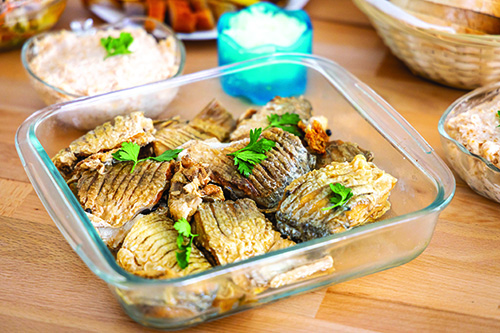
Traditional recipes using freshly caught fish characterise the food at La Grisha.
Fresh Danube fish, ethnic Lipovan heritage, family history, and the surrounding natural landscape form the core identity. By consistently reinforcing these elements across all channels (website, social media, PR engagements etc), La Grisha positioned itself as a destination rather than a venue. Moreover, the project does not aim to attract everyone. The ideal guests are educated, urban consumers with the means and curiosity to seek authentic experiences. This strategy determined the tone, visuals, and digital marketing, drawing visitors from hundreds of kilometres away. In addition, the communication strategy explicitly shares the stories of the local fishermen, beekeeper, vegetable farmer, or baker the restaurant sources from. Besides the day to day service, La Grisha also organises special events like wine tastings, fine dining menus with guest chefs, and themed cultural evenings.
The result is a steady flow of visitors, national media coverage, conference invitations, and even a documentary film, all emerging from a village that few Romanians could locate on a map just a few years ago.
What began as a small family project has evolved into a driver for local development. Fish is sourced from local fishermen who rely on low-impact, artisanal fishing methods and traditional wooden lotca boats. When a species is spawning, it disappears from the menu and guests are told why. In a world where traditional fishing is in decline and younger generations are reluctant to join the profession, the restaurant demonstrates that gastro-tourism can provide a viable economic future and could thereby inspire young people to stay rather than migrate from their communities.
Encouraging the consumption of local fish
While Romania possesses a significant aquatic surface across its extensive river network, the Danube Delta, numerous lakes, and the Black Sea coastline, statistics indicate that approximately 70-80% of the fish consumed in Romania is imported. Recent industry analyses highlight that while consumption is growing, it is largely driven by frozen white fish fillets and salmon. Local fish is often overlooked due to a lack of processing infrastructure and a perception that local fish are bony and difficult to clean and cook. By focusing on freshness, local origin, and unique recipes, restaurants like La Grisha may be able to revive interest in fish from the region.
Ioana Matei, senior communications consultant and co-founder of La -Grisha, hello@ioanamatei.info,
www.-ioanamatei.info, www.lagrisha.ro