This article was featured in Eurofish Magazine 3 2026.

A Spanish company is farming vannamei in the middle of Spain using a new microbial technology. The shrimp is marketed on the strength of its environmental credentials and its proximity to the market.
At first glance, the idea sounds almost contradictory: premium shrimp from inland Spain. Yet that apparent contradiction is precisely what has enabled Noray Seafood to stand out in a crowded and highly competitive market. In Medina del Campo, far from the coast and far from the traditional geography of shrimp production, the company has built a business around a proposition that would once have seemed improbable: it produces fresh, shrimp, raised in a controlled environment, and marketed as a premium alternative to both imported farmed shrimp and wild-caught products.
For decades, shrimp in Europe have largely followed two familiar models. The first is imported aquaculture shrimp, usually sold frozen, where scale and price are decisive. The second is wild-caught shrimp, which carry connotations of tradition, quality, and authenticity, especially in premium segments. Noray has sought to create a third path. Its shrimp are neither an anonymous commodity nor a nostalgic product tied to capture fisheries. Instead, they are presented as a modern, climate-smart seafood option, characterised by control, traceability, freshness, and proximity to market.
The shrimp sector today is under pressure to answer questions that were once easier to ignore. Consumers, retailers, and chefs are looking more closely at how seafood is produced, how far it travels, and what environmental costs are hidden behind the final product. Wild shrimp, especially where trawl fisheries are involved, are increasingly scrutinised for their fuel intensity and broader ecological footprint. Imported farmed shrimp, meanwhile, may face criticism over traceability, chemical use, transport distance, and uneven production standards. Against this backdrop, Noray offers a product that is sold not only on its taste and quality, but also on its fully controlled production and defensible environmental narrative.
From inland Spain to a new shrimp proposition
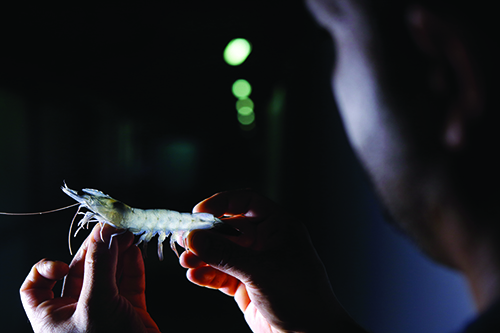
Noray’s model turns technical control into market value. Shrimp are produced indoors in a tightly managed system using artificial seawater and a microbial farming process designed to maintain stable conditions throughout the production cycle. This allows year-round production and gives the company a degree of consistency that is difficult to achieve in many conventional shrimp systems. More importantly, production involves no antibiotics, no chemical aftertreatments, full traceability, and predictable quality. In much of the European shrimp market, the distinction between genuinely fresh product and thawed product can be blurred. Imported shrimp may arrive frozen and later be sold in ways that suggest a higher degree of freshness than is actually the case. By contrast, inland production close to the end market makes it possible to supply freshly harvested shrimp to a fish counter or restaurant kitchen. Freshness affects flavour, texture, appearance, and shelf-life factors that are critical in the premium segment.
Spain is one of Europe’s great seafood-consuming nations, with strong culinary traditions and an informed customer base. Yet it is also a market where price, even in premium categories, is decisive. Convincing consumers, chefs, and other buyers to embrace a higher-priced shrimp therefore required Noray to demonstrate that a shrimp produced in an inland aquaculture facility can justify a premium because it offers something different from both cheaper imported shrimp and conventional wild-caught options, namely certification to the ASC standard. The company was the first indoor shrimp farming company in the world to receive this certification which acknowledges the company’s commitment to responsible aquaculture and sustainability and guarantees good practices in terms of the environmental and social integrity of the product. Moreover, the use of a new technology to rear the shrimp, full control over the production cycle, and a location close to the market are all compelling justifications for charging a premium.
Freshness, traceability, and climate credentials weigh as much as shrimp
Noray does not compete head-on with large-volume shrimp suppliers on price. Instead, shrimp are sold not simply as seafood, but as a set of values: Spanish, fresh, additive-free, traceable, and better aligned with modern environmental expectations. Buyers are thus encouraged to see the shrimp as a product made possible by a different way of thinking about aquaculture. The use of chefs has played an important role in that process. Chefs show how a product behaves in the kitchen, what makes it distinctive, and why it deserves attention. Culinary endorsement provides a form of translation from technical innovation into gastronomic legitimacy. A chef can make the unfamiliar feel natural, even desirable. In the Spanish context, where seafood culture is strong and culinary authority carries weight, this has been particularly valuable.
Trade fairs and gastronomic events have also been central to the company’s marketing efforts. They create opportunities to demonstrate the product directly, answer questions, and offer samples to gauge the public’s reaction. And coverage in specialist, culinary, and mainstream outlets has helped broaden awareness beyond immediate buyers. This is important because the company’s challenge has never been limited to selling shrimp. It has also had to familiarise the market with the very idea of inland premium shrimp aquaculture.
Equally effective has been the ability to adapt the story to different markets. In Spain, the emphasis naturally falls on national production, culinary quality, and the appeal of a premium shrimp grown domestically. In wider European markets, the same product can be presented more strongly through the language of sustainability, innovation, and controlled aquaculture.
Noray has shown that the future of premium seafood depends not only on how products are farmed or caught, but also on how they are marketed. By combining inland aquaculture with careful brand-building, it has created a space for a new kind of shrimp on the Spanish and European markets.
Søren Espersen Schrøder, Eurofish,
soren@eurofish.dk