
This article was featured in Eurofish Magazine 4 2026.

Auctions follow a basic principle—the highest bidder gets the product on offer. Fish auctions follow the same principle but in addition to selling fish, they can also offer other services such as quality control, sorting, grading, storage, distribution, and even processing.
In Denmark, after a period of consolidation, there are today four fish auctions—in Thyborøn, Thorsminde, Hvide Sande, and Gilleleje that operate under a shared management structure and use the Dutch PEFA system. In addition, there are auctions in Hanstholm, Hirtshals, Strandby, and Grenaa. The consolidation among auctions has also led to mergers among local fish collection centres as fish sorting and selling activities often take place at the same location. Consolidation has not affected smaller ports as refrigerated trucks drive to even small landing sites to pick up the fish and bring it to auction. Distances are not large and fishers tend to benefit from having their fish grouped into larger lots as it usually leads to better prices.
Warming climate brings changes in species composition
In 2025 about 48,000 tonnes of fish were sold through Danish auctions of some 174,000 tonnes of fish landed for human consumption. Poul Ole Nielsen, director of Qfish, a consultant for Danish Fish Auctions, there is a gradual specialisation. For example, Gilleleje and Strandby in Norway lobster; Hanstholm in whitefish; and Thyborøn in flatfish. While these are still the major groups of species sold at Danish auctions, Denmark is not immune to the impacts of climate change. Rising sea temperatures are causing a decline in landings of some traditional species, while minor volumes of species common in the south, such as red mullet, European sea bass, John Dory, and thick-lipped grey mullet, are now being landed.
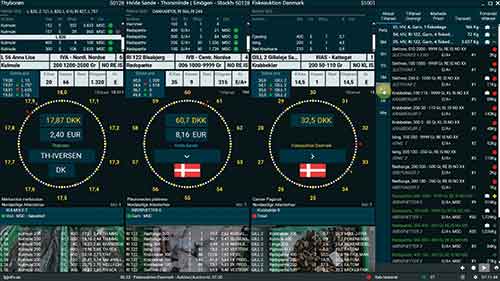
The Dutch PEFA system used by Danish Fish Auctions, the company managing
the auctions in Thyborøn, Thorsminde, Hvide Sande, and Gilleleje.
The larger fish auctions try to attract foreign vessels to land their catches as this is also likely to bring more buyers creating a virtuous cycle. Research from Norway has shown that prices increased with the number of bidders. A study of frozen Atlantic cod auctions found that, compared with auctions with only one bidder, prices were 4.51% higher with two bidders, 6.47% higher with three, 7.18% higher with four, and 9.88% higher with five or more, after controlling for lot size, quality, seasonality, and other factors. Logistical support for foreign vessels including assistance with provisioning and vessel and gear repair facilities are among the reasons for foreign vessels to dock at Danish ports. But perhaps the biggest incentive is the higher prices foreign vessels can obtain for their fish. As a result, there is a growing volume of fish mainly from Norway that arrives by truck to be sold at Danish fish auctions. Mr Nielsen says that prices often are higher when compared to other major European fish auctions such as Urk in the Netherlands, Zeebrugge in Belgium, and Boulogne-sur-Mer in France. For the Danish processing industry foreign landings are an important source of supply. The imposition of a CO2 levy on fishing vessels was suspended when it led a to a decline in foreign landings that affected both the auctions and the fish industry. But Mr Nielsen points out that from 2029, the tax will be phased in at a rate of DKK 375 per ton of CO2. As of 2030, the fishing industry will be required to pay the full uniform CO2 tax of DKK 750 per ton of CO2 emitted, which he feels will be disastrous for part of the Danish fishing industry.
Danish fish auctions are both physical and digital
Danish auctions are both physical when buyers or their representatives can see the fish in person, or online. In
Mr Nielsen’s opinion there is place for both formats and, critically, any difference in sales prices are insignificant. The advantage of the online auction is that it is faster to conduct and more buyers can participate—in the Danish context also buyers from Netherlands and France. On the other hand, traditional auctions are preferred by processing companies if they have their facilities in the area of the auction and can send their representatives to assess the quality of the fish in person. Online buyers get information about the quality and quantity of the lots electronically. The auction provides all the information mandated by law as well as any additional information buyers may request. Each individual box of fish has a large volume of data associated with it which is available to buyers. Overseas buyers participate in the auctions knowing that, even based in Paris, they can take physical possession of the fish within 24 hours of it being sold.
Regulatory burden gets steadily heavier
The benefits of the Danish auctions are however being undermined by the increasing regulatory demands being imposed on the sector by political authorities. Though the ever-growing burden of control and registration is ordained by the EU, Mr Nielsen thinks that Danish authorities “goldplate” the rules, creating greater challenges for Danish auctions than are faced by auctions in other EU countries. Certain information must be provided to the authorities two or three times over for little practical purpose, he claims. He hopes the EU will soon make some long-awaited progress towards simplifying regulations and removing red tape. As an example, he cites the new Control Regulation (2023/2842). This calls for fish that is weighed and packed on board using approved scales to be re-weighed on landing. To do this the fish must be transferred into new boxes without ice, a considerable undertaking for the auctions, and one which can delay the sale of the fish to the next day with consequences for the quality, shelf life, and price.
Auctions play an important role in the distribution of fish
Another issue he raises is the restrictions on fishing activities, rigid control regulations and registration requirements, and stiff penalties for even minor infractions. Bottom trawling is another topic that generates controversy about its impacts even among scientists. The view among some politicians that bottom trawling should be largely or entirely prohibited due to damage caused to the seabed is not scientifically substantiated, in Mr Nielsen’s opinion, and would deal a fatal blow to Danish fishing as it exists today while eliminating 80% of the fish auctions’ turnover. He argues that a better route would be to intensify efforts to develop gear that is gentler on the seabed and more selective regarding the species caught which would benefit both the marine environment and the fishing industry. Auctions play an important role in the supply of fish for human consumption, specifically demersal fish and crustaceans (pelagic fish is generally sold directly to customers), and slashing their turnover would have repercussions further down the value chain, which had an estimated turnover of DKK21bn in 2020 and employed some 1,800 people, according to a 2023 paper from the University of Copenhagen. For fishing vessels, the ability to land the fish in a port and leave the practical work of sorting, grading, and sales to the collection centre and/or auction is a huge benefit as they do not have the physical capacity or administrative infrastructure to do this themselves.
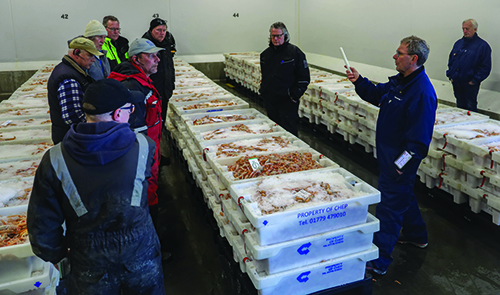
Not all auctions are electronic. Here, buyers can physically inspect the boxes (in this case, of Norway lobster)
and then bid for them at a traditional auction managed by an auctioneer.
IUU fish unlikely to slip through auctions
A captain heading for an auction may not know the exact value of the fish he has on board until it is sold, but from the season, location, and current price levels he can make a fairly accurate estimate. Some fish landed in Danish ports by foreign vessels, typically flat fish landed by Dutch vessels, is sent overland to auctions in the Netherlands, while fish not sold through the auctions is usually sold directly to processors at a price either determined in a contract for the season or negotiated prior to landing. As already mentioned, landings at Danish auctions are carefully controlled so that the risk of IUU (Illegal, Unreported and Unregulated) fish entering the market is remote. Imported catches must be accompanied by a catch certificate, and data on landings is reported immediately to the authorities and can be cross checked with logbook information that is sent prior to arrival at the port. Mr Nielsen believes that the potential for illegal fish to enter the market is greater from direct sales than from the auctions.
Danish auctions are adapting to the challenges they face from shrinking fleets and falling landings by consolidating, shifting to electronic platforms, and offering comprehensive and efficient services. If efforts to reduce the demands placed on them by regulatory bodies are also implemented, it would allow them to better fulfil their role as the first point in the supply of fish to the Danish market.