This article was featured in Eurofish Magazine 4 2025.

On a small Danish island in the South Funen Archipelago, a restaurant has spent four years building its menus around a single question: what does this place actually produce, right now, at its best? That discipline has become one of the reference points for a European project asking a much larger version of the same question about the continent’s coastal waters and fish innovation.
Local action can solve global issues. The restaurant Marstang Mad & Vin was founded in June 2022 and as travel journalist Jeanine Barone wrote in Forbes magazine, it offers one of the most scrumptious and sustainable eating experiences she had encountered in Denmark. The philosophy is simple: “Don’t make it too complicated; it should be local, sustainable, fun and taste good.” Local farms send a weekly email listing of what is ready to harvest. The wine arrives on tap, each keg replacing twenty-seven bottles, cutting transport emissions in half.
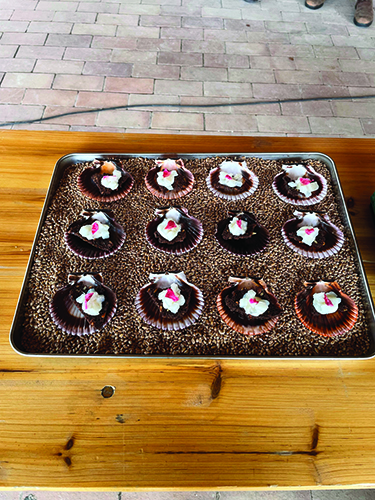
Fish and shellfish are sourced from the island and surrounding archipelago, treated with a whole-catch discipline that turns frames into stock, livers into amuse-bouche, and skin into garnish. Nothing is wasted. The restaurant challenges its guests—serving cabbage to people who say they don’t like cabbage, confident that the right preparation will sway stomachs and minds. The same confidence, applied to lesser-known species, is the operational heart of what the Forgotten Fish project has spent two years trying to make transferable across European coastal communities.
Islands like Ærø sit within a broader coastal culture in which communities live in active relationship with the ocean—aware of what it provides, attentive to its constraints, and willing to build their identity around what it offers rather than importing a standardised global seafood repertoire. And that relationship is an economic and ecological necessity for future European fisheries policy.
What we learned from an octopus…
The Forgotten Fish project is an Erasmus+ KA210-VET small-scale partnership launched in September 2024, led by Marstang Mad & Vin with three partners: Nordic Wellbeing Academy, NWA (Denmark), the Lazareta Cultural Association (Greece), and Igor Vitale International (Italy), connecting Ærø with Syros island and the Foggia peninsula. Over two years the consortium has surveyed 117 restaurateurs and fishermen across the three countries, developed a four-module MOOC (massive open online course) on forgotten fish in gastronomy and artisanal fishing, and produced a 24-recommendation policy and business framework for the sustainable integration of underutilised species into European seafood systems.
Lars Münter, International Director of NWA, attended the Eurofish International Conference in Istanbul in June 2026—as NWA also did in Tallinn in 2024—to network with European fisheries stakeholders and bring practical project evidence into a broader professional exchange. He says the barriers keeping forgotten fish off European menus are not really ecological, as many of these alternative species are present in viable volumes. The barriers are more structural—partly as supply chains are strongly calibrated to a few commercial species, and as most culinary training skips the lesser known species too.
The survey data from Greece, Denmark, and Italy tell a strikingly consistent story despite the differences between a Cycladic island, a South Funen archipelago, and a Pugliese coastal town. Awareness of the forgotten fish concept is low everywhere. Consumer demand is minimal in all three countries. Fishermen across all three contexts routinely discard, eat at home, or sell at a loss the species that market infrastructure has no room for. And in all three countries, both restaurateurs and fishermen express genuine openness to change—if given the training, the supply chain relationships, and the communication tools to act on it. But the data revealed other interesting facts, such as how Danish fishermen regularly catch octopus in island waters and ship it to Italy and Greece, because no Danish culinary tradition or processing infrastructure exists for it.
Similarly, Italian and Greek restaurants import comparable North Atlantic seafood at premium prices. So, while the product value that Danish coastal communities could capture is used elsewhere, the culinary knowledge that Greek and Italian practitioners have about, for example, octopus preparation and presentation is exactly what Danish kitchens could benefit from.
From practice to policy: four frames for action
The project’s 24 recommendations are organised around four interconnected frames that together describe what European seafood systems need to change. The first is adaptive governance. Quota systems designed for a different ecological era cannot accommodate species whose abundance is shifting with climate change. While cod allocations have dropped radically, available octopus, shore crab, and recovering lobster populations in Danish coastal waters have no commercial regulatory framework at all. The recommendations call for real-time adaptive quota systems, simplified EMFAF access pathways for micro-scale artisanal operators, and the integration of social sustainability indicators into the CFP Vision 2040 consultation—recognising that environmental regulations which are economically unviable for coastal fishing communities will not, in practice, be sustainable at all.
The second frame is direct market infrastructure. Fisher-chef cooperative programmes, community-supported fishery models delivering weekly forgotten species boxes, digital supply chain platforms connecting landing sites to restaurant kitchens, and processing grants for emerging species—shore crab boiling equipment in Danish island communities, on-board processing capacity for smaller Italian and Greek vessels—are some of the ways to create a value chain. The third frame is culinary knowledge transfer. The project’s MOOC addresses four modules on basic marine biology and forgotten fish ecology; on tips to promote forgotten fish in dining and gastronomy; on fine dining practice and culinary exercises; and on business models and fisher-restaurant synergies.
The fourth frame is demand creation at scale. EU-wide labelling for forgotten fish, integration of underutilised species into public procurement for schools, hospitals, and old-age homes, consumer awareness campaigns rooted in provenance storytelling rather than sustainability lectures, and the establishment of a European Forgotten Fish Network as a low-cost transnational community of practice: these are the demand-side instruments that make the supply-side investments commercially viable.
A Danish story with European application
Or course, one cannot just copy Ærø or Marstang Mad&Vin to other places. But what transfers is the concept. Let the season, climate, and place determine what is on the menu, use all of what arrives in the kitchen, and communicate its value to guests with the same confidence you would bring to any other dish. It’s a revitalising of the Italian cucina povera tradition.
What the Forgotten Fish project has tried to build is the policy, educational, and market infrastructure that turns that relationship into a commercially sustainable food system. And tools—the MOOC, the micro-credential model, the 24-recommendation framework, the direct procurement agreement templates—are freely available from the project website. But the deeper lesson from Ærø and the project is about the relationship between a community and its marine environment. When that relationship is active—when the people living on a coast are curious about what the water around them actually produces—the conditions for forgotten fish practice already exist.
Lars Münter, Founder and International Director, Nordic Wellbeing Academy, lars@wellbeingacademy.dk