This article was featured in Eurofish Magazine 4 2026.

A new land-based farm has commenced commercial scale production of greater amberjack in a recirculating aquaculture system. Alicante Aquaculture has built its business around this high-value species that is well known to chefs but so far overwhelmingly as wild-caught.
Alicante Aquaculture, the first farm developed by the parent company, Global Aquaculture, farms greater amberjack (Seriola dumerili) in a land-based RAS located in the port of Alicante. The company positions its fish, sold under the brand Seriola Ibérica, somewhere between salmon and bluefin tuna. It is aimed less at retail shelves than at high-end restaurants looking for a fresh, premium fish with the texture, fat content, and culinary versatility demanded by sushi and Mediterranean cuisine.
A first for Alicante and for Spain
Eloy Meseguer Hernández, chief operating officer of Global Aquaculture, says the decision to farm greater amberjack rather than yellowtail amberjack (Seriola lalandi) was shaped by both regulation and market preference. The former occurs naturally in Spanish Mediterranean waters, while farming the latter would require additional authorisations because it is not native to Spain. The company is in fact applying for permission to grow yellowtail on land as a possible additional species, but its present focus remains greater amberjack. According to Mr Meseguer, market soundings in Asia, the Middle East, the United States, and Europe also pointed towards a preference for greater amberjack, known in Japan as kanpachi (while yellowtail is often associated with hamachi). Most marine farms in Spain produce seabass, seabream, bluefin tuna, turbot, and sole. Greater amberjack has been farmed in cages in the Mediterranean, including in Greece, Turkey and, until recently, Spain, but volumes remain small. Mr Meseguer says some cage producers have struggled with winter conditions and parasites when water temperatures fall below about 18 degrees C. Alicante Aquaculture’s answer is to move the fish ashore, where temperature, water quality, diseases, and health parameters can be completely controlled.
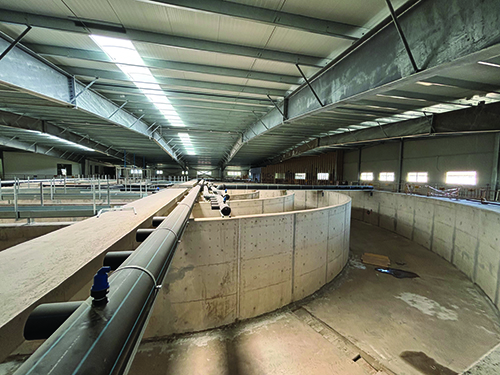
The system can produce 600 tonnes of fish in about 7,000 sq. m.
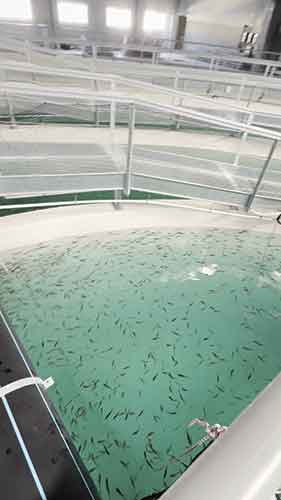
The company’s farm covers about 7,200 square metres in the port of Alicante. Mr Meseguer says the investment was around EUR15m and gives the facility an initial production capacity of 600 tonnes a year, with plans to expand to 900 tonnes. The site is among the first land-based farms for this species and contains four circular grow-out tanks with a combined water volume of 6,500cubic metres and a capacity for 200,000 fish. The tanks are arranged differently from the typical pattern of separate round tanks. To maximise space and optimise the use of resources, the system has been designed as a series of concentric rings, through which the fish move as they grow through a system of gates between the rings. Fingerlings enter the first ring at around 10 g. After approximately three months, when they reach about 200 g, a gate is opened and the batch moves to the next ring. The process repeats as the fish reach 600 to 700 g, then 1 to 1.5 kg, before entering the outermost ring for grow-out to market size. New fingerlings can then be stocked in the first ring, giving the farm four batches a year and allowing harvests of about 150 tonnes every three months once production reaches steady state.
Farming is about trade-offs
The structure is designed save space. Mr Meseguer says the system was envisaged to produce 600 tonnes of fish in about 7,000 square metres, while matching each stage of growth with equipment sized to the biomass in that section. In a conventional design, he argues, parts of the system can be over-dimensioned for much of the cycle because they must be able to cope with the final biomass. The ring design reduces that inefficiency, but it creates a different management problem. Batches do not all grow at exactly the same pace, and market demand can shift towards larger fish. If the third ring is ready to move, the fourth ring must be empty. That limits flexibility, particularly if customers ask for fish above the main three-kilo target. For now, the commercial target is a fish of about 3 kg after roughly one year of grow-out. The company sees potential in larger fish of 5 kg to 6 kg, which Mr Meseguer describes as a smaller but more profitable market. Reaching that size would require additional time and dedicated tank space. Alicante Aquaculture is therefore seeking more land in the port to add large tanks for fish destined for these larger sizes.
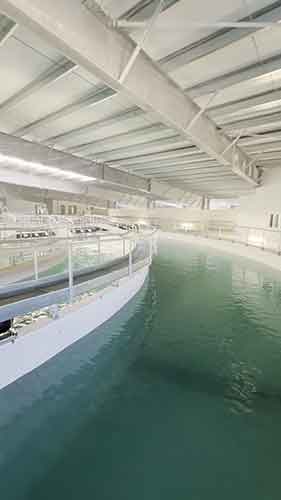
The unconventional design solves the over-dimensioning that is characteristic of traditional
fish tanks where capacity is wasted during part of the growth cycle.
In winter, the incoming seawater in Alicante can be around 16 degrees C, so the farm heats it to about 22 degrees C. In summer, when Mediterranean seawater can reach 26 to 28 degrees C, the system cools the water. Mr Meseguer says temperature stability supports growth and helps avoid the winter slowdown and parasite pressure seen in cage systems. He claims growth in the RAS can be much faster than in sea cages because the fish’s growth performance is not hampered by adverse seasonal conditions. The system draws seawater from the port area, then filters and recirculates it. Around five percent of the water is discharged each day. Before discharge, water passes through a settlement tank where solids are removed and collected by an external company for use as fertiliser or a similar product. Water leaving the farm is subject to official control points, allowing government authorities to inspect discharge quality.
Sustainable energy for more than half the energy requirements
Energy demand is one of the main questions facing any land-based marine farm. Heating, chilling, pumping, oxygenation, and filtration all require energy. Alicante Aquaculture has covered the farm with solar panels, which Mr Meseguer says provide around 55 to 60 percent of the company’s power requirements. In terms of sustainability, in addition to producing their own power, 99 percent of the water is reused, there are no fish escapes, and no parasite transfers from or to the wild. Fish welfare is not only critical to product quality but is also necessary to maintain the fish in good health. Poor welfare increases the likelihood of fish succumbing to an illness. In a RAS, treating fish that are unwell is complex and risky as antibiotics or chemicals can damage the biofilter. For Mr Meseguer, prevention is a natural part of the farm operations. The company controls current, temperature, density, light, and water quality, trying to create what he calls “a little piece of the sea” for a marine fish that needs movement. Alicante Aquaculture is also involved in research with the University of Murcia, the University of Copenhagen, and other institutions on welfare indicators for greater amberjack. The company sees a role for artificial intelligence and automation. It is working on systems to control and count fish as they move between rings and on bacterial monitoring in the water, fish mucus, and tank surfaces. In RAS, a pump failure, oxygen drop, or biofilter problem can quickly affect the whole stock. Mr Meseguer expects the farm to employ about 20 people once it is operating at full capacity, with round-the-clock staffing for rapid response times in case of an emergency.
The route to production has been long. Mr Meseguer says the company spent about six years securing licences, despite support from authorities at European, national, regional, and municipal levels and subsidies from the European Maritime Fisheries, and Aquaculture Fund. He distinguishes between the content of regulation and the time it takes to get clearances and permits. Environmental checks and official documents are reasonable in themselves, he says, but the duration it takes to get them is difficult for investors, especially for a project located in an industrial port rather than on a natural beach. One example he cites was the need to secure archaeological documentation for reclaimed land less than a decade old. He is not alone, however. Across the EU, bureaucracy has been identified as one of the major reasons aquaculture has seen no growth for years.
Ambitious export plans
Commercial production is expected to begin with fresh whole fish for restaurants and specialist intermediaries. The first batch of fingerlings came from a hatchery in southern Spain, but Alicante Aquaculture plans to build its own hatchery and become vertically integrated with broodstock, eggs, juveniles, and grow-out under its control. This would reduce dependence on a limited juvenile supply and give the company greater control over genetics, timing, and biosecurity. The target markets are Spain, Italy, France, the Middle East, Japan, and the United States. The company wants to avoid supermarkets and large buyers that might squeeze margins and dilute the premium reputation of the fish. Fish will mainly be sold fresh and whole, although some markets may ask for gutted fish or fish killed using the Japanese ikejime method.
Alicante Aquaculture’s success will depend not only on producing a good fish, but on doing so consistently, at a cost that the restaurant market will pay. If the company can prove that model, Seriola Ibérica could become a source of inspiration for others interested in farming high-value marine species on land in Europe.