This article was featured in Eurofish Magazine 5 2026.

From a small town in the heart of continental Croatia, family-run Kamber Tech is finding customers far beyond the Adriatic for its automatic, solar-powered feeding systems designed around the practical needs of fish farmers.
Kamber Tech began with a request from a group of carp anglers. They wanted an easier way to distribute large quantities of boilies without relying on throwing sticks or bait boats. Boilies are essentially a dough rolled into balls which are cooked to harden the outer layer. They are often used to fish for carp. A throwing stick is a long hollow tube bent at the top that is used to hurl boilies into the water. Basic sticks can fling boilies 60 to 80 m, while graphite models can shoot a boilie up to 120 m. Ivan Kamber, an engineer by training, took up the challenge and developed what became a boilie cannon, an automatic launcher capable of delivering boilies accurately over long distances.
Family-run company—for now
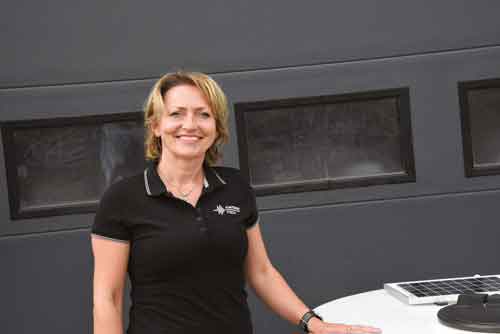
For Marina Kamber and her husband, the success of this invention suggested that there might be a business behind Ivan Kamber’s instinct for solving practical problems. Kamber Tech was established in 2020 in Grubišno Polje, a town of around 3,000 inhabitants in the middle of continental Croatia. The timing was hardly ideal, coinciding with the Covid-19 pandemic, but the fledgling company was supported by a local incubator that made available an affordable production space. From that starting point, Kamber Tech began moving into the aquaculture sector, a much larger field. However, the company remains a distinctly family-run enterprise. Marina Kamber handles sales, marketing, purchasing, and much of the commercial work, while Ivan Kamber is responsible for engineering, design, calculations, programming, and production. Both have continued to hold full-time positions while building the business. For the moment the company has one permanent employee with additional workers brought in temporarily when larger orders require it.
The main product for aquaculture farmers is the MariFeeder, a solar-powered, remotely controllable feeder intended for cage farms and ponds. The feeder can be programmed to distribute feed according to any feeding regime, for example at fixed intervals, continuously, on alternate days, or whatever the farmer decides. The device is aimed at fish farms where the feeding is manual, and the production volumes do not justify the investment in a feeding barge. The company works directly with farmers, finding out how they feed, which species and pellet sizes they use, and how their cages or ponds are configured, to adapt the equipment precisely to the farmer’s needs. Close contact is maintained with the customer so that any feedback can be used to further develop the machine. The basic principle behind the feeder is straightforward. Feed is stored in a hopper mounted on a floating platform and released through a rotating spreading unit. The spinning spreading unit can distribute feed at different distances, allowing pellets to be spread evenly across the cage rather than concentrated in one place. According to Ms Kamber, this is especially useful because all the fish in a cage need simultaneous and equal access to feed to ensure they grow at roughly the same rate. The spreading unit can also be adapted to different pellet sizes.
Feedback from customers used to introduce improvements
The MariFeeder is solar powered, incorporates an internal battery, and communicates by radio with software that allows feeding schedules to be programmed remotely. The feeder can operate for up to five days without sun. Versions with hopper capacities from 30 kg to 700 kg, are available in HDPE. The spreading unit is made of polycarbonate, while HDPE is used extensively for the floating structures because of its resistance to marine conditions. As customers have suggested features, Kamber-Tech has added functions. An internet bridge has been developed for farms that want to manage feeders over Wi-Fi from an office some distance from the cages. Sensors can also be integrated. A dissolved oxygen probe, for example, can stop feeding if oxygen drops below an appropriate level, helping farmers avoid wasting feed when fish are unlikely to eat.
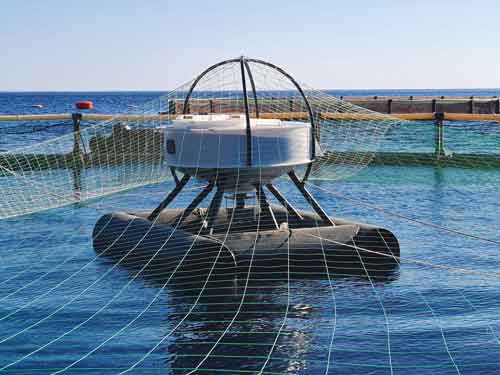
The MariFeeder is a solar powered, remote controlled feed distributor for use on fish and shrimp farms.
Feed efficiency is one of the company’s main selling points. Feed is the single largest operating cost on a fish farm, and poorly timed or uneven manual feeding results in higher costs as well as negative environmental impacts. According to Ms Kamber, trials with a company farming tilapia in Honduras indicated a potential payback period of about three months thanks to improvements in mortality and feed conversion compared with manual feeding. International expansion has come surprisingly quickly for such a small company. In Croatia, customers have included marine farms producing species such as sea bass and sea bream. But Kamber Tech has also supplied feeders to Italy, Malta, Morocco, and Uganda. In Uganda, the company installed two large feeders at a tilapia operation on Lake Victoria owned by one of the biggest producers of this species. The cages there are 35 m in diameter and Kamber Tech supplied feeders with a 700 kg capacity.
Interest from countries around the world
Latin America is another important area of interest. Kamber Tech has placed feeders for testing with a well-known tilapia farming company and with a shrimp producer in Honduras, and Ms Kamber has attended trade fairs in Ecuador and Mexico. Shrimp farming, however, requires another element if the company is to compete for feeding larger animals: hydrophones that detect the sounds shrimps make when ready to feed and which can trigger feed delivery. Mr Kamber is developing such a system which, Marina Kamber says, has shown promising results in trials.
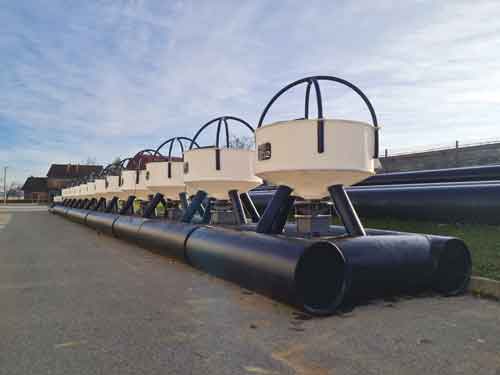
A fulfilled order for twelve feeders waits to be transported to Italy.
Rather than trying to enter every possible market, Kamber Tech is concentrating on places where it believes farmers lack suitable alternatives. In highly developed markets such as Norway, for example, sophisticated feeding systems are already widely available. Smaller farms in southern Europe, tilapia producers in Africa, and selected Latin American markets offer a better fit with the company’s technology and scale. The approach also reflects the company’s current production capacity. The company owns its CNC and other manufacturing equipment and carries out cutting, plastic welding, assembly, and testing at its facility in Grubišno Polje. Motors, batteries, solar panels, electronics, and raw materials are sourced from several European and Asian suppliers. A recent order for 12 platforms and feeders from Italy required around three weeks of intensive work, with the family and additional labour contributing to production.
Expanding production will call for some tough decisions
Scaling up will therefore require decisions about staff, space, and service and, not least, about their current jobs. Kamber Tech has already received enquiries involving quantities far beyond its current output, including a request for a quotation for 1,000 units. However, the company is cautious about growing faster than it can manage. The priority, says Ms Kamber, is to build a reputation, keep close contact with customers, and improve the machines in real farming conditions. A system of after-sales service also needs to be developed and implemented. A small Croatian manufacturer cannot fly to Honduras every time a component fails, so the company is working to establish local partners able to handle maintenance and spare parts in different countries. The same principle applies to distribution. In Ecuador, for example, the company has been discussing cooperation with a local business already serving shrimp farms.
For Kamber Tech, being small is both a constraint and an advantage. It limits how many feeders can be produced at once, but it also allows the company to respond quickly when a farmer asks for a change. That willingness to listen has taken a product developed in a small Croatian workshop to cages on Lake Victoria and trials in Central America. The next stage will be to preserve that flexibility while building the production and service structure needed for a wider market.