This article was featured in Eurofish Magazine 1 2026.

The interactions between politics and aquaculture are extremely complex and difficult. On the one hand, subsidies are paid even when they do not result in any significant growth. At the same time, wherever the sector is performing better, governments seek to profit themselves through higher taxes.
Máximo Torero, Chief Economist of the FAO, called in June 2024 for greater investment in aquaculture in order to meet the food needs of the growing world population in future. Global production, he said, would have to increase by a further 22 per cent by 2050 if current levels of supply are to be maintained. With these demands, the FAO is setting ambitious targets for all nations. Analyses of the current situation and development of aquaculture in the EU, however, show that the Union is poorly prepared for these challenges. While aquaculture worldwide has grown by 32 per cent (22.9 million tonnes) since 2010, the EU is stagnating. For fish species such as trout, production has even declined. In this way, the EU is clearly unable to make an effective contribution to feeding the world, as requested by the FAO. The value of European aquaculture production did rise by almost 75 per cent between 2010 and 2022. This, however, is due solely to higher prices, as production volumes have been almost unchanged for years. In addition, aquaculture production in the EU is very unevenly distributed. Two-thirds is generated by only four countries – France, Greece, Spain, and Italy. More than half of total output consists of shellfish, mainly mussels and oysters. One of the few areas where EU aquaculture can claim progress is in environmental sustainability. Animal welfare standards have been improved, and the European Commission’s ‘Green Deal’ praises the advantages of aquaculture as a source of ‘low-carbon’ aquatic protein.
EU heavily dependent on seafood imports
Instead of improving seafood supplies for other regions of the world, the opposite is happening, as trade flows are being diverted from those regions towards Europe. The EU’s trade balance in the seafood sector looks bleak. Well over two-thirds of demand now has to be met by imports. This may be helpful for the economies of supplying countries, but it often creates new dependencies and, for local people, sometimes even supply problems. Problems also arise in EU Member States, where many aquaculture producers have to defend themselves against cheap imports from third countries.
One exception is salmon, whose production in the EU has almost completely collapsed since the United Kingdom left the Union (Brexit). EU demand is now covered almost 100 per cent by imports. Norway in particular has benefited as the most important supplier of salmon, accounting for just over 83 per cent of EU imports. Measured in live weight equivalents (LWE), apparent salmon consumption at EU-27 level was just under 1.2 million tonnes.
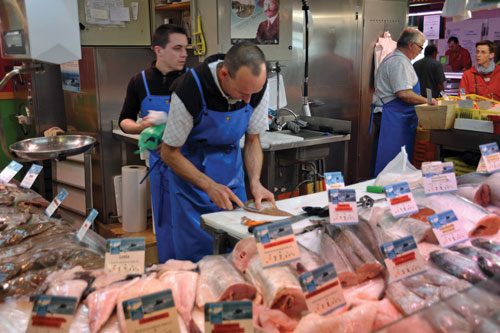
Almost no new aquaculture facility is built in the EU without some subsidies.
Given such unsatisfactory levels of self-sufficiency, the question inevitably arises as to why aquaculture in the EU is not being expanded. While aquaculture is growing dynamically in almost all parts of the world, Europe is standing still. Why is the potential of this sector, to which the FAO attributes great importance for future global food security, being so grossly neglected? In surveys, bureaucratic requirements and administrative burdens are highlighted above all as obstacles. Applications and permits, official requirements, and countless monitoring and reporting obligations often stifle initiatives and growth plans in the early conceptual phase. These obligations relate not only to essential water use rights, animal husbandry, or sites, but often also to peripheral areas that have no direct connection with the planned projects. High costs for electricity, fuel (transport), logistics, and feed further dampen any enthusiasm for investing in new facilities or expanding existing operations.
Everything subordinated to sustainability objectives
This has not gone unnoticed by policymakers in the EU. As early as 2023, a special report on aquaculture policy found that production was stagnating despite substantial financial support. Neither the European Maritime and Fisheries Fund (1.2 billion euro for 2014–2020), nor its successor, the European Maritime, Fisheries and Aquaculture Fund (1.0 billion euro for 2021–2027), has generated any significant economic, social, and employment policy growth effects. The sector has not grown since 2014, and employment has been declining. Instead of addressing the causes of this negative trend, complaints focus rather on the lack of robust indicators for the environmental sustainability of aquaculture in the EU. The data reported are deemed insufficient to assess the environmental and social sustainability of the aquaculture sector, as well as its competitiveness, in concrete terms. As if that were our biggest problem. Nobody claims that environmental and social sustainability are unimportant, yet this strange prioritisation of objectives helps explain why aquaculture in the EU is not really advancing.
Recently, for example, the European Investment Fund (EIF) announced support for the venture capital fund Blue Revolution Fund. Under the InvestEU programme, 20 million euro will be invested in aquaculture start-ups to promote innovation and sustainability in this field. In practice, however, the money is likely to flow only partly into production. The press release states that the Blue Revolution Fund aims to ‘address bottlenecks and market gaps in the aquaculture sector by providing capital to support the commercial production of fish, shellfish and algae’. At the same time, however, it emphasises that ‘sustainable technologies and alternative protein solutions for seafood’ are the priority. Working with The Nature Conservancy, it is also intended to contribute to the restoration of marine ecosystems. It is therefore doubtful whether this financial support will in the end have any measurable impact on the ‘output’, that is, the production volume of EU aquaculture.
In the end, it all comes down to money
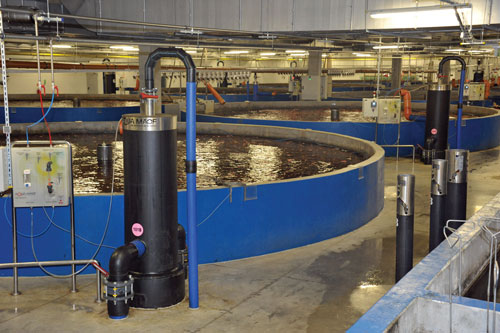
In the EU there is an above-average reliance on financial support from national governments and EU funding instruments. Hardly any major purchase, new facility, or other project is undertaken without first calling for financial assistance. It is hard to avoid the suspicion that EU aquaculture has become a bottomless pit. The situation is different in booming aquaculture countries such as Norway, where even large aquaculture projects are mostly financed with private capital. This is not surprising, as investment tends to flow where returns are attractive. One example of this strategy is the construction of Arctic Seafarm’s land-based salmon farm in Nesna (Helgeland), which is being financed, among others, by the private equity fund EMK Capital. Anyone who thinks that private investment in Norway might be associated with concessions on sustainability, animal welfare, or environmental and climate protection – which are often cited in the EU as reasons for subsidies – is mistaken. On the contrary, Arctic Seafarm intends to rear salmon on land in a more sustainable way than by traditional sea-based farming. The state-of-the-art facility is said to make no concessions on climate or animal protection. The salmon are safe from sea lice and environmental impacts, and wild salmon populations are protected from escapes. Thanks to photovoltaics, hydropower, and energy recycling, the facility is largely self-sufficient in terms of energy needs. Even the treated water that flows back into the sea after use is utilised to generate electricity by means of turbines. It is a well-designed and sustainable concept that the EU would almost certainly have subsidised.
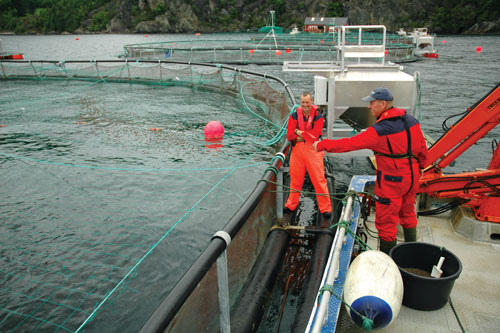
Norway’s salmon industry is highly profitable. This has awakened appetites among policymakers,
who want to skim off part of the profits through a new tax.
However, when it comes to money, conditions in Norwegian aquaculture are not entirely rosy either, albeit with one key difference from the EU. While aquaculture projects in the EU are almost routinely accompanied by calls for financial support, the situation in Norway is more or less the reverse. There, policymakers demand that the aquaculture sector share an appropriate portion of its profits. The substantial profits of the Norwegian salmon industry in recent years have whetted appetites. In 2023, the Norwegian parliament decided to introduce an additional tax on profits generated during the marine rearing phase of salmon, trout, and rainbow trout. This resource tax was justified on the grounds that aquaculture makes private commercial use of fjords and marine areas, and should therefore ‘give something back’ to Norwegian society. The Storting agreed a tax rate of 25 per cent, which is levied in addition to corporation tax. Revenue from the new tax is shared between local municipalities and the state. Frustration and anger in the aquaculture industry are running high.
Willingness to invest has fallen noticeably
The new tax is dampening confidence and damaging the investment climate in the salmon industry. The mere announcement of the tax plans wiped 4.5 billion euro in market value from the Oslo Stock Exchange. Planned investments worth more than 3.5 billion euro were cut back, cancelled, or postponed. The contract market for salmon collapsed. Revenue from the auctioning of licences for salmon, trout, and rainbow trout production fell by almost 400 million euro, and there were no buyers at all for some licences. Projects that would have created jobs in remote coastal regions also suffered as a result. The salmon tax affects not only salmon farmers, but also the supply and service industries, although these are not directly subject to the tax. Weaker demand from their customers is hitting them hard.
Deliberations by the Norwegian Aquaculture Price Council, which is to set fish prices on a regular basis for tax calculation purposes, have even met with sharp criticism from the ASC because of their ‘negative impact on incentives’. The Price Council proposed a premium of 2 NOK (0.17 euro) per kilogram on salmon from ASC-certified farms. If implemented, ASC-certified companies would have to pay a ‘penalty surcharge’, which would affect more than 40 per cent of the salmon farms in the country. ASC CEO Chris Ninnes described the tax mechanism as ‘impractical and flawed’ in a letter to the Norwegian Ministry of Finance at the end of January 2025. He fears that this ‘penalty tax’ would undermine the attractiveness of ASC certification.
Tor Anders Elvegård, director of Nordlaks Aquaculture and head of Seafood Norway, urged the government in the Norwegian financial medium ‘E24’ to abolish the current model of resource rent tax on the salmon industry and to work towards a cross-party tax agreement for aquaculture in parliament. In particular, he argued, the salmon industry, through its investments, has created attractive, profitable jobs in many rural coastal areas threatened by depopulation, and has fostered growth and value creation. Under the present tax model, there is a danger that these positive developments will be slowed down.
Manfred Klinkhardt