This article was featured in Eurofish Magazine 5 2026.

The VeriFish project has developed a nutritional score for seafood that enables the nutritional value of different species to be compared
Seafood is often described simply as “healthy”, but this broad label conceals substantial differences amongst species and products. Oily fish may provide high concentrations of long-chain omega-3 fatty acids and vitamin D, whilst shellfish can be rich in iodine, selenium or vitamin B12, but white fish still provides meaningful amounts of micronutrients; in some cases, more than animal protein sources (pork, chicken, and beef). Processing and the edible portion assessed can affect the nutritional profile and, therefore, meaningful comparisons require more than a general recommendation to eat fish/seafood. It requires reliable data, common definitions and a transparent way of communicating what different seafoods contribute to the diet. This challenge was being addressed by VeriFish, (grant agreement number 101156426) an EU-funded project tasked with developing a verifiable indicator framework, bringing together environmental, socio-economic, and nutrition and health information, to support responsible communication around seafood sustainability and consumption.
From nutrient data to nutritional indicators
The nutrition and health pillar began by identifying the characteristics needed to describe seafood accurately including species, edible portion, processing state, and nutrient composition. Such distinctions matter: a value reported for raw fillet cannot automatically be applied to a cooked product, or a range of products cooked in different ways, or canned product stored in different media (e.g., brine, spring water, vegetable oil). The nutritional indicators are measurable characteristics, principally quantities of selected nutrients per 100 g of the edible product. They are not opinions about whether a food is good or bad, but provide evidence required to understand potential contribution to the diet.
This evidence was drawn from EuroFIR FoodEXplorer, which provides access to harmonised food composition data from national and specialised databases. Before these data could be compared, foods and nutrients had to be described consistently, which was challenging because historically there are known issue with seafood composition data ranging from lack of specificity regarding species the primary determinant of nutrient content to mixed units and missing components. Species names, edible portions and processing states were aligned, whilst nutrient definitions, units and data provenance were checked against EuroFIR and FAO/INFOODS standards. This harmonisation is essential because apparent differences between foods can arise from incompatible units, conflicting analytical definitions, or treatment of missing values rather than genuine differences in composition.
Indicators were selected using three main considerations: relevance to public health in Europe, availability of an appropriate dietary reference value, and sufficient data coverage across foods being compared. A nutrient could be biologically important but still unsuitable for comparative scoring if values were unavailable for most seafood products. The resulting framework covers 25 beneficial nutritional contributions and two components, intakes of which should generally be limited (i.e., sodium/salt and saturated fat). Nutrients represented include macronutrients such as protein and long-chain omega-3 fatty acids EPA and DHA, and micronutrients including vitamin D, vitamin B12, iodine and selenium.
What does the VeriFish nutritional score show?
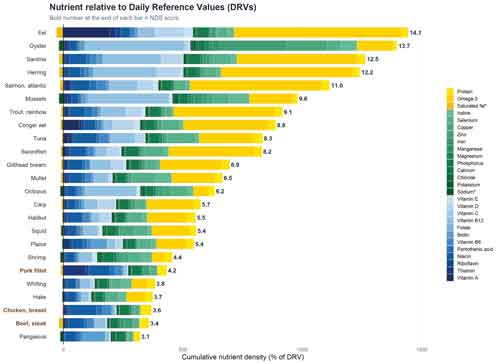
A list of nutrient concentrations is scientifically useful but difficult for most consumers and actors in the value chain to interpret. Milligrams of one nutrient cannot be compared directly with micrograms of another, and a numerically large amount does not necessarily represent a large dietary contribution. VeriFish therefore developed a scoring approach that relates amounts of each selected nutrient to an established dietary reference value. Reference values were drawn primarily from the European Food Safety Authority, including population reference intakes and adequate intakes. This normalisation places nutrients measured in different units on a common health-related basis, i.e., contribution to daily nutritional requirements, which can be further refined using population-specific values to consider, for example, dietary needs of children. Individual contributions can then be combined to provide an overall indication of relative nutrient density per 100 g of edible portion of a seafood. Importantly, the score does not measure environmental sustainability, ethical production, or fisheries management. These aspects are assessed through other VeriFish indicators. Nor is the nutritional score a health claim, personalised dietary recommendation, or assessment of the risks and benefits of eating a particular product. Instead, it is a structured way of comparing nutrients provided by different seafoods—and, where appropriate, other commonly consumed protein sources—under the same assumptions.
The score is accompanied by underlying information rather than presented as an unexplained number. Users can see which nutrients contribute to the result and approximately how much of the relevant dietary reference value is supplied. This guards against a common weakness of composite scores: two foods might obtain similar totals for quite different nutritional reasons. For consumer-facing communication, products were assigned to relative nutrient-density categories, ranging from lower to very high. Presentation also identifies when 100 g of a product provides a nutritionally significant amount of a nutrient. The thresholds correspond to established European and Codex basis for “source of” and “high in” nutrition claims: at least 15% and 30%, respectively, of the relevant reference value. A colour-coded display separates macronutrients, vitamins and minerals, allowing users to move from the overall category to the nutrients behind it.
A system that allows for changes when necessary
The VeriFish Knowledge Base does more than store figures. It links food composition information to clearly described species and products whilst retaining the source of each value and a route for future updates. This means that the scoring process can be repeated when corrected or more recent data become available. That traceability is particularly important because food composition data are not fixed. Values may vary with season, production system, feed, geography, analytical method and processing. National databases may also differ in the foods and nutrients they cover. The score should therefore be understood as a transparent interpretation of the best harmonised data currently available, not an immutable ranking of species.
For businesses, policymakers and communicators, this approach provides a more defensible basis for discussing seafood nutrition. It replaces generic claims with evidence showing what a product contributes, how that contribution was assessed and where data originated. The wider value of the VeriFish framework lies in keeping nutritional quality visible alongside environmental and socio-economic considerations without collapsing these distinct dimensions into a single verdict. Responsible seafood choices involve several questions: how the product was produced or caught, how people were treated, and what the food contributes nutritionally. VeriFish has created a common evidence base needed to answer each question clearly, or show that relevant information is not available now, and communicate answers without losing the detail behind them.
Siân Astley, Secretary General,
EuroFIR AISBL, sa@eurofir.org