This article was featured in Eurofish Magazine 3 2026.

A Spanish producer organisation whose members operate 18 freezer trawlers in Northwest Atlantic and Northeast African waters has used a board game in a campaign to attract young people to the sector.
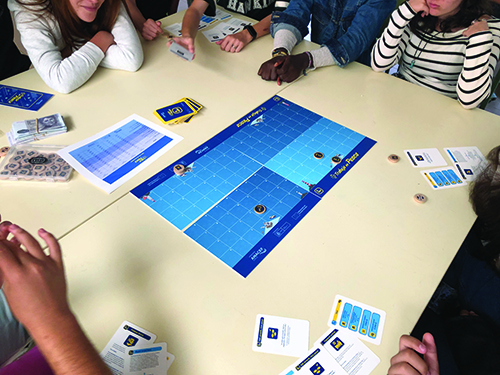
ANACEF, based in Las Palmas on the Canary Islands, has found an unlikely tool for one of the sector’s most stubborn challenges: a board game. Trabaja en pesca (Work in Fisheries), takes the question of generational renewal into the classroom, and into the hands of teenagers aged 13 to 16. The game was developed under ANACEF’s broader Programme for the Promotion of the Fishing Profession.
Fewer young people are choosing fisheries, and it might be a perception issue. Teenagers know that fisheries are made with boats, without sparing a thought for all the other companies, people, processes, and equipment that underlie the whole sector. Unable to see the whole picture, they cannot make an informed choice, and many potential candidates are lost before they ever seriously consider a profession in the industry.
Game forces players to take decisions like a skipper
The game puts players in the role of a vessel owner and asks them to make the kinds of decisions that define real fisheries: what and where to fish, how much (quotas), how to control costs across crew, fuel, and gear, and how to respond when things go wrong. Catch is landed and sold, and players begin to understand that profitability in fisheries is rarely straightforward. Sessions were led by a former fishing captain, that helped students understand complex issues.
The first campaign ran in Las Palmas de Gran Canaria in 2023, reaching close to 500 students across three secondary schools. The talks generated genuine engagement, and the game sparked competition, laughter, and the occasional heated debate about quota decisions. It also exposed just how little most of these students knew about fisheries. And that, in a sense, was perhaps the most valuable outcome as it showed the wide gap between the sector’s complexity and its public image.
A second edition followed in 2025, on Tenerife, giving ANACEF the opportunity to compare attitudes across different islands. The survey results were encouraging as between 53% and 79% of students said they could imagine a professional path connected to fisheries. Students were also clear about what they wanted next: port visits, time on board, and the chance to meet young people who had actually gone into the sector.
Credible on-board scenarios give pupils a window into fishing
Realism is among the fundamental attributes of the game. For example, quotas run out, fishing grounds have limits, and decisions have consequences. It is perhaps a more honest introduction to how the sector actually works than most formal approaches manage. ANACEF’s hope is that some of the students who encountered fisheries for the first time around a classroom table will one day choose to make it their career. If even a handful do, a board game will have proved to be one of the sector’s more consequential recruitment tools, and a reminder that the most effective interventions are not always the most obvious ones.
Ixai Salvo, Eurofish, ixai@eurofish.dk