This article was featured in Eurofish Magazine 3 2026.

In 2024, the Fisheries Information Centre project was relaunched with the support of the EMFAF (European Maritime, Fisheries and Aquaculture Fund). As in the two previous periods, the centre’s task is to help the fisheries sector improve its economic performance by building knowledge and exchanging experience, while avoiding damage to ecological resources.
Operating under the Estonian Marine Institute of the University of Tartu, the Fisheries Information Centre fosters cooperation between fishers, fishing enterprises, and scientists, often acting as an intermediary in communication with state authorities. Since it is unlikely that the future will bring any significant increase in fish quotas in the Baltic, income from fisheries can only be increased through smarter management. During its two years of operation, the centre has organised dozens of training sessions for aquaculture producers, fishers, and fish processors, ranging from gear construction and marketing to production hygiene and business management. A recent trend has been great interest in training on artificial intelligence (AI).
Training on the use of AI to optimise fishing efficiency
This training introduced fishers and fisheries entrepreneurs to the world of AI’s endless possibilities and covered models and apps, prompt-engineering basics, report and data analysis functions, and market research. In addition to opportunities, the risks were also addressed as not every response from an AI is gold-plated, and confidential information should not be uploaded indiscriminately. In their daily work sector operators can use AI for optimising fishing trip routes (most economical trajectory, impact of wind and waves on fuel consumption); weather and sea condition forecasting; product sales and pricing; and purchasing equipment and technical supplies. AI has also proven to be an effective aid in project appraisal and product marketing. In addition to training, three international conferences as well as numerous seminars and information days have been organised.
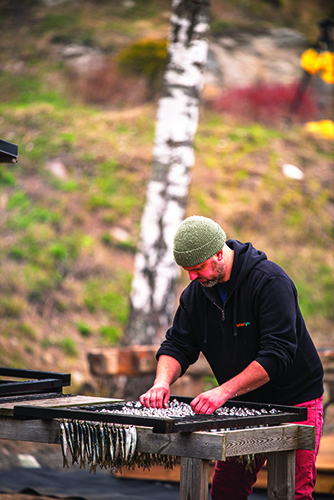
The consumption of domestically caught fish including sprats, Baltic herring, pike,
and perch is promoted by the centre. Pictured, sprats prepared to be smoked.
Although the average age of an Estonian coastal fisher is nearly 55, several dozen young people apply for a professional fishing certificate each year (preparatory training for the professional exam is held under the auspices of the centre). Therefore, it is logical to keep pace with technological developments in this field as well, especially since the submission of logbook data is only permitted electronically. As in most countries, the fishing community in Estonia is ageing. Entry into the sector, however, is quite difficult for young people. In addition to passing the professional exam, a commercial fisher must hold historical fishing rights (a state-determined proportion of all gear) for specific gear in a specific county. These rights have historically been concentrated in the hands of active fishers and rarely appear on the open market. When they do it is often at a very high price. The large initial investment required is also an obstacle to young people entering the sector. In addition to purchasing historical fishing rights, significant expenditure on boats, gear, and other equipment must also be taken into account. Therefore, there are relatively few young people joining as fishers, even if many of them are people coming from within the system, that is, sons continuing their fathers’ trade.
Scientific studies on practical issues
Through the Fisheries Information Centre, aquaculture producers, fishers, and fish processors can commission small-scale studies on topics of practical interest. Over the last two years, 15 such studies have been completed ranging from reports on fish diseases and cormorant predation pressure on fish stocks to cost-benefit analyses of technologies and marketing strategies. Just recently, UT (University of Tartu) scientists started a study commissioned by the centre, to explain the drastic decline in perch catches in Pärnu Bay over the last decade. Pärnu Bay has historically been the most profitable area for Estonian coastal fishing and in the middle of the previous decade annual perch catches exceeded a thousand tonnes. In 2025, however, only 131 tonnes were caught. There are several suspected influencing factors. Dumping that took place about ten years ago may have changed the bay’s benthic ecosystems; the stock of an invasive alien species—the Harris mud crab—has grown explosively, and the number of cormorants increases every year, which also affects the fish fauna. Climatic conditions and the direct impact of fishing must also be taken into account. By studying the combined effect of all these factors, the researchers will attempt to find the reasons for the decline in perch stocks and, ideally, design and implement measures to curb this downward trend. For the local fishing community, this is critical, because historically it is perch, alongside herring, that has put bread on the tables of Pärnu fishers.
The Fisheries Information Centre also continues to collect fisheries statistics and reflect them in yearbooks and economic reviews. A good overview of the entire Estonian fishing industry can be found at https://www.kalateave.ee/images/2024/Estonian_Fishery_2024_veebi.pdf.
Outreach efforts in kindergartens to create awareness
The centre also publishes manuals and textbooks. At the end of 2025, a new fish book for preschoolers with a fresh approach was published, Minu kala-aabits(My Fish Alphabet). To date, the book has reached all five hundred Estonian kindergartens—approximately 12,000 toddlers who start school in 2027. Upon graduating from kindergarten, each child receives their very own fish alphabet book as a gift to take home. The idea of the alphabet book is to introduce children from an early age to fish as a valuable natural resource and a healthy food source to be treated with respect. The fish alphabet book tells tales of the fisherman’s profession and the activities of fish scientists. The publisher and authors hope that the alphabet book will inform the children, together with teachers and parents, the rhythms of nature through the lives of fish.
The first presentation of My Fish Alphabet took place on 20 March in Tartu at the Naerumaa kindergarten, where one of the book’s authors spoke about what inspired the stories in the book. The biologist authors have woven the activities of their own family circle and friends into the stories using fishing trips with grandchildren, cooking together to put the catch on the table, boat trips, and tagging fish with scientists. Children were captivated by the puzzles presented in the alphabet book, the fishing tips passed down through generations, and the identification of fish species. They were also impressed by the realistic drawings of fish. Based on feedback from kindergarten teachers, the alphabet book, which invites children to discover Estonian fish and the cycle of nature in an age appropriate and engaging way, is also a helpful tool for them in guiding children into the exciting world of fish.
Film and game engage school pupils in fish and fisheries
The educational film Kalandusest ja kalurikutsest (On Fisheries and the Fisher’s Profession), produced at the initiative of the centre, is aimed at higher primary school classes (grades 7–9), natural science teachers and hobby leaders in general education schools, and anyone interested in fisheries. The film introduces the principles of sustainable fishing and provides an overview of the charms of the fishing profession, as well as a brief overview of fish processing and aquaculture. Who is a fisher and who is a fisherman, what are the most common fishing gears, which fish is caught the most in Estonia, how does trawling work, and why is aquaculture important, are among the questions addressed in the film. The Interactive Fish Gametests young people’s knowledge of the main Estonian fish species and introduces the everyday reality of underwater life.
Public-facing activities promote the sector and fish consumption
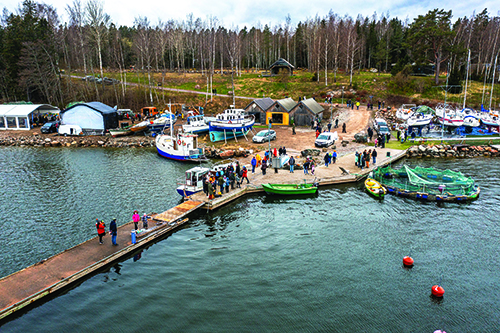
Traditionally, the Open Fishing Ports Day takes place on the last Saturday of every April, where fresh fish can be bought directly from fishers in nearly twenty ports across Estonia. The day offers fish-related activities for the whole family, especially children: the basics of sustainable fishing and angling lessons, fish research and identification, puzzles and quizzes, and fish cooking workshops. Fishing Ports Day brings together local fishers and current and future fish lovers, showing that delicious fish dishes are very easy to prepare. In the longer term, the event could help convert more people to fish consumption than at present, which in turn would help increase the economic well-being of the sector. This year (2026) was the eighth anniversary of the event and nearly 16,000 fish enthusiasts explored the harbours, bought fresh “silver of the sea” straight from fishermen, and tasted local delicacies. The Fisheries Information Centre thanks everyone who visited the harbours as well as all organisers for contributing to the event’s success!
Similarly, the traditional Estonian Fish Week continues to be organised in the last week of September—Estonian Food Month. In 2025, Fish Week took place in six catering complexes of the Defence Forces, where restaurant chefs, hand in hand with the Defence Forces’ kitchen staff, prepared fish delicacies from fresh Estonian farmed and wild fish. One of the Information Centre’s largest initiatives of the current period—a large-scale nationwide fish campaign—is driven by the same theme, with the following objectives.
• To increase the fish consumption of Estonians. Ideally, fish consumption could rise to twenty kilograms per person per year (15 kg/capita in 2021).
• To increase the habit of eating fish among young people up to the age of 29. According to studies, this age group consumes far too little fish.
• To dispel myths that fish as a food product always costs a lot.
• To encourage the consumption of less common fish species. Currently, mostly red fish is bought in Estonia, while local species—sprat, Baltic herring, perch, pike—are unfortunately underrated.
Competition serves to foster public knowledge of fisheries
The centre also regularly organises a competition to select the fishing achievement of the year. Among the thirteen shortlisted candidates in 2026 were the State Forest Management Centre for restocking efforts for seatrout and sturgeon and for demolishing two dams; the Estonian Fishing Association for safeguarding the interests of the fisheries sector; and the Turja Fishing Association for organising youth camps on fisheries and maritime issues on Saaremaa island. The winner was the state Environmental Board in cooperation with fisheries action groups and the Aquatic Biota Society for their work in the management and deterrence of cormorants to reduce predatory pressure on fish stocks. Moreover, the Environmental Board and its partners won both among the jury of experts and among voters from the general public.
The Fisheries Information Centre will operate until at least 2029 and will do its utmost to ensure that fish stocks in Estonian waters and the Estonian fisheries endure in the long term.
Toomas Armulik and Ave Menets
Fisheries Information Centre